Contents:
Do you know that one old coin in your pocket may be a valuable rare 1967 quarter worth far more than its face value? Today, we are going to talk about its error list, no mint mark worth, and what makes these pieces so special. No matter who you are - a collector or just interested in - we will equip you with the knowledge to spot 1967 quarters worth money, and the best way to check collector coins for value.
Denomination | 25 Cents |
Year | 1967 |
Mint Mark Location | Not applicable |
Composition | Copper-Nickel Clad (No 1967 quarter silver content) |
Weight | 5.67 grams |
Diameter | 24.26 mm |
Thickness | 1.75 mm |
Edge | Reeded (119 reeds) |
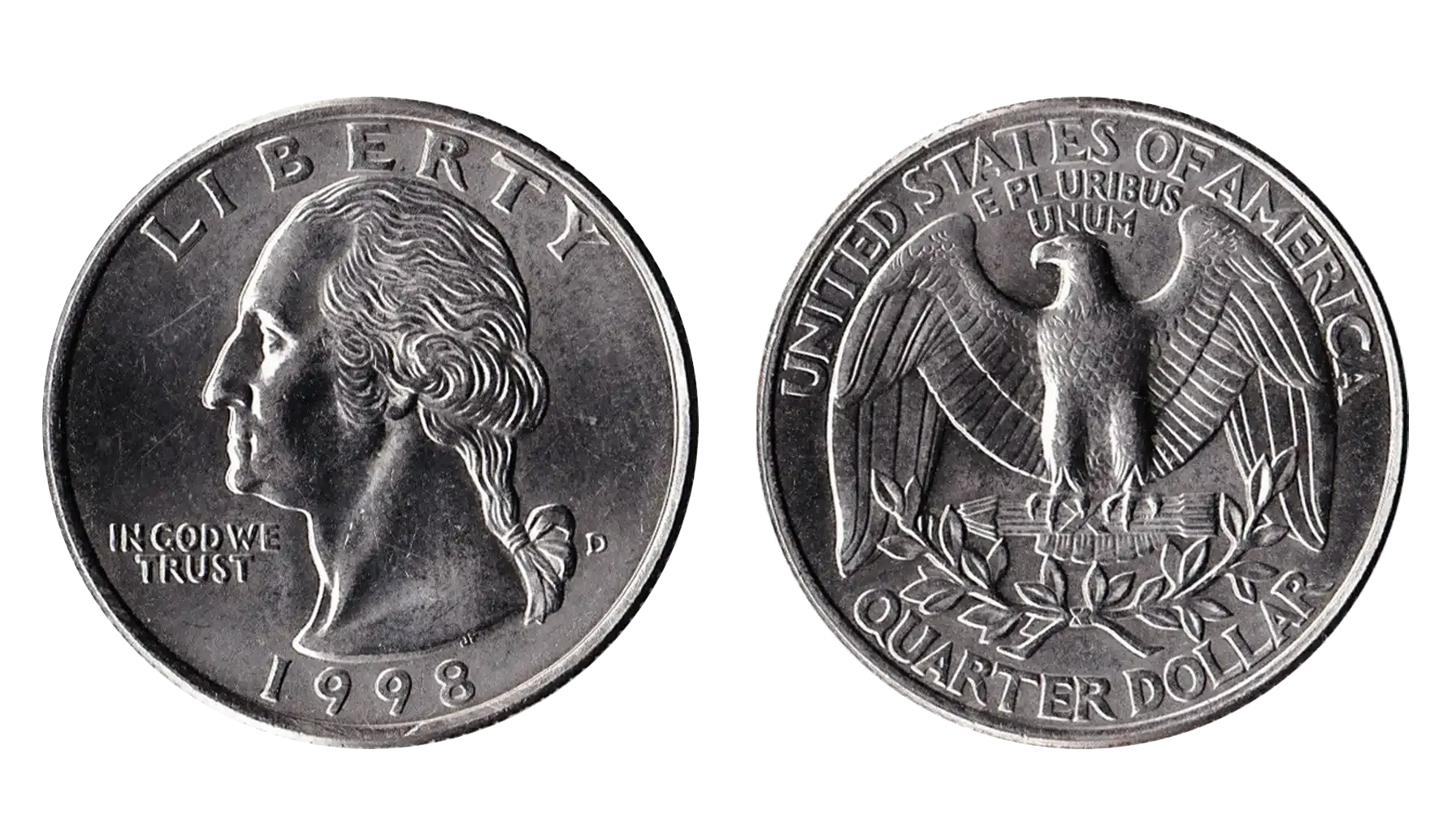
Obverse Design | Portrait of George Washington facing left |
Reverse Design | Eagle with wings spread, clutching arrows and olive branches |
Mintage | 1,524,031,848 |
How Much Is a 1967 Quarter Worth? Value Chart
Where is the mint mark on a 1967 quarter? All 1967 quarters lack a mint mark due to the Mint's policy at the time. Therefore, a 1967 quarter with no mint mark is normal and not necessarily valuable on that basis alone.
There are pre and post 1967 quarter mint mark location variations. On quarters with mint marks (pre-1965 and post-1967), the mint mark is located on the obverse side, to the right of Washington's hair ribbon.
Since only 1967 no mint quarter pieces exist, there are no "D" (Denver) or "S" (San Francisco) mint mark quarters for that year. Any specimen claiming to have such marks should be scrutinized.
The value of 1967 quarter may be:
Circulated: Generally worth face value.
Uncirculated: Worth a few dollars to collectors.
Errors: The 1967 quarter value no mint mark in these cases can range from $50 to several thousand dollars.
1967 Quarter Price Guides: Consult auction results and overviews for the most accurate valuations.
Here are the most valuable quarters you may like to have information about.
So, is a 1967 quarter worth anything? The answer is:
Yes, if the coin has a 1967 quarter value error, is in uncirculated condition, or possesses some unique characteristic.
No, if it's not a rare 1967 quarter but a standard, circulated piece with no notable features.
Quick-Reference Value Summary Table
Grade | SMS (Standard) | SMS (Cameo — CAM) | SMS (Deep Cameo) |
SP-65 / MS-65 | $15 — $24 | ~$24 | ~$175 |
SP-66 / MS-66 | $20 — $34 | ~$34 | ~$500 |
SP-67 / MS-67 | $32 — $100 | ~$100 | ~$2,150 |
SP-68 / MS-68 | ~$165 | ~$850 | ~$5,750 |
SP-69 / MS-69 | ~$1,600 | ~$4,500 | — |
What Makes a 1967 Quarter Valuable? The Two Key Factors
Many new collectors ask how much a well-preserved 1967 quarter is worth on the current market. Most pieces were produced in very large numbers and are common in circulation. However, some coins from this year can be worth more than face value. Their value usually depends on two main factors: condition and mint errors or varieties.
1. Condition (Coin Grade)
Specimens that circulated for many years often show wear, scratches, and dull surfaces. These pieces typically remain worth only their face value.
Quarters that avoided circulation and still display strong mint luster are much more desirable. High-grade coins graded in the Mint State (MS) range can bring higher prices, especially if they show sharp details and minimal contact marks.
Top-grade examples are difficult to find because most 1967 quarters entered circulation soon after they were minted.
People who compare similar clad-era coins often wonder how much a typical 1966 quarter is worth in circulated and uncirculated grades today, since it was produced during the same shortage period as the 1967 issue.
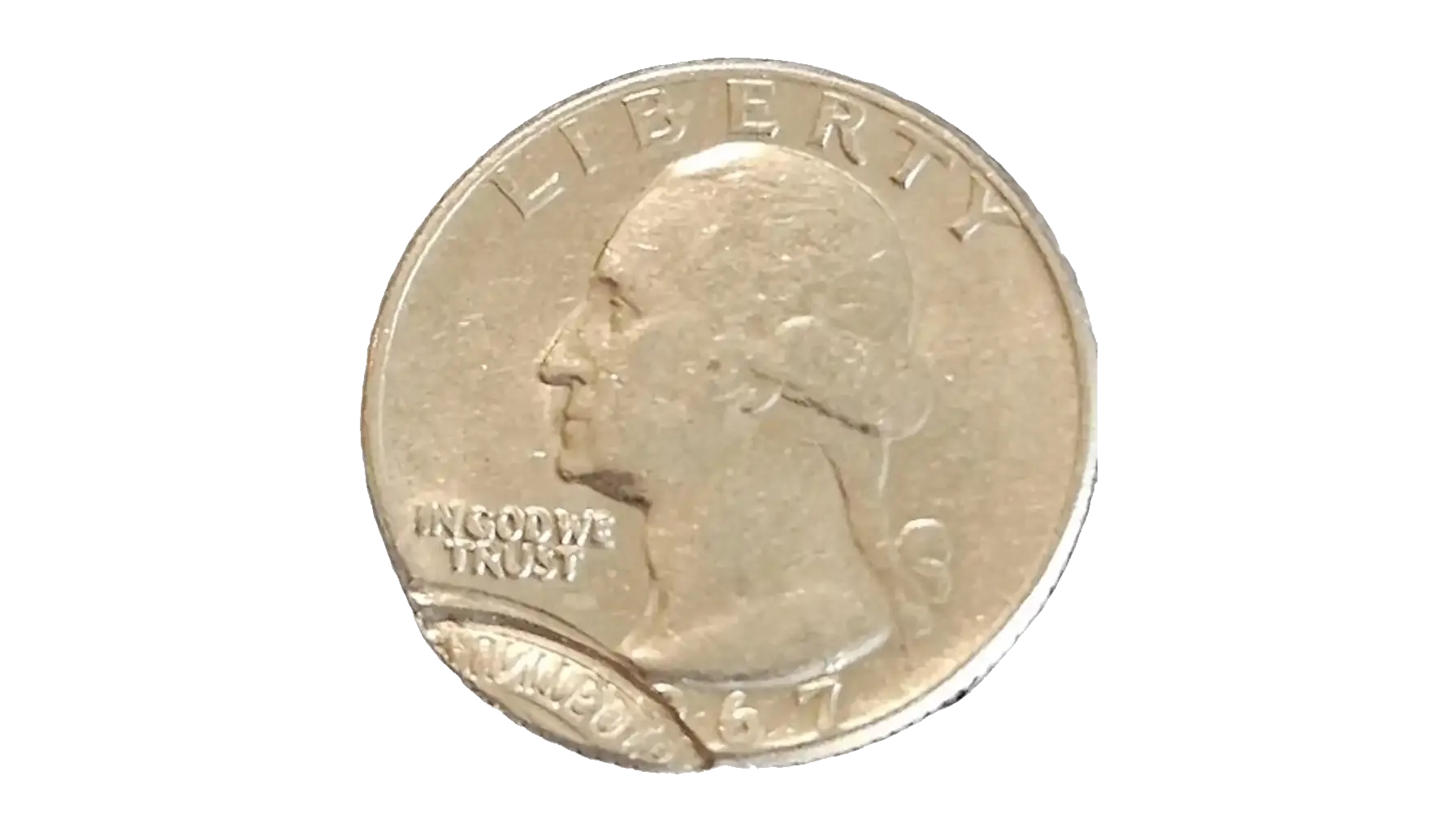
2. Mint Errors and Varieties
Another factor that can increase value is the presence of a minting error. Errors occur when something goes wrong during the production process, creating coins with unusual features.
Examples are:
Off-center strikes
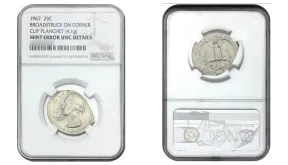
Broadstrikes
Clipped planchets
Struck-through errors
Is 1967 quarter worth anything? Coins with clear errors often attract collector interest. Even though most 1967 quarters are common, unusual mint errors or exceptional preservation can make certain examples much more valuable.
Identifying Your 1967 Quarter: Key Features
If you believe you've found a piece with a high 1967 quarter dollar value, consider having it authenticated and graded by a professional service like PCGS or NGC. Or you can try the Coin ID Scanner app.
The 1967 Quarter with No Mint Mark: Why It's Normal
A 1967 Washington quarter without a mint mark is completely normal. During the mid-1960s, the U.S. Mint temporarily removed mint marks from circulating coins. This policy was used from 1965 through 1967 to discourage collecting and hoarding during the nationwide coin shortage.
Because of this decision, all quarters struck for circulation in 1967—regardless of where they were made—appear without a mark and have a standard 1967 no mint mark quarter value. Production took place primarily in Philadelphia and Denver, but the coins were intentionally left unmarked.
How to Spot a Valuable Special Mint Set (SMS) Quarter
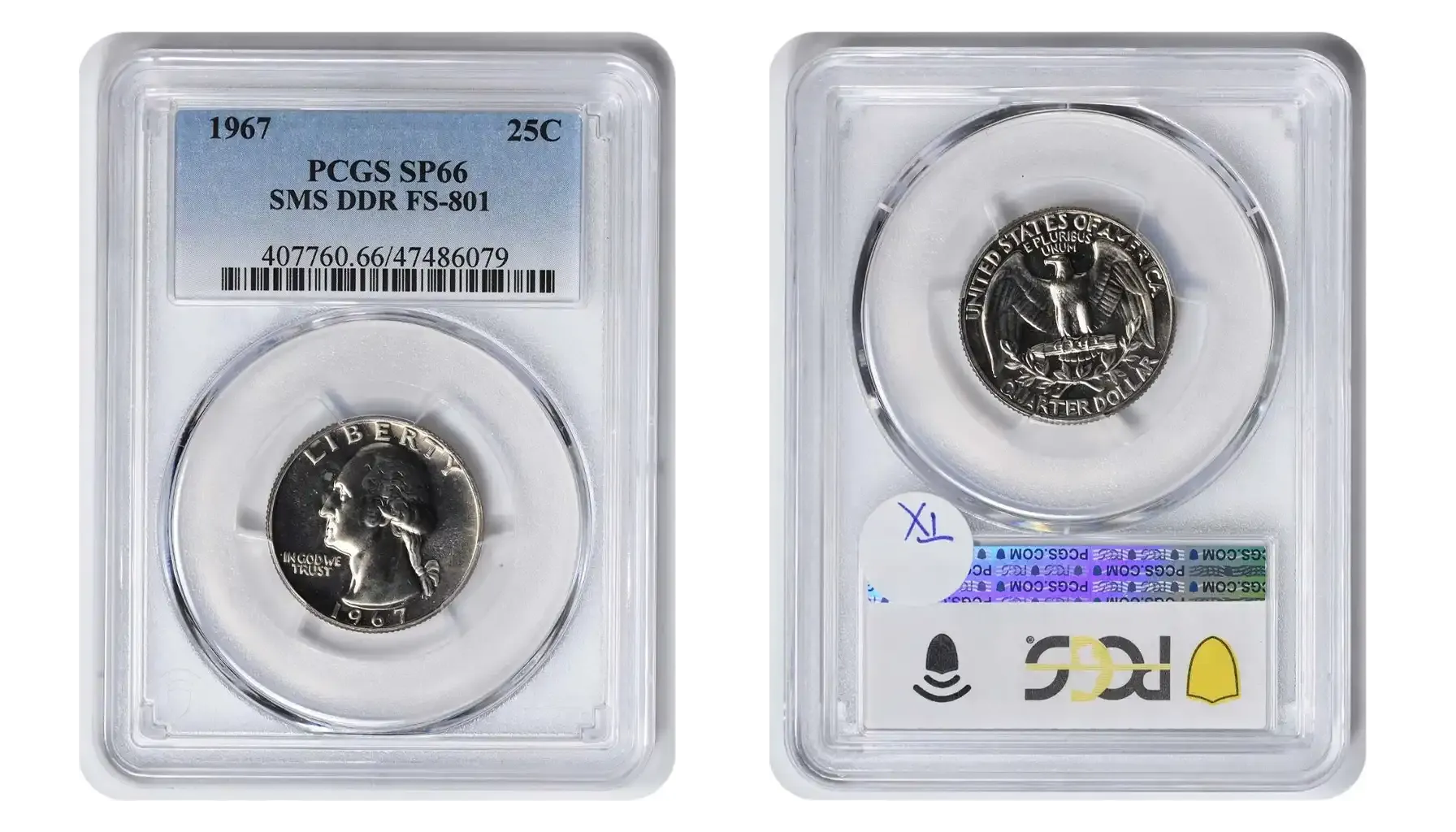
Instead of traditional proofs, the U.S. Mint produced Special Mint Sets (SMS) between 1965 and 1967. These pieces were struck with better preparation than regular circulation coins.
A 1967 SMS quarter usually shows several features:
Sharper details than a normal circulation strike
Smoother surfaces with fewer contact marks
Satin-like luster rather than a mirror finish
Well-defined edges and rims
What is a 1967 quarter worth if it is SMS? Collectors sometimes find SMS coins that display unusually strong strikes or cameo-like contrast. These higher-quality examples are the ones that tend to attract greater interest.
Grading Guide: From Circulated to Mint State
Grading describes the condition of a piece and helps determine its market value.
Good (G) – heavy wear, most design details faint
Fine (F) – moderate wear, major details still visible
Extremely Fine (XF) – light wear on the highest points
About Uncirculated (AU) – slight wear but still retains much of its original luster.
MS60–MS63 – no wear but visible contact marks
MS64–MS65 – stronger luster and fewer marks
MS66 and higher – very well preserved with minimal imperfections
Higher grades are harder to find because most coins experience wear during circulation.
Rare 1967 Quarter Errors That Increase Value
During the minting process, mishaps occasionally occurred. Understanding these errors—and knowing the error 1967 quarter what to look for—can increase the value.
Doubled Die Obverse (DDO) & Reverse (DDR)
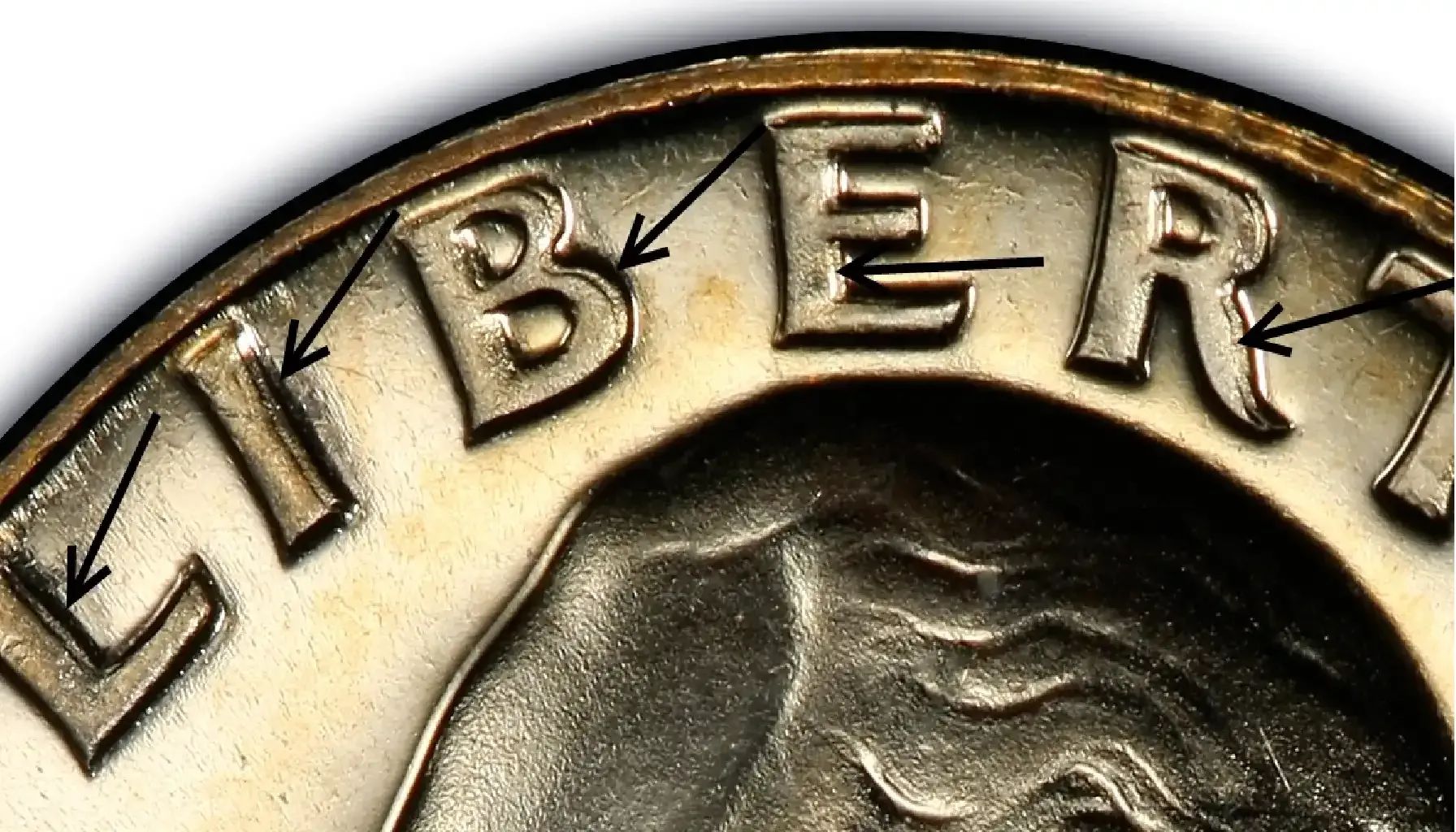
One of the errors is the Double Die Obverse (DDO). This error happens when the obverse is struck twice by the die in slightly misaligned positions. The result is a doubling effect, most noticeable on inscriptions like "LIBERTY," "IN GOD WE TRUST," or the date itself. If you examine these areas under magnification and notice a clear duplication of the letters or numbers, you might possess a DDO error example.
Similarly, the Double Die Reverse (DDR) affects the reverse side, where the eagle design resides. Doubling may appear on the eagle's feathers, the arrows and olive branches it holds, or the lettering encircling the design.
Off-Center Strikes and Clipped Planchets
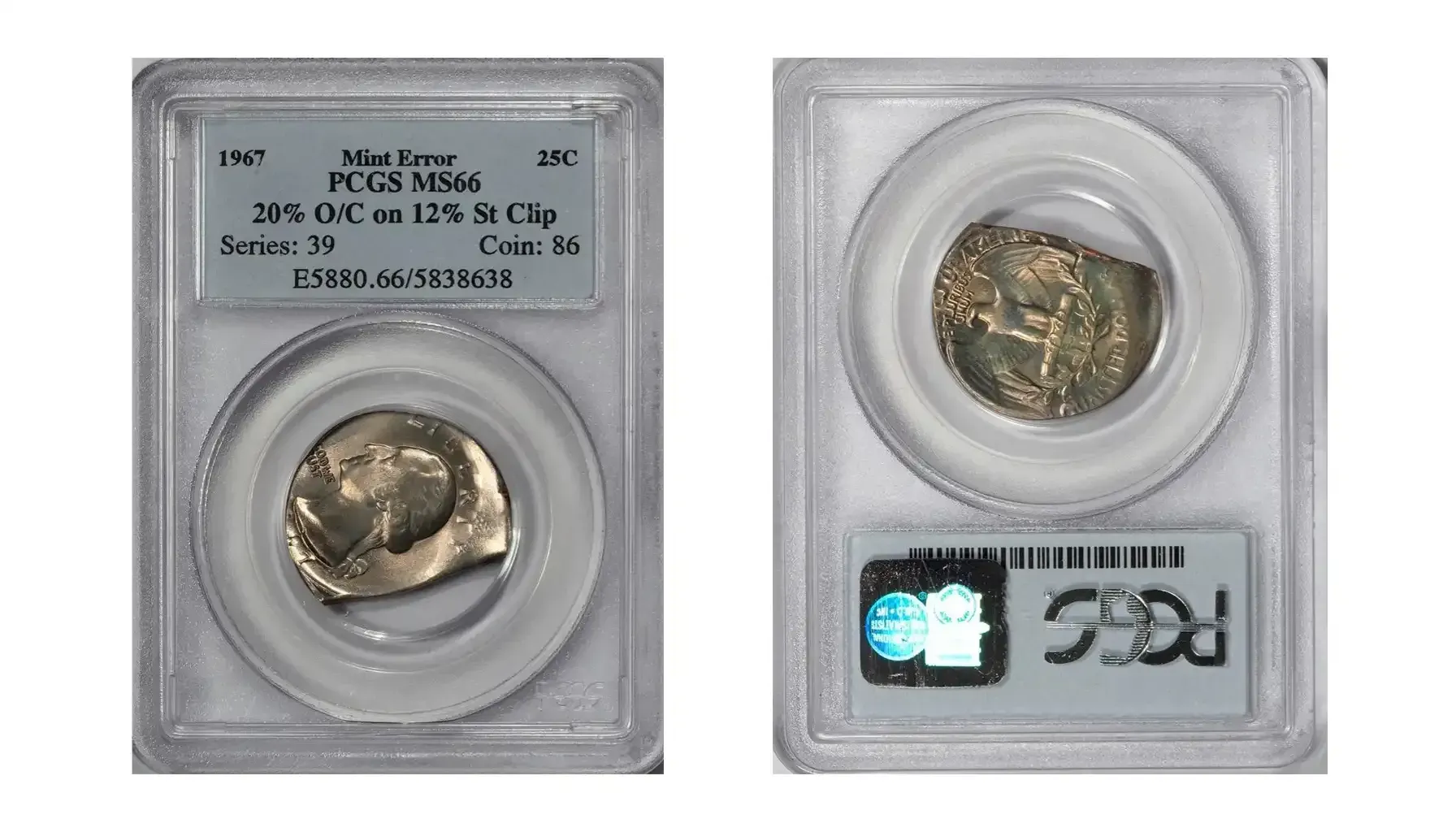
Another example from the 1967 quarter error list is the Off-Center Strike. This occurs when the coin planchet isn't properly aligned within the coining press. The resulting piece will have part of the design missing, with a blank area where the die didn't make contact.
”A 1967 quarter that is 10% to 25% off center could be worth $50 to $100, whereas one that shows 50% of the design missing yet offers a completely visible date can take $200 or more.”
– Joshua McMorrow-Hernandez, Senior editor
U.S. Coins Guide
Clipped Planchet errors are also noteworthy. These happen during the blanking process when the metal strip doesn't advance correctly, causing the blanks to overlap the edge of the strip. This results in a portion missing along the edge, known as a "clip."
Struck on Wrong Planchet Errors
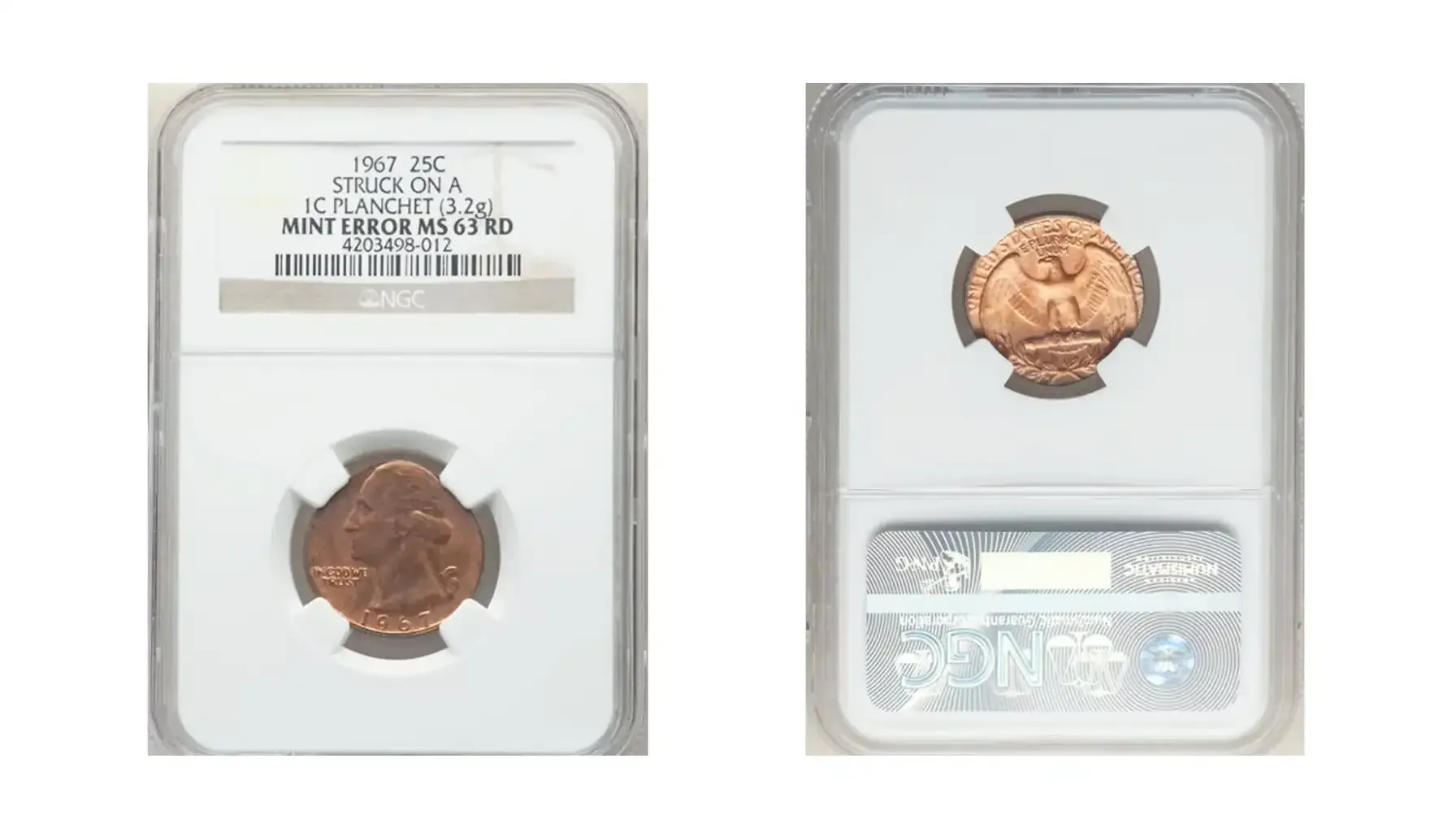
Perhaps the rarest and most valuable errors are the Wrong Planchet errors. These occur when a coin is struck on a planchet intended for a different denomination or metal composition. For instance, if a 1967 rare quarter was mistakenly struck on a dime planchet or an old silver planchet from before 1965, it would be an extraordinary find.
The History Behind the 1967 Quarter
The Great Coin Shortage and the End of Silver
The United States faced a nationwide shortage of coins during the early 1960s. Many people began saving silver coins because their metal value was increasing. As more coins disappeared from circulation, businesses struggled to maintain enough small change for daily transactions.
In response, Congress passed the Coinage Act of 1965. This law removed silver from quarters and dimes and replaced the traditional composition with a copper-nickel clad structure. So, no silver quarters 1967 exist.
The Special Mint Set (SMS): A Collector's Compromise
Because regular proof sets were suspended during the coin shortage, the U.S. Mint introduced Special Mint Sets (SMS) from 1965 through 1967. These sets were produced for collectors and offered coins of higher quality.
Frequently Asked Questions
Are 1967 quarters worth anything?
Most of them are common and usually worth their face value of 25 cents in circulated condition. The 1967 Washington quarter collector market value today depends on preservation quality, original luster, and whether it belongs to a Special Mint Set.
Why is there no 1967 quarter no mint mark?
Finding a 1967 Washington quarter coin with no mint mark on the obverse is normal, since mint marks were intentionally removed from circulating ones between 1965 and 1967.
Is a 1967 quarter silver?
No, a 1967 quater is not made of silver.

 Facebook
  X (Twitter)
  Pinterest
  LinkedIn