Contents:
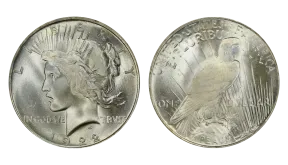
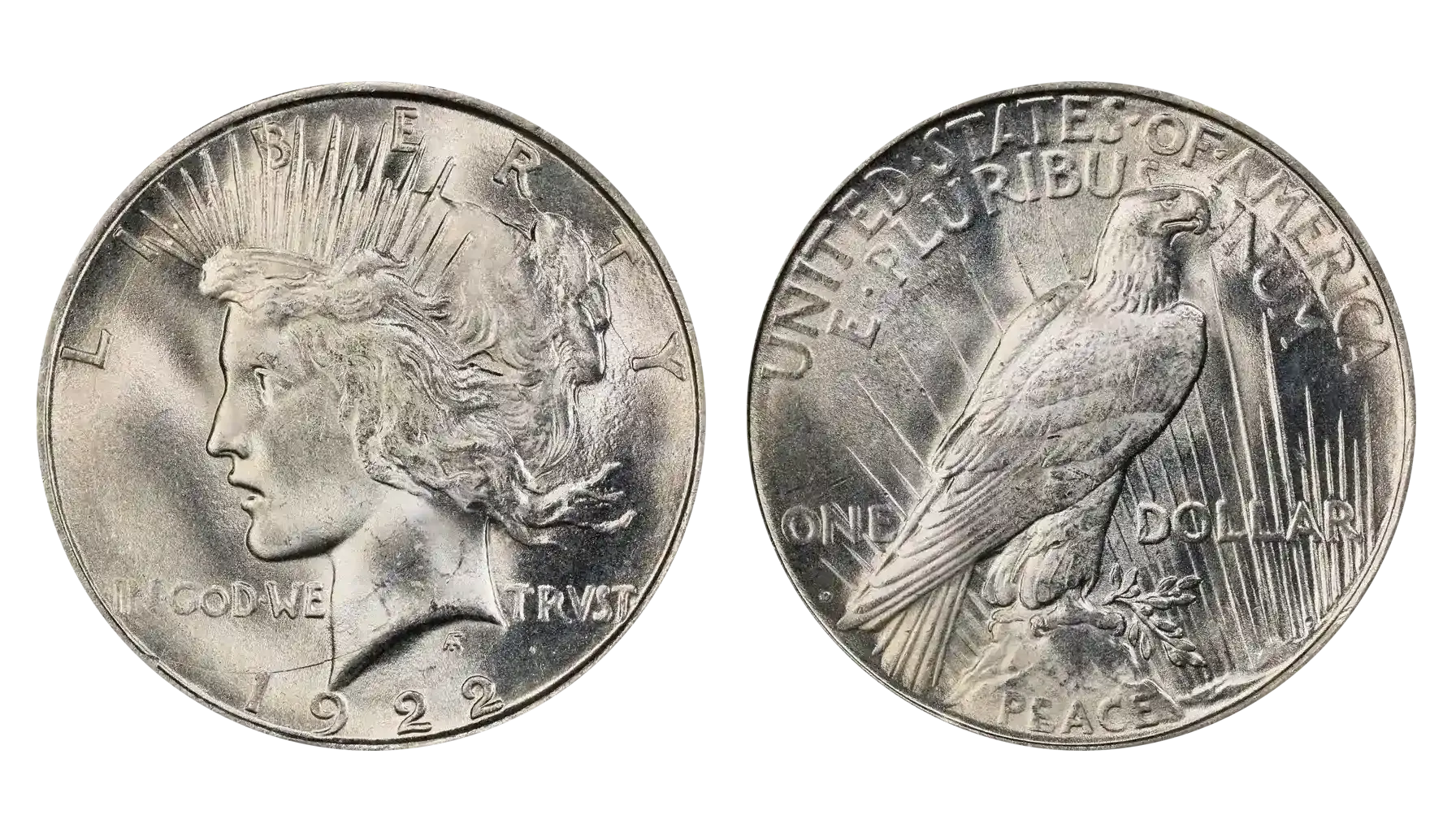
A 1922 Peace Dollar is a U.S. silver one-dollar coin issued to commemorate the restoration of peace after World War I. It belongs to the Peace Dollar series (1921–1935) and was struck by the United States Mint.
1922 was the first full production year of the series. What is a 1922 silver dollar worth? Collectors often discover that the value of a silver dollar dated 1922 depends far more on condition and mint origin than on age alone. Most examples are affordable, though high-grade coins (MS65+) and well-struck pieces can cost more.
The best AI coin identifier will help you know more about these coins.
The 1922 Peace Dollar: History in Your Hand
The Dawn of the Peace Dollar
After World War I, the United States wanted a new silver dollar that reflected peace rather than expansion or commerce. The Morgan Dollar had filled that role for many years, but it no longer fit the moment.
A 1922 Morgan Silver Dollar does not exist. This type was minted from 1878 to 1904, with a one-year revival in 1921 only. After 1921, the Morgan design was permanently replaced by the Peace Dollar, which was issued from 1921 to 1935 by the United States Mint.
A new design was approved in 1921. Early strikes that year were difficult to produce, so the relief was reduced. A silver dollar struck in 1922 represents the first fully established year of the Peace Dollar design. In 1922, minting became efficient and large-scale.
Most 1922 Peace Dollars were struck for storage and financial use, not for daily circulation. They became an example when the Peace Dollar moved from concept to mass-produced coin.
The Key Change: From High to Low Relief
The earliest Peace Dollars struck in 1921 were produced in high relief. Visually, they were impressive, with many details and a sculptural appearance. In practice, however, the design caused major problems. The dies required excessive pressure, wore out quickly, and often failed to bring up full details in a single strike. Production was slow, costly, and inconsistent—unsuitable for the large quantities of silver dollars the government needed.
“…high-relief dies were unsuitable for coinage and the search for a replacement.”
—Roger W. Burdette, numismatist
Making the Peace Dollar, Part Three: Victory or Disgrace, CoinWeek (2024)
To solve this, the Mint modified the design for 1922 by reducing the relief. The lowered relief allowed coins to be struck more easily and uniformly, extended die life, and made mass production feasible. Peace Dollars dated 1922 were produced in large numbers after the design was adjusted for easier minting.
So, a 1922 High Relief Peace Dollar doesn’t exist as a regular U.S. Mint issue. Mentions of a Peace Dollar from 1922 in high relief usually come from confusion with the earlier 1921 version, which had a much deeper strike.
The shift from high to low relief is one of the most important technical moments in the series. It explains why 1921 Peace Dollars look noticeably different from later issues and why 1922 became the starting point for widespread Peace Dollar production.
Decoding Your 1922 Dollar Coin
All pieces share the same design and silver composition, but the 1922 silver dollar value today and strike quality depend on where it was minted. Mint marks influence both.
The Philadelphia Story (No Mint Mark)
Peace Dollars struck in Philadelphia carry no mint mark. These make up the largest portion of 1922 production and are the most commonly encountered today.
Each 1922 Peace Dollar no mint mark is:
Well struck compared to other mints
Easier to find in higher Mint State grades
The standard reference point for pricing the date
For collectors, the 1922 (no mint mark) is often the entry specimen into the Peace Dollar series.
The Denver Mint’s Output (1922-D)
The 1922-D Peace Dollar was struck at the Denver Mint and is identified by a small “D”. Where is the mint mark on a 1922 silver dollar? It’s on the reverse, below the word ONE.
Denver issues are known for:
Weaker strikes, especially on Liberty’s hair and the eagle
Fewer fully detailed examples
Greater difficulty in high grades
Because of strike quality, sharply struck 1979 dollar coin D pieces command stronger premiums than Philadelphia pieces at the same grade.
The San Francisco Challenge (1922-S)
The 1922-S, struck at San Francisco, carries an “S” mint mark and presents the greatest challenge of the three.
San Francisco coins are:
Frequently weakly struck
Often flat in central details
Scarcer in true high Mint State condition
Even though overall mintages were high, well-struck 1922-S Peace Dollars are difficult to find because they are the most condition-sensitive of the year.
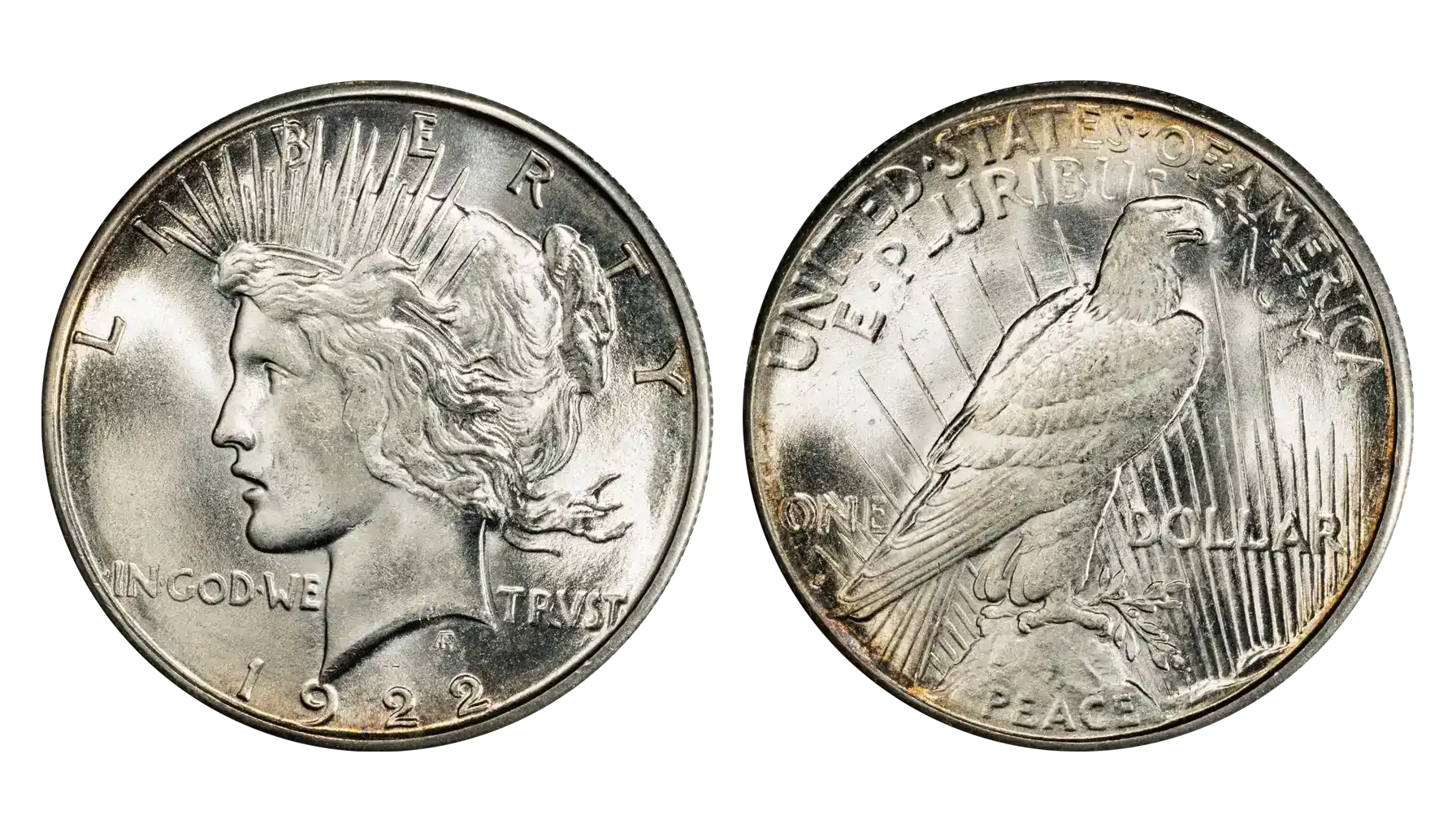
What Determines the 1922 Peace Dollar Value?
The price depends less on age and more on mint mark, strike quality, condition, and genuine mint errors. All were produced in large numbers, so premiums come from specifics rather than the date itself.
Mint Mark Influence: “D” and “S”
They affect strike quality and high-grade survival.
No mint mark (Philadelphia)
Generally the best struck. These coins are easiest to find with strong detail and clean surfaces, especially in Mint State. As a result, they set the baseline for market value.
“D” (Denver)
Often weakly struck, particularly in Liberty’s hair and the eagle’s feathers. Fully detailed examples are harder to locate, which pushes prices higher in MS grades.
“S” (San Francisco)
The most condition-sensitive of the three. Flat centers and soft details are common. Well-struck 1922-S coins are genuinely scarce in high Mint State and carry the strongest premiums.
Mint mark impact is about quality, not mintage totals, even though all were produced by the United States Mint.
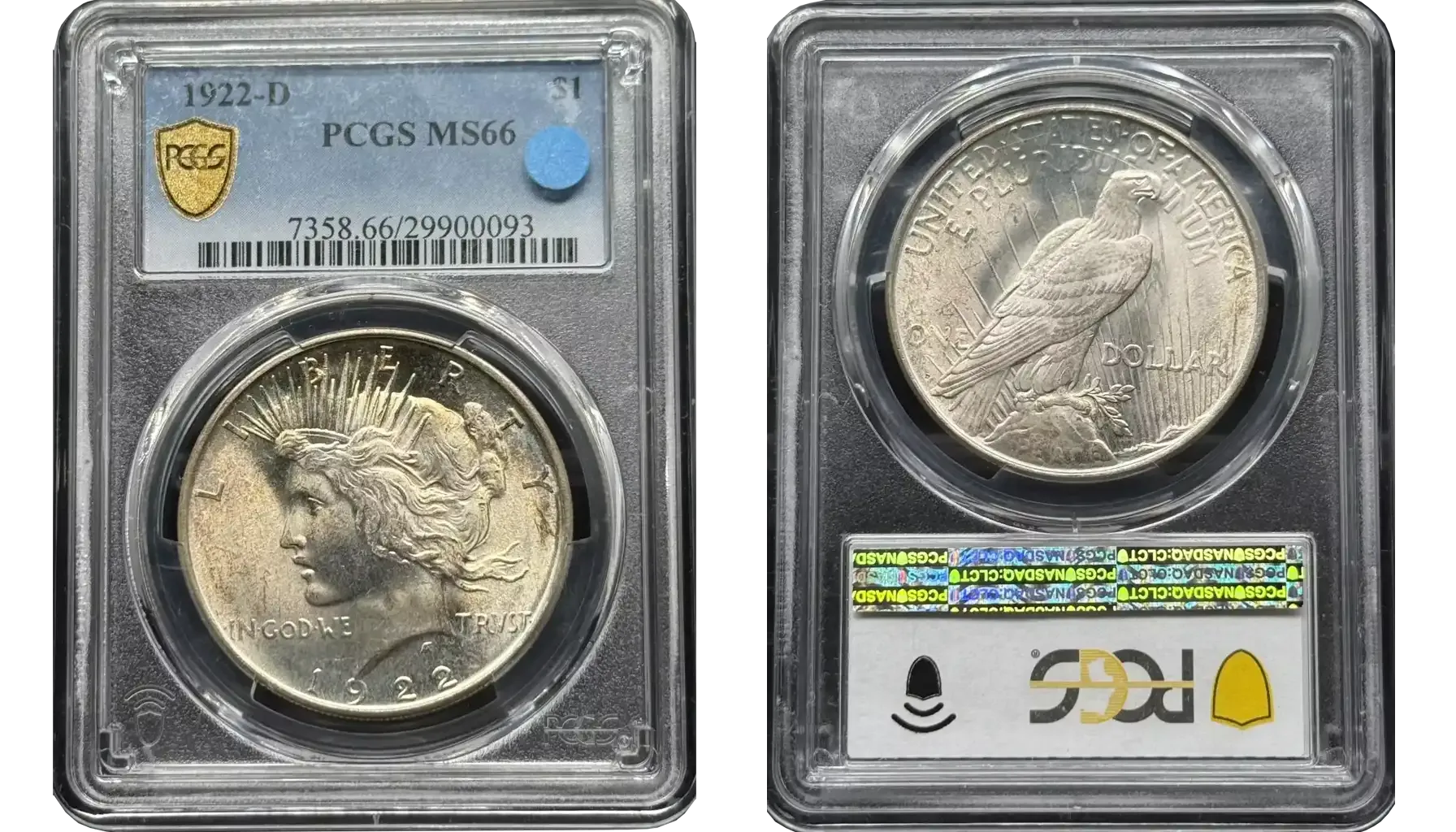
The Rarity of Errors: What Makes a 1922 Peace Dollar Rare
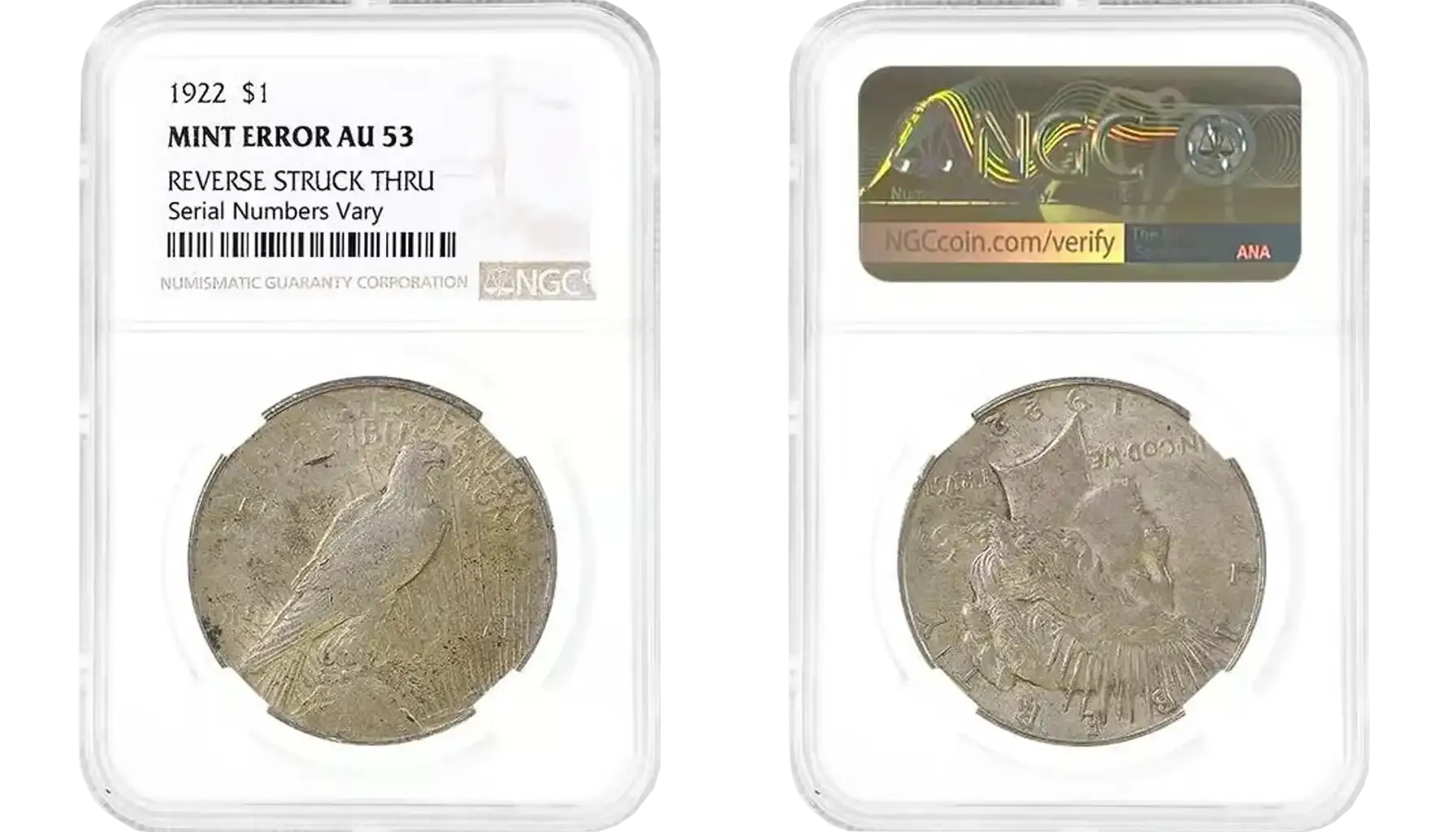
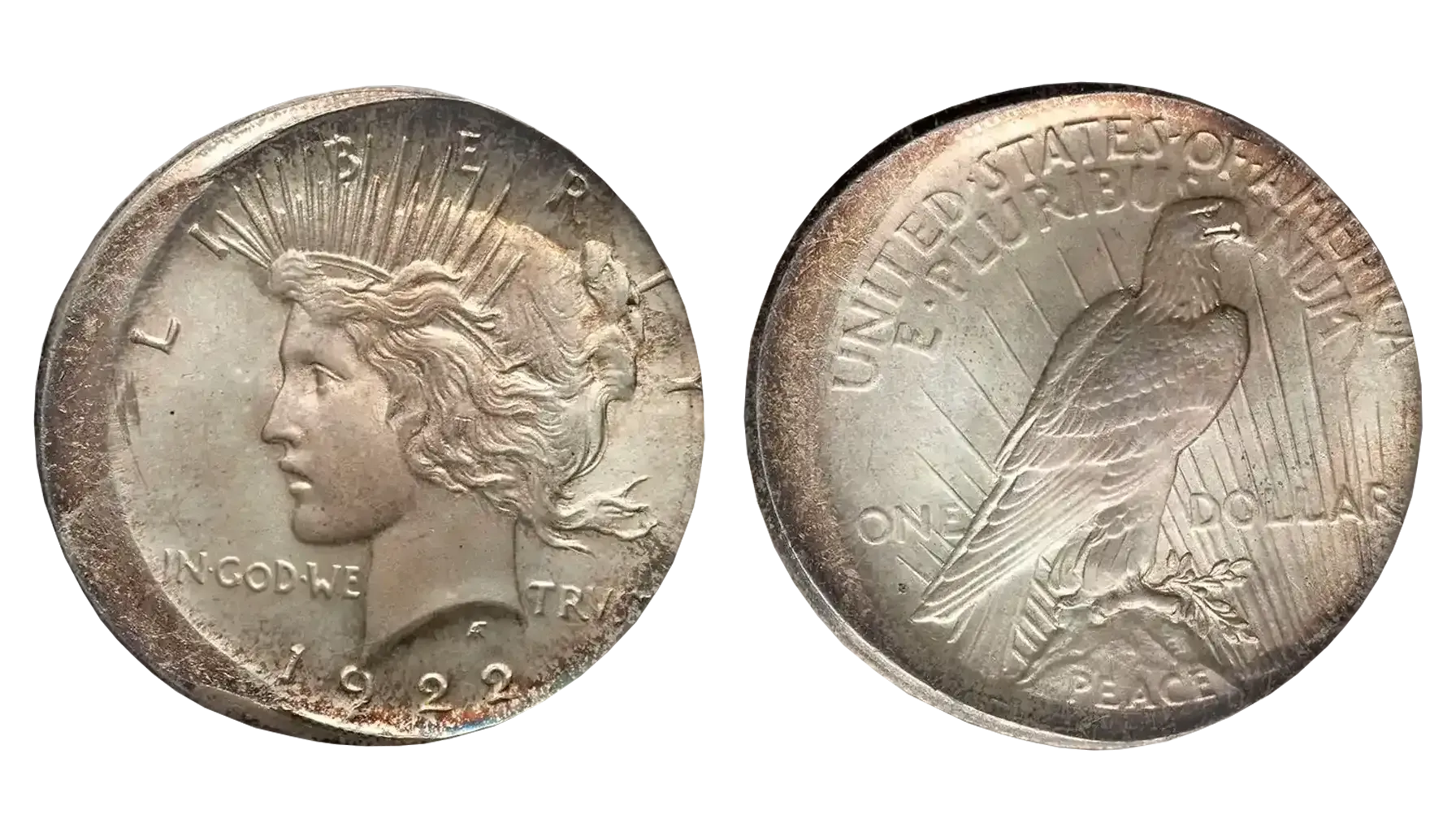
Most specimens are normal strikes. True rarity comes from documented mint errors, not minor flaws.
Legitimate premium errors include:
Major off-center strikes
Broadstrikes
Clipped planchets
Significant die breaks or retained cuds
Read more about errors: 1922 Liberty Silver Dollar.
What does not add value:
Weak strikes
Bag marks
Wear or cleaning
Because Peace Dollars were heavily handled in bags, many surface marks are normal. Only clear, unmistakable mint errors create real scarcity which influences the market value of a Peace Dollar issued in 1922.
Investment Potential and Market Outlook
How much is a 1922 silver dollar worth? Investors choose this coin because of silver content, condition sensitivity, and mint-mark difficulty, especially for Denver and San Francisco issues. Below is a 1922 Peace Silver Dollar value table.
Mint | Circulated (VF–XF) | AU | MS63 | MS64 | MS65 |
1922 (P) | $25–35 | $40–55 | $65–85 | $110–160 | $300–500 |
1922-D | $25–35 | $45–65 | $90–130 | $180–280 | $800–1,400 |
1922-S | $25–35 | $50–75 | $120–180 | $300–500 | $1,800–3,000+ |
What makes a 1922 Peace Dollar rare? Circulated prices closely follow silver spot. Premiums rise sharply from MS64 upward, driven by strike quality. True MS65 examples for 1922-D and especially 1922-S are scarce.
Pros and Cons of Investing in 1922 Peace Dollars
Pros
90% silver content provides intrinsic value
Strong collector demand for high-grade D and S mints
Stable, well-documented market history
Easier entry compared to key-date Peace Dollars
Cons
Common in lower grades
Weak strikes limit upside for average Mint State coins
Certification costs for slabbed coins matter at higher grades
Not suitable for short-term speculation
Building a Collection: 1922-D or 1922-S
Choosing between the 1922-D and 1922-S Peace Dollar is less about which is “better” and more about what kind of collector you are. Both coins were struck in large numbers, yet they behave very differently in the market because of strike quality and survivability.
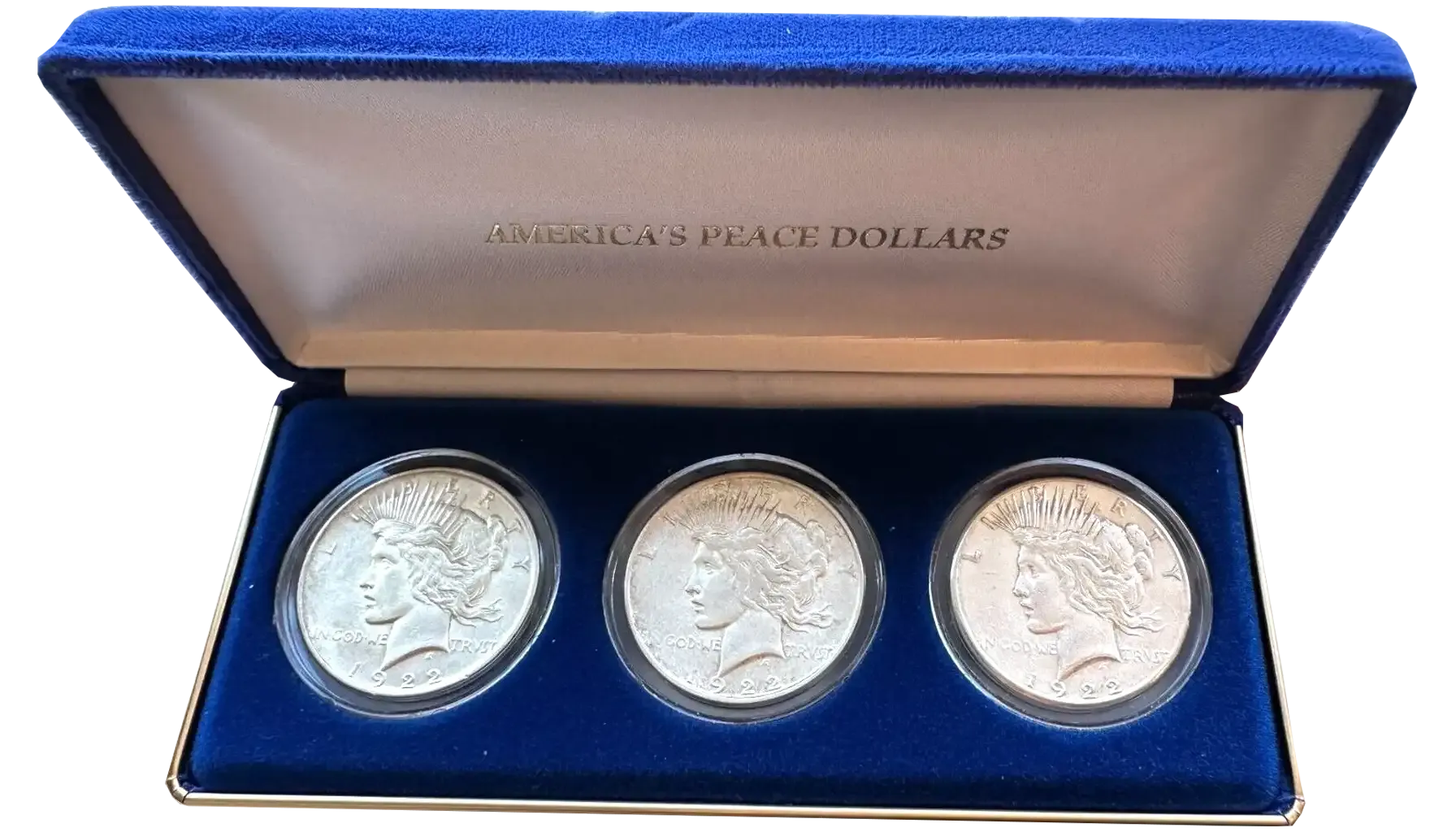
The Case for 1922-D (Denver)
The Denver issue offers the best balance of difficulty and affordability. Weak strikes are common, especially in Liberty’s hair and the eagle’s breast, but fully detailed examples do exist.
Why collectors choose 1922-D:
Sharply struck coins are scarce but attainable
MS64 examples often show visible improvement over MS63
MS65 coins command strong premiums but remain within realistic budgets
Steady demand from collectors upgrading lower-grade sets
For many collectors, the 1922-D becomes a long-term upgrade coin—one you replace slowly as better strikes appear.
The Case for 1922-S (San Francisco)
The San Francisco issue is a true condition challenge. Flat centers and weak detail are the norm, not the exception. Even coins graded Mint State often lack sharp definition, which is why genuinely well-struck pieces are rare.
Why collectors pursue 1922-S:
Strong strike quality is genuinely difficult to find
High-grade examples separate quickly in value
Registry collectors actively compete for top-end coins
Eye appeal matters more than the numeric grade
Practical Collecting Strategy
Do not buy based on grade alone
Compare strike detail across multiple examples
Prioritize eye appeal, not slab labels
Certification matters at higher grades due to strike variability
Both coins were produced by the United States Mint in the same year, with the same silver content. What separates them is how well these silver dollar 1922 specimens were struck and how few survived in truly sharp condition.

 Facebook
  X (Twitter)
  Pinterest
  LinkedIn