Contents:
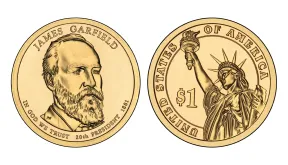
The Presidential $1 coin series often serves as a starting point for collectors seeking to complete the full cycle of US presidents. The James Garfield issue, a later addition to the program, is noteworthy for its combination of a short presidential period and a clearly structured design emphasizing the year 1881.
Overview of the James A. Garfield Presidential $1 Coin
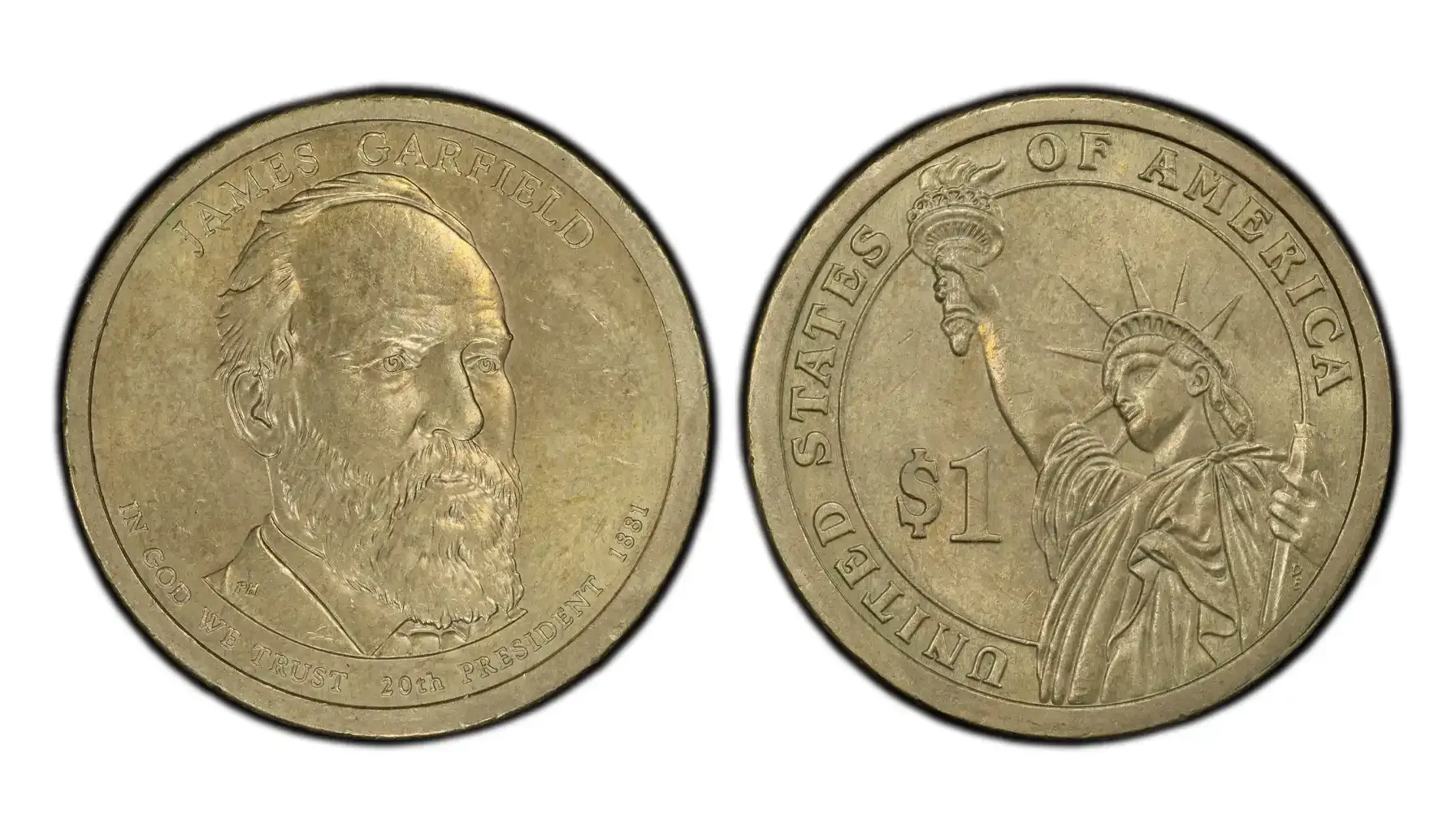
When collectors handle a James Garfield One Dollar coin, their eye usually lands on two things right away—the portrait and the 1881 date. The style here aims for a real likeness, not a generic face, so the coin stands out when you put it next to other issues from the series.
Main elements of the obverse:
Garfield's bust;
Inscription: James A. Garfield;
Presidency date: 1881;
Order of presidency in the series.
The reverse design is consistent with all presidential dollars: the Statue of Liberty remains the central element, while the field structure and lettering make the design recognizable even in partially worn condition.
“Acquire coins and exonumia for the pure fun of the chase; hold a piece of history in your hand and have a feeling of accomplishment.”
— Nona Moore, American numismatist
Interview in The California Numismatist, Fall 2008
Collectors highlight the James Garfield Dollar coin 1881 (the year of the presidency) for several reasons:
The 2011 issue completes the 2011 Presidential Dollar line and marks the 20th issue in the series;
Some Philadelphia pieces have particularly clean fields;
The specimen is often found in sets, which is good for finding high grades.
Within individual collections, the coin is sometimes considered alongside the Benjamin Harrison dollar, as both issues are associated with the same historical era and allow for a more coherent chronology to be constructed.
Key features of the 1 dollar coin James Garfield:
Parameter | Value |
Metal | Manganese–brass alloy |
Diameter | 26.5 mm |
Weight | 8.1 g |
Reverse | Statue of Liberty |
Obverse | Portrait of James A. Garfield |
Year of Issue | 2011 |
Mints | Philadelphia (P), Denver (D), San Francisco (S Proof) |
James Garfield Dollar Coin Value (Circulated, Uncirculated & Proof)

How much is a James Garfield Dollar coin worth? The market for presidential dollars stays fairly steady. Interest comes from how rare some pieces are and from collectors who want to build a full set.
The value of specimens in circulation.
A typical James Garfield 1 Dollar coin that has been in circulation for a long time is valued in the range:
$1–$2 — if signs of wear are visible;
$2–$3 — in moderately good condition.
Here it is important to consider the uniformity of luster and the depth of relief—these are the characteristics that collectors use as a guide.
Uncirculated (BU).
For the uncirculated James Garfield $1 coin, the demand level is higher.
Typical price ranges:
$4–$6 — MS62–MS63;
$7–$12 — MS64;
$14–$25 — MS65.
MS66 units are significantly rarer, with prices exceeding $40.
Proof versions.
Proof sets of the 1881 dollar coin James Garfield with a high-quality mirrored finish are in demand thanks to the contrast between the matte portrait and the glossy fields.
Guidelines:
$3–$10 — standard level
$20–$30 — pieces in sets that preserve the original U.S. Mint packaging
James Garfield Dollar coin 1881 value chart:
Condition | Estimated Value (may vary) |
Circulated | $1–$3 |
Uncirculated MS63–MS64 | $4–$12 |
Uncirculated MS65 | $14–$25 |
MS66 | $40+ |
Proof | $12–$30 |
Collectors also compare this issue to the Grover Cleveland Dollar series to assess how the design has changed over time.
James Garfield Dollar Coin Errors and Their Values

Presidential dollar errors are not common, but demand remains firm. This also applies to the James Garfield Dollar coin error, although the number of known varieties is limited.
Edge lettering is missing.
This is one of the most noticeable and rare errors. The edge inscriptions, which are required on a standard issue, are missing:
E Pluribus Unum;
In God We Trust;
The year of minting and the mint mark.
The complete disappearance of the edge inscription is a category of errors that occur during the edge rolling process. The piece begins to resemble a token without the markings visually.
Price: $50–$150—the upper range is typical for specimens with clean rims and minimal contact marks.
Doubled-edge lettering.
When the inscription is applied twice, the text appears split or slightly offset. The second strike creates a distinct additional line, which is why this variation is officially classified among Presidential Dollar errors.
Collectors value it for its clarity. The defect is easily identified even without magnification.
Price: $40–$90—closer to the upper end of the scale for AU/MS coins, where the inscription remains in contrast.
Off-center strike.
For the James Garfield coin 1881, the image shift ranges from 10 to 40%. Slightly off-centered coins are more common, but truly rare specimens are those where part of the portrait "moves" toward the rim, revealing a blank space.
A shift of more than 40% effectively makes the specimen unique, as such a strike indicates significant die wear and misalignment.
Price: $50–$150.
Weak strike.
A weak strike is more often found on Denver coins. This is most noticeable in the following areas:
Beard and hair;
Clothing folds;
Light transitions on the facial relief.
This kind of error isn’t always easy to spot, but it can change how the coin looks and that affects the price. Specialists usually suggest checking it against reference photos of the 2011 die to be sure.
Price: $10–$25.
Lamination errors.
Delamination errors appear as areas with lifted or swollen metal on the surface. They occur due to impurities or temperature fluctuations during the blank’s formation.
For the James Garfield Dollar coin 2011 D, such defects are not common, but when they are found in stable condition without corrosion, their collectibility increases noticeably.
Price: $20–$60—higher values apply to pieces with a large but stable defect that did not cause metal breakdown.
To quickly evaluate James Garfield coin value from a photo, the Coin ID Scanner app is convenient. It analyzes the coin’s image, compares it with a database of sold examples, highlights characteristic defects, and generates an estimated market range for your coin’s condition.
Additional aspects that influence the 1881 James Garfield Dollar coin value.
When evaluating what collectors often refer to as the James Garfield gold dollar coin 1881, it is important to consider a combination of factors that affect the value of all Presidential Dollars.
Collectors note the following:
Presence of the original blister or capsule—especially important for specimens from sets;
Absence of cleaning marks—mechanical intervention is easily detected through micro-lines;
Even luster without spots—oxidation spots sharply reduce value;
High-quality fields—minimal contact marks, no rub in the area around the portrait.
Each of these factors can multiply the final James Garfield 1881 Dollar coin value when a coin moves, for example, from AU to MS, especially if the coin already carries a rare error.

 Facebook
  X (Twitter)
  Pinterest
  LinkedIn