Contents:
Presidential Dollar Coins honoured the presidents of the United States. Some presidents served in hard, tribulating times. Some, like Andrew Johnson, had a somewhat calmer time. What kind of coin was dedicated to Andrew Johnson, and was it valuable? Let us find out.
About the Andrew Johnson Presidential $1 Coin
In 2011, the U.S. Presidential $1 Coin Program issued an Andrew Johnson 1 dollar coin, aimed to honor the 17th President of the United States (1865–1869).
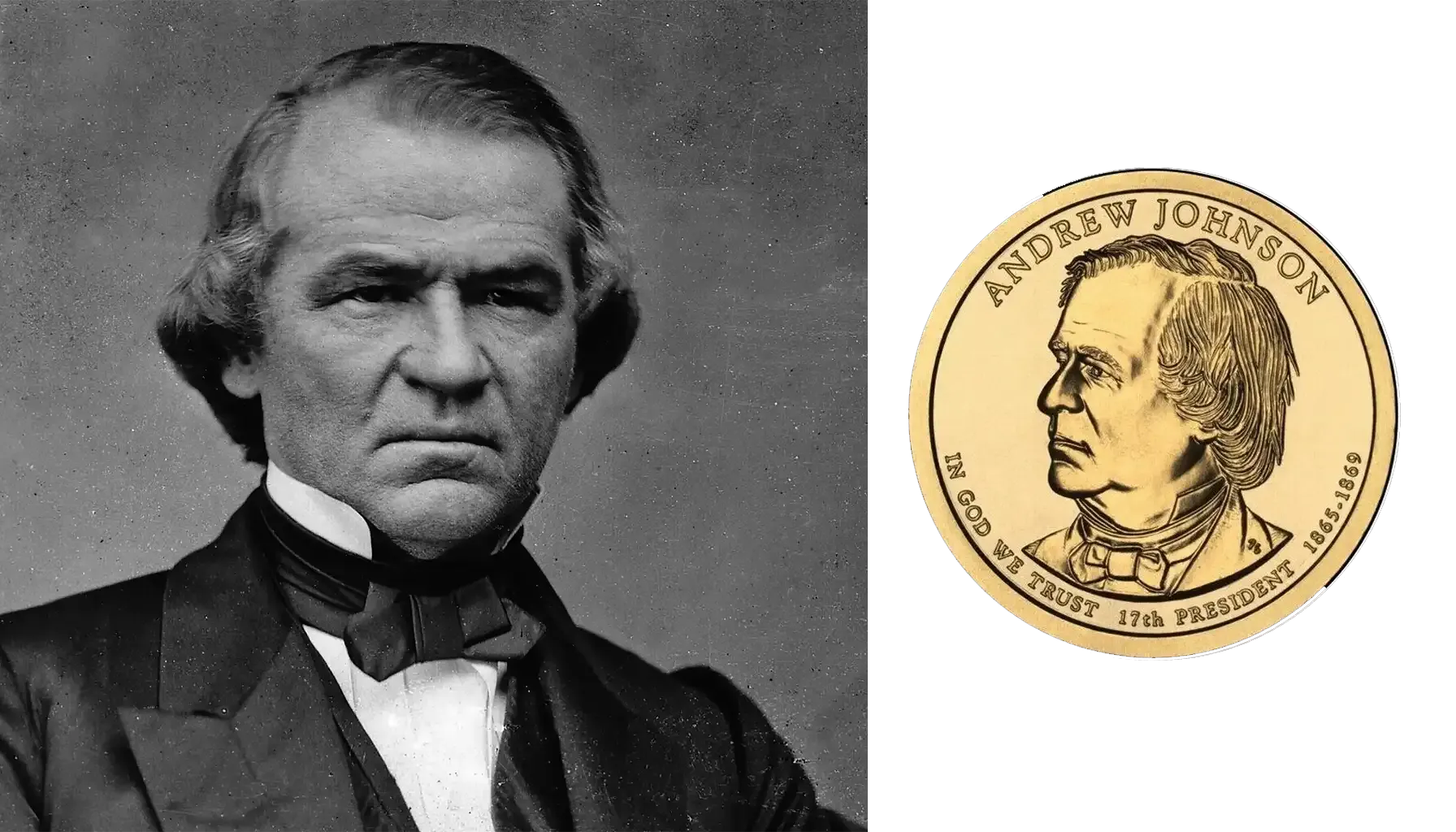
In politics, Andrew Johnson cared a great deal about poor people, as he also had a humble origin. He helped make farming and agriculture easier for poor people to manage. After his term as president, he also served in the Senate. Johnson was, in fact, the only president to also serve in the Senate.
While each present was unique, the coins that represented them (at least in technical terms) were similar.
Andrew Johnson One Dollar Coin Overview | |
Country | United States |
Years of Minting | 2011 |
Type | Circulating commemorative |
Shape | Round |
Metal Content (Composition) | Manganese-brass clad copper (77% Copper, 12% Zinc, 1% other. Pure Copper core) |
Diameter | 26.5 mm |
Weight | 8.10 g |
Mintage (Total) | Philadelphia: 35,560,000 bits Denver: 37,100,000 bits San Francisco: 1,972,863 bits |
Johnson’s coins were slightly lower in mintage than other issues, but during the release, they were relatively popular.
"Beginning today, millions of Andrew Johnson Presidential $1 Coins will be released into circulation by Federal Reserve Banks across the Nation… During 2011, they will make their way into the hands and pockets of many Americans, connecting America through coins to Andrew Johnson and his Presidency."
— Daniel P. Shaver, the United States Mint Chief Counsel
United States Mint Official Website
Market Value of Andrew Johnson Dollar Coins (Circulated, Uncirculated & Proof)
Andrew Johnson dollar coin value 1865-1869 is relatively low, rarely going above the face value. It’s not a unique price range, and many other Presidential dollars (e.g., Ulysses S. Grant dollar) go for the same values:
Category | Typical Value Range | Notes |
Circulated (P and D) | ~$1.00 | Common. Most circulated bits trade at face value. |
Uncirculated (P and D) | $2–$10 | Uncirculated bits have better-preserved details and luster. |
Proof (S) | $10+ | Proof coins were made only in San Francisco and had enhanced contrast. |
Grade is the most important value setter, but not the only one. Coin varieties and errors also affect the final price.
1865–1869 Design Andrew Johnson Coin Varieties
The Andrew Johnson coin had several varieties, but one base design.
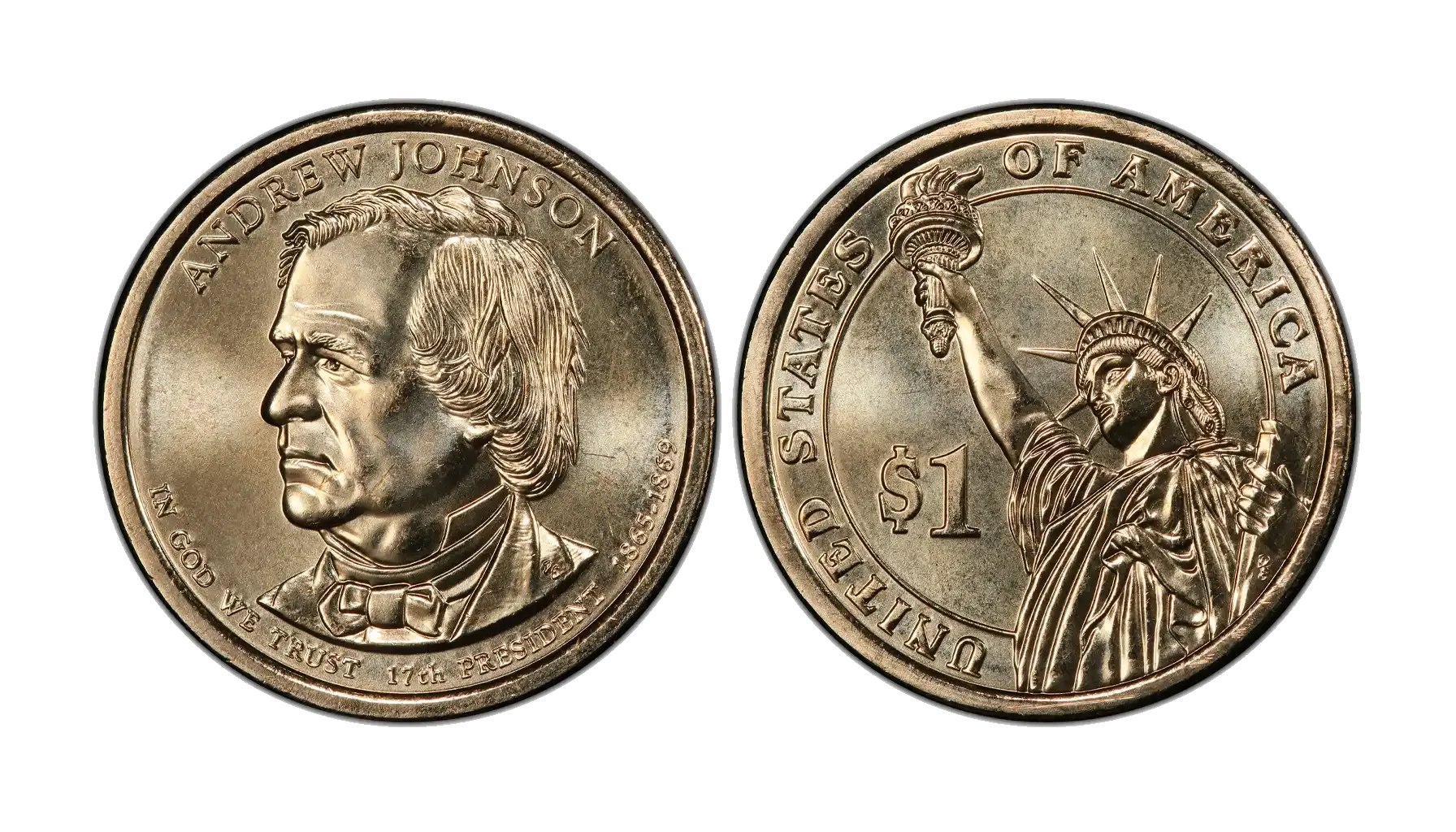
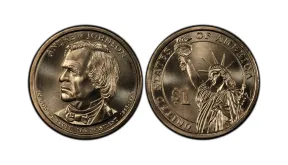
The obverse shows the portrait of Andrew Johnson. This site featured inscriptions “ANDREW JOHNSON”, “IN GOD WE TRUST”, “17TH PRESIDENT”, and 1865–1869 (office years). The obverse side was made by Don Everhart, who designed other issues in the series (i.e., Rutherford dollar).
The reverse side depicts the Statue of Liberty holding the torch. There are inscriptions UNITED STATES OF AMERICA, and $1 (the denomination). Don Everhart also designed and sculpted this side.
The mint produced business strikes for circulation (Philadelphia, Denver) and a proof version struck at San Francisco. They have the same design, and the only difference comes from the mint mark on the edge.
Yet, there is another variety (a whole class, rather), which has drastically different designs. Errors. For various reasons, some Andrew Johnson $1 coins came off the presses drastically changed:
1. Missing Edge Lettering:
The most popular error type for Presidential dollars.
Edge inscriptions (e.g., year, mint mark, E PLURIBUS UNUM, and stars) are completely absent.
The error occurs when a coin bypasses the edge-lettering machine after striking.
Value: Often $50–$150+, depending on condition.
2. Doubled Edge Lettering:
The edge lettering may be doubled. Some cases even have mirrored double letterings.
The error appeared when the coin was accidentally put in an edge lettering machine twice.
Value: Typically $75+.
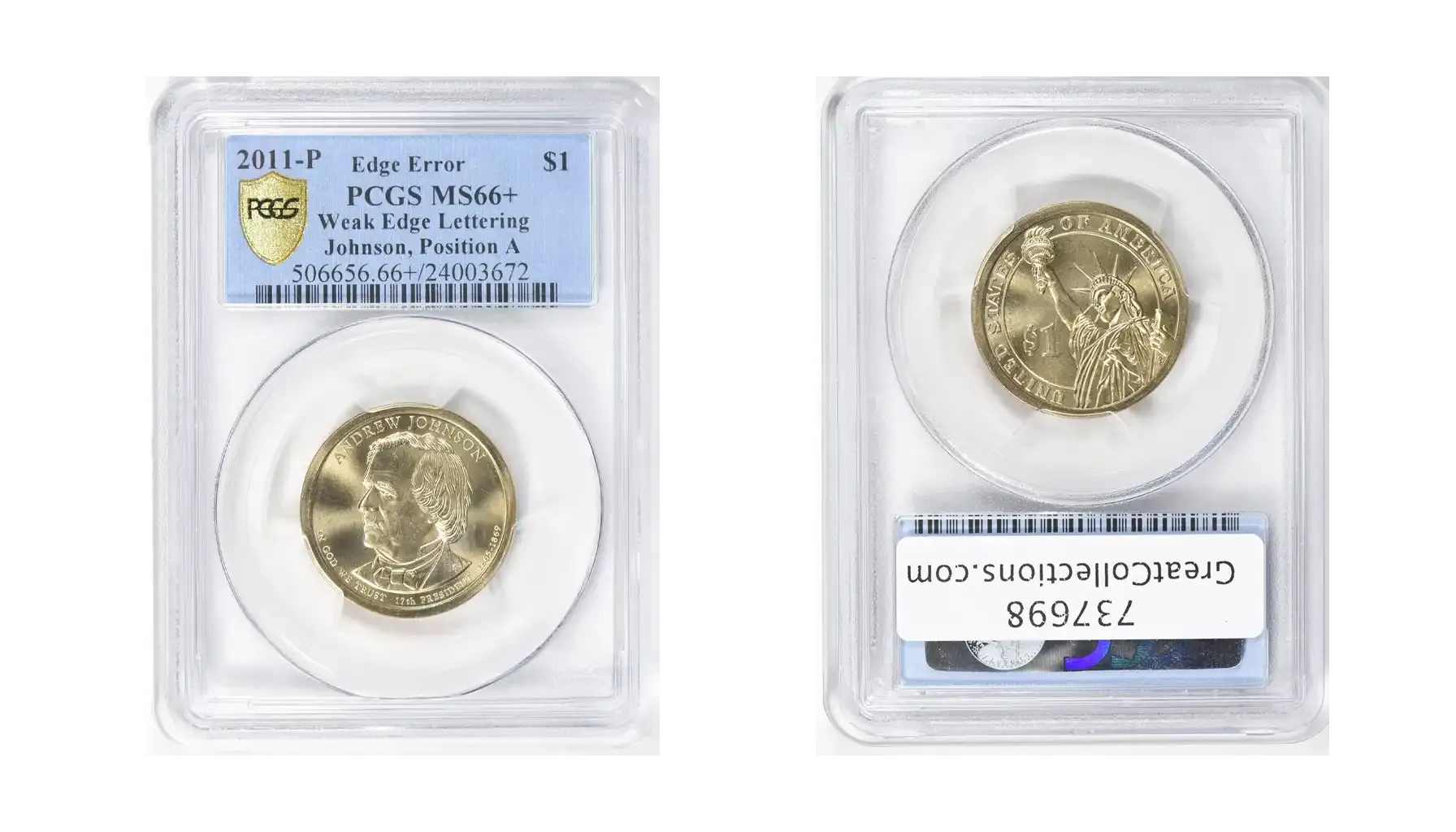
3. Weak or Incomplete Edge Lettering:
Letters appear faint, and some are outright incomplete.
The errors usually happen due to low pressure or worn lettering dies.
Value: Usually $50+ (weak lettering), and $70+ (incomplete).
5. Off-Center Strikes:
A part of the design is missing due to misalignment during striking.
The error is relatively common for old coins, but scarce for modern presidential series.
Value: Depends on off-center shift. Strong off-centers are often worth $70+.
Andrew Johnson's coin value might not be high for a common coin, but in a way, it is a priceless dollar. After all, it shows one of the most important people ot the United States, and helps us remember his deeds even centuries later.

 Facebook
  X (Twitter)
  Pinterest
  LinkedIn