Contents:
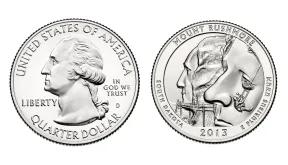
The coin depicting the work on the Mount Rushmore sculpture has become one of the most notable issues of the America the Beautiful program. Collectors appreciate it for its unique perspective and the variety of strike types. The Mount Rushmore quarter 2013 is often used as a centerpiece in collections due to its recognizable design and the wide range of mintage conditions available on the market.
2013 Mount Rushmore Quarter Overview
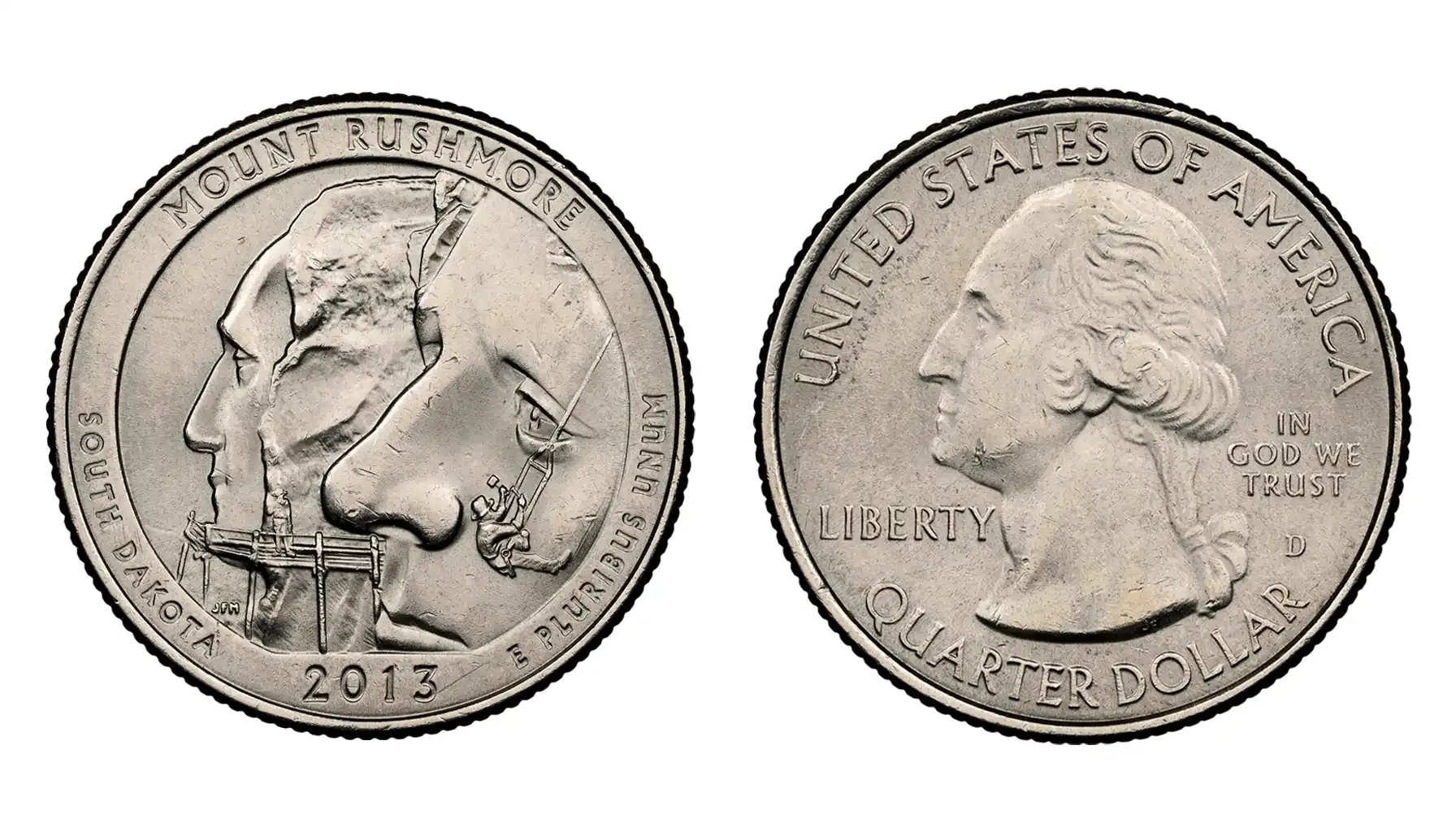
The issue is dedicated to the National Memorial in South Dakota. The reverse depicts Theodore Roosevelt's face being worked on—a rare angle on U.S. commemorative coins, so the design quickly became recognizable.
Key features:
Metal: copper-nickel alloy;
Denomination: 25 cents;
Thickness: 1.75 mm;
Weight: 5.67 g;
Edge: reeded.
The coin was minted at two mints—Philadelphia and Denver. In addition to the circulation version, the issue included decorative versions: satin finish, proof, and silver proof.
Characteristic | Value |
Metal | Cu-Ni clad |
Weight | 5.67 g |
Diameter | 24.26 mm |
Thickness | 1.75 mm |
Edge | Reeded |
Mints | Philadelphia, Denver, San Francisco |
Year | 2013 |
For comparison, collectors often look to other commemorative series that feature similar issue formats, such as the 2013 Perry's Victory quarter, to help track differences between coins of the same year.
“This new design is distinctly different and offers a unique and educational perspective on how Mount Rushmore was created and sculpted.”
— United States Mint
US Mint website
2013 Mount Rushmore Quarter Value Guide
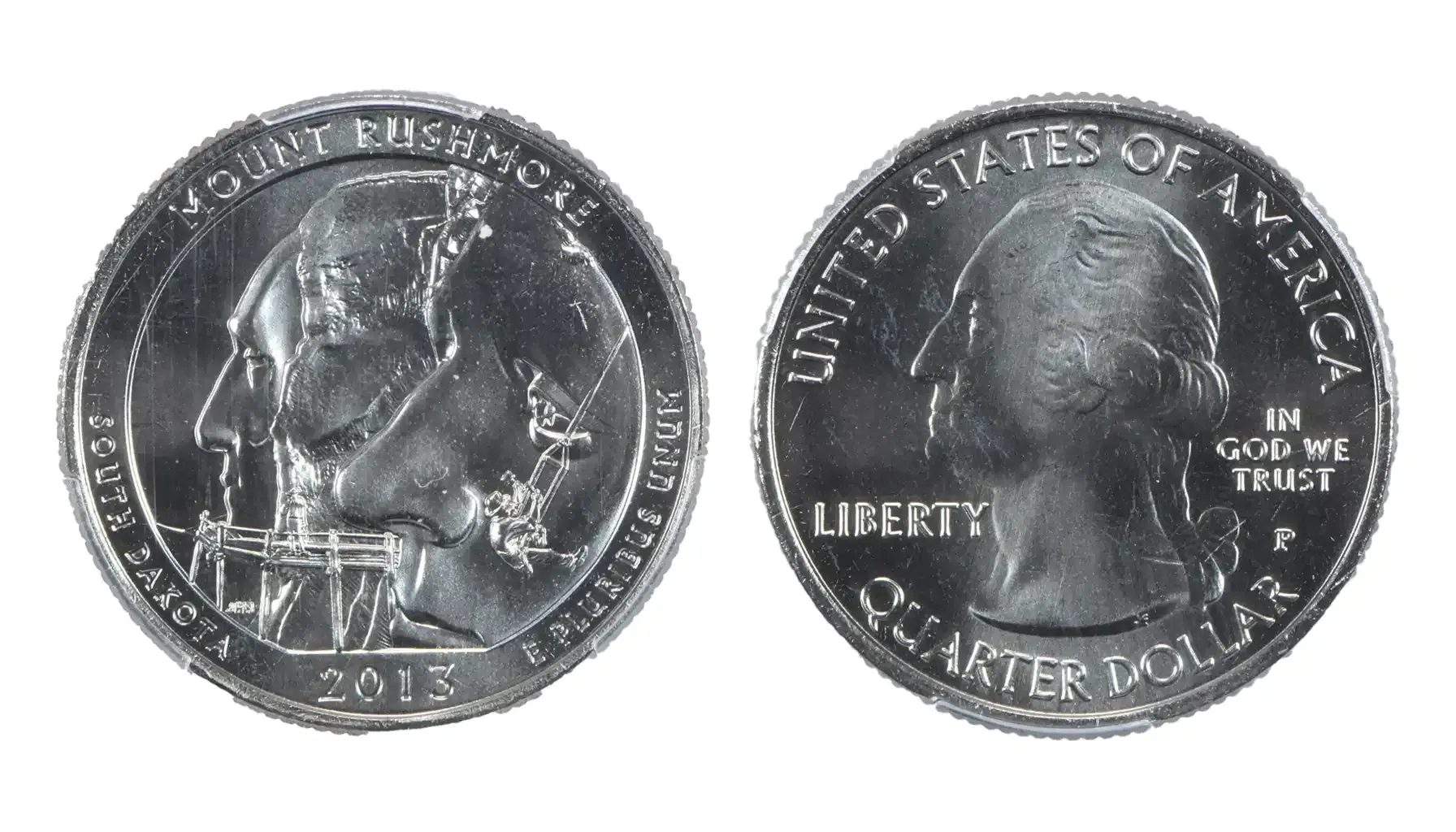
Let's start with a key question for readers—the Mount Rushmore quarter value in standard condition.
Circulation value:
Condition | Approximate Price (at the time of writing) |
XF | $0.30–$0.40 |
AU | $0.50–$0.70 |
MS60 | $1–$2 |
MS63 | $3–$5 |
MS65 | $6–$12 |
Cost of upgraded versions:
Type | Price |
Proof (S) | $4–$6 |
Silver Proof (S) | $10–$18 |
Satin Finish | $5–$8 |
MS67 coins can reach $150–$250, while rare MS68s can fetch over $1,000 at auction.
Heritage sales have seen high-grade coins fetch significantly higher prices than the average. For example, one such sale ended at around $1,800.
A coin's value depends on its condition, variety, and demand. In practice, valuation always begins with basic factors. These include:
surface condition;
mint type;
place of manufacture;
presence of errors or weak areas;
consistency of demand for a particular series.
Want to quickly determine the price of a coin? The Coin ID Scanner app is convenient—it scans the reverse and obverse, compares them to the base coin, and displays an approximate value.
2013-P and 2013-D Mount Rushmore Quarter Details
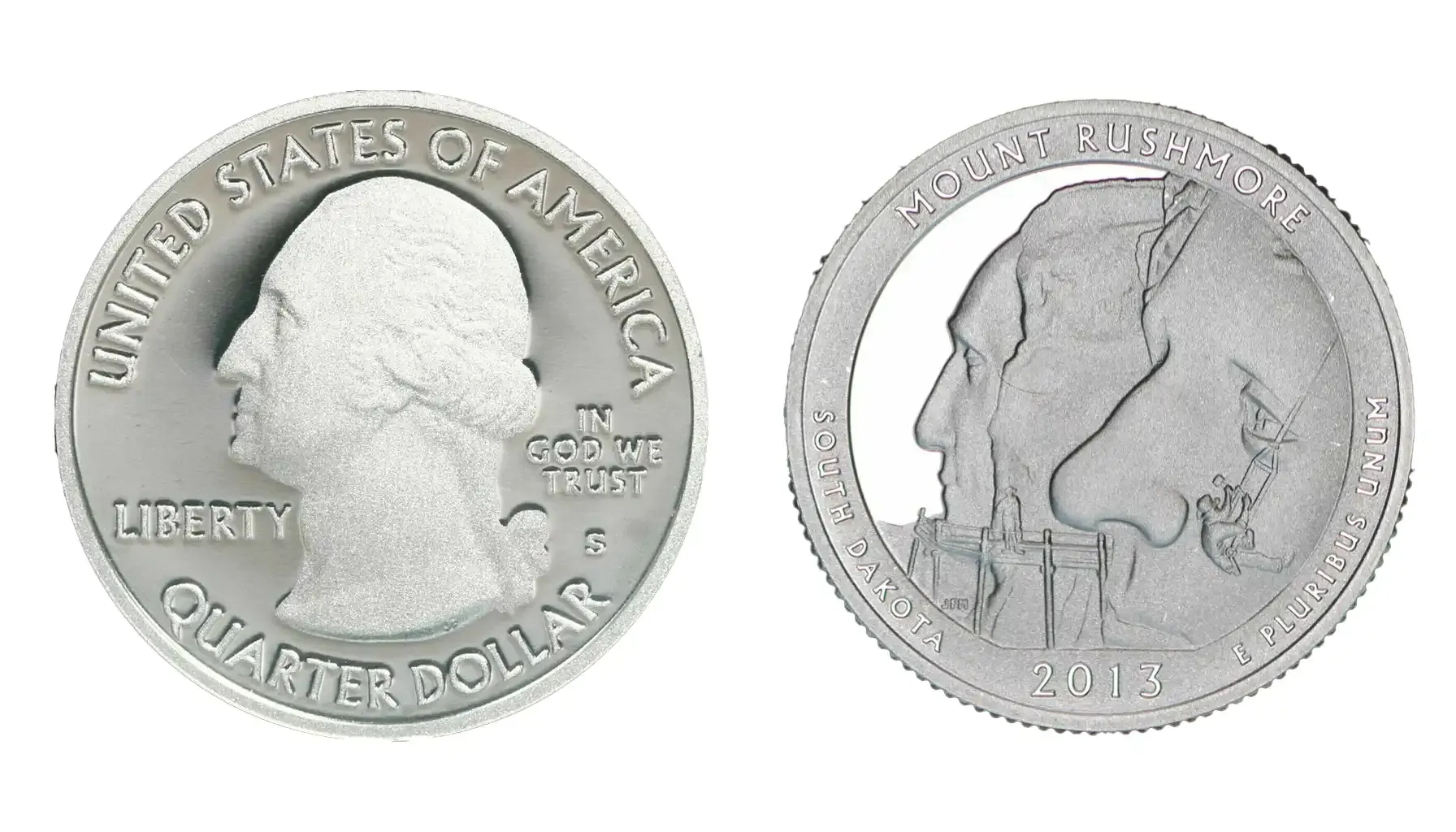
The coin production in Philadelphia and Denver was quite large. Collectors pay attention to the difference between them, especially when evaluating specimens in higher grades. For example, the 2013 mount rushmore quarter P is usually found with a more consistent strike, which becomes noticeable when comparing groups in MS65+.
Coins from Denver traditionally show a slightly wider variation in strike quality. Because of this, some collectors find it practically useful to search for pieces marked 2013 D mount rushmore quarter, especially if the goal is to assemble a complete set with maximum detail.
Mint | Mintage |
2013-P | 272,400,000 |
2013-D | 272,000,000 |
San Francisco (Proof) | 1,260,000 |
Silver Proof | 875,000 |
The coin marked 2013 P mount rushmore quarter appears slightly more often in higher-quality MS65+ conditions, which affects the price — the spread between P and D is noticeable mainly at the MS67 level and above.
If we look at market-related questions, collectors often ask: how much is a 2013-D mount rushmore quarter worth in MS65 condition? On average, such pieces sell for about $8–$12, which makes them affordable yet appealing for thematic collections.
Factors by which collectors differentiate between 2013-P and 2013-D Mount Rushmore coins in the higher grades include:
Relief depth on the sculptor's tools. Denver lots have areas with slightly less-defined detail, which affects the final grade.
Field luster. Philadelphia coins typically have a more consistent and uniform luster, increasing the likelihood of receiving an MS66–MS67 grade.
Presence of micro-scratches from transportation. Denver lots often have a significantly higher percentage of minor scratches, which is why coins are less likely to be elevated to the higher grades.
Uniformity of die pressure. P issues often exhibit uniform strike pressure across the entire surface, while D issues exhibit slight variations.
Edge quality. Denver coins sometimes show traces of slight displacement or irregularities, reducing the likelihood of receiving an MS67+ grade.
Surface clarity in the area of the presidential faces. This zone is critical for both coins: the Philadelphia coin more often has a clear, grain-free area.
The extent of circulation in the early batches. Some of the D mintage entered circulation earlier, reducing the chance of finding true pristine luster.
At the same time, collectors are also studying other year issues, such as the 2013 Great Basin quarter, to assess rarity by comparison.
2013 Mount Rushmore Quarter Errors
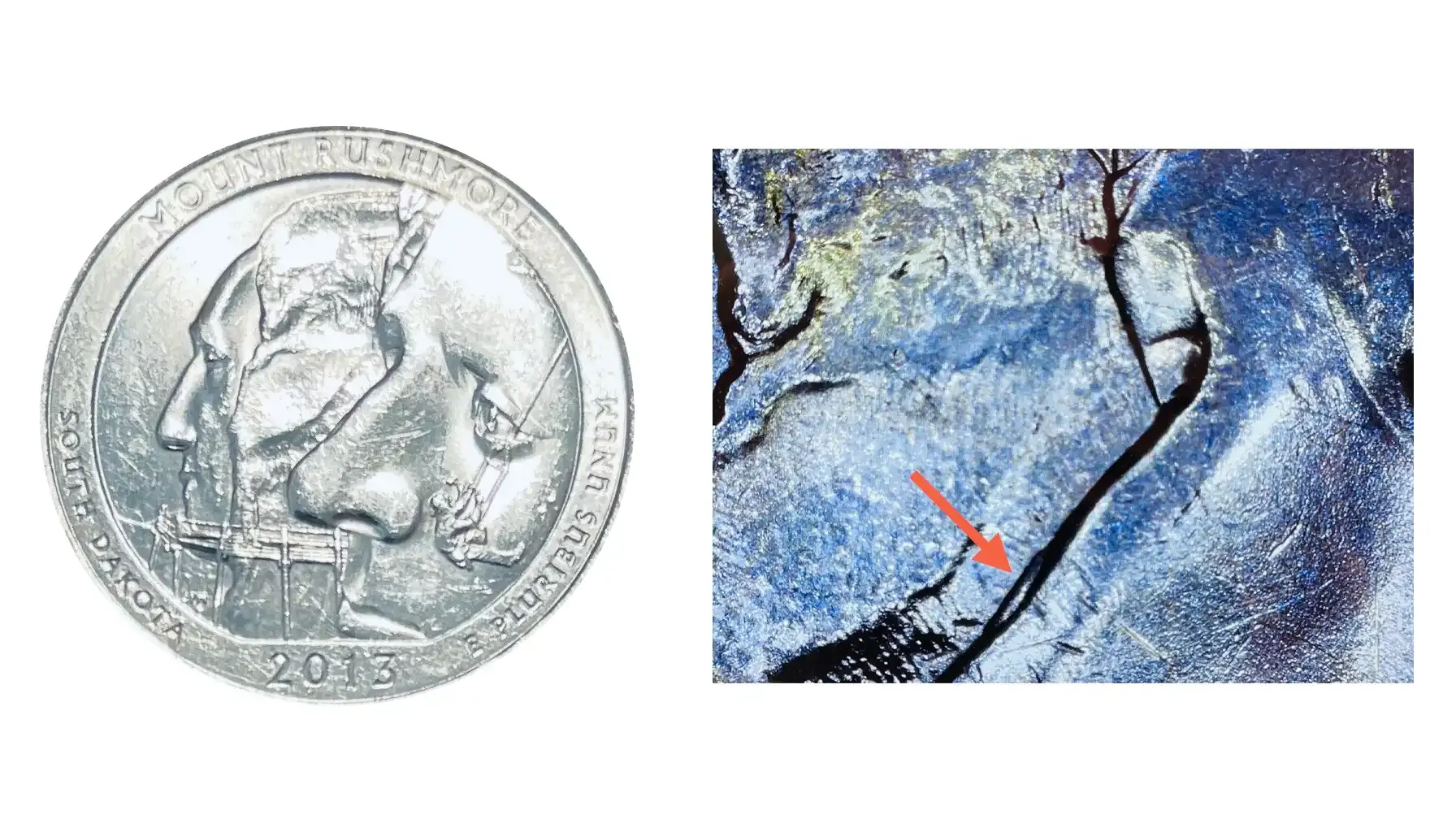
The Mount Rushmore quarter error was recorded early in the series' circulation, when collectors discovered several atypical defects directly related to tool wear and manufacturing process characteristics.
The main errors discovered were:
Strikethrough. The surface is partially deformed due to the die's contact with fabric fibers, metal shavings, or other particles that have fallen onto the die. On the coin, this appears as depressed or washed-out areas.
Die Chips. Small metal deposits in the area of the sculptor's tools. Often found on coins with increased die wear. This type is attractive to collectors because the defect comes in a variety of shapes and sizes, so the market values each chip individually.
Misaligned Die. A slight or pronounced misalignment of the obverse or reverse relative to the rim. These errors are easily visible even without magnification, making them popular with beginning collectors.
Partial Collar. A protrusion forms along the edge due to the ring not fully encircling the blank. Externally, the coin resembles a specimen with an asymmetrical rim.
Error Type | Description | Price |
Strikethrough | Surface distortion | $40–$150 |
Die Chip | Metal build up | $20–$40 |
Misaligned Die | Die misalignment | $50–$180 |
Partial Collar | Incomplete collar strike | $70–$150 |
Conclusion
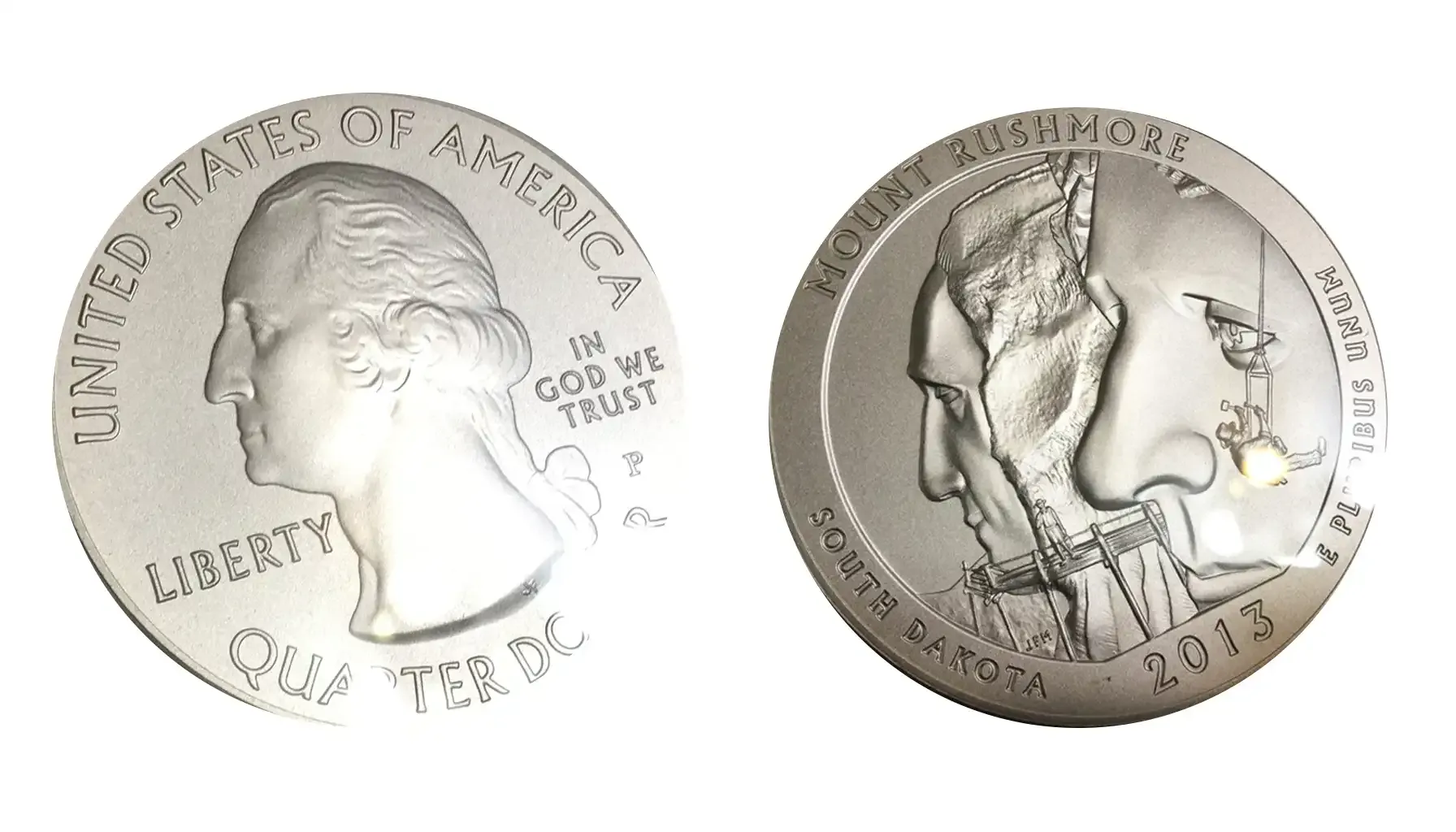
This issue is appreciated by collectors for its design, the differences between conditions, and the presence of rare minting errors. MS67+ examples appear only in limited quantities, and defective coins in high grades show the most noticeable price growth.
For thematic collections, mount rushmore 2013 quarter value remains a stable reference point: the coin is considered a solid choice for those collecting the America the Beautiful series.
The 2013 quarter mount rushmore is valued for its clear and predictable market structure: the coin offers a wide range of conditions, allowing collectors to choose a specimen that fits their budget and collection level.

 Facebook
  X (Twitter)
  Pinterest
  LinkedIn