Contents:
The 2006 quarter South Dakota belongs to the State Quarters series, where every U.S. state was given its own reverse design. The issue features a rich composition and a small number of rare minting defects, which sometimes occur within individual batches.
South Dakota State Quarter Overview
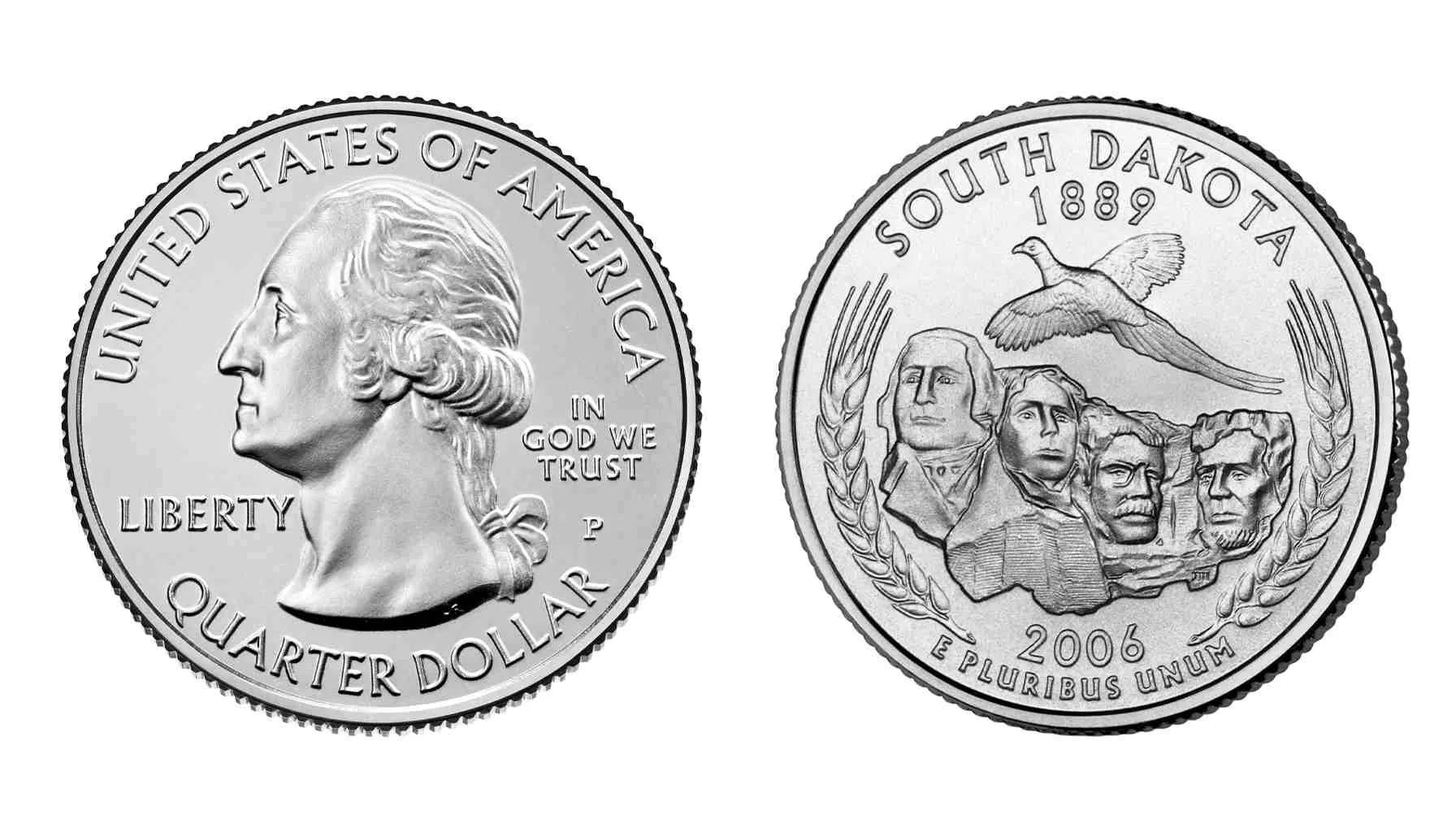
The South Dakota State quarter has one of the most complex reliefs in the entire program. On the reverse, you can see Mount Rushmore, a ring-necked pheasant, a wheat wreath, and the state’s admission date. The layered design made the dies harder to produce, and that shows in how clear the details appear.
Standard clad alloy was used for the issue, and minting took place at two mints: Denver and Philadelphia. Denver pieces have a slightly brighter surface luster, while Philadelphia more accurately captures the fine lines of the pheasant’s feathers, helping to identify early strikes.
The 2006 South Dakota quarter is easily distinguished by its composition, rich in state symbols.
Parameter | Value |
Metal | 91.67% Cu / 8.33% Ni |
Weight | 5.67 g |
Diameter | 24.26 mm |
Mintage | approx. 510 million |
Mints | P, D |
Year | 2006 |
Numismatists often compare market trends with specimens like the 2007 Utah quarter to identify general price trends and rare varieties across years.
“Owning a coin is like owning a piece of history. Coins are universal and timeless. Every piece is worthy of being saved.”
— Unknown author
Boy Scouts of America, from the “Coin Collecting” badge booklet
2006 South Dakota Quarter Value and Errors Guide
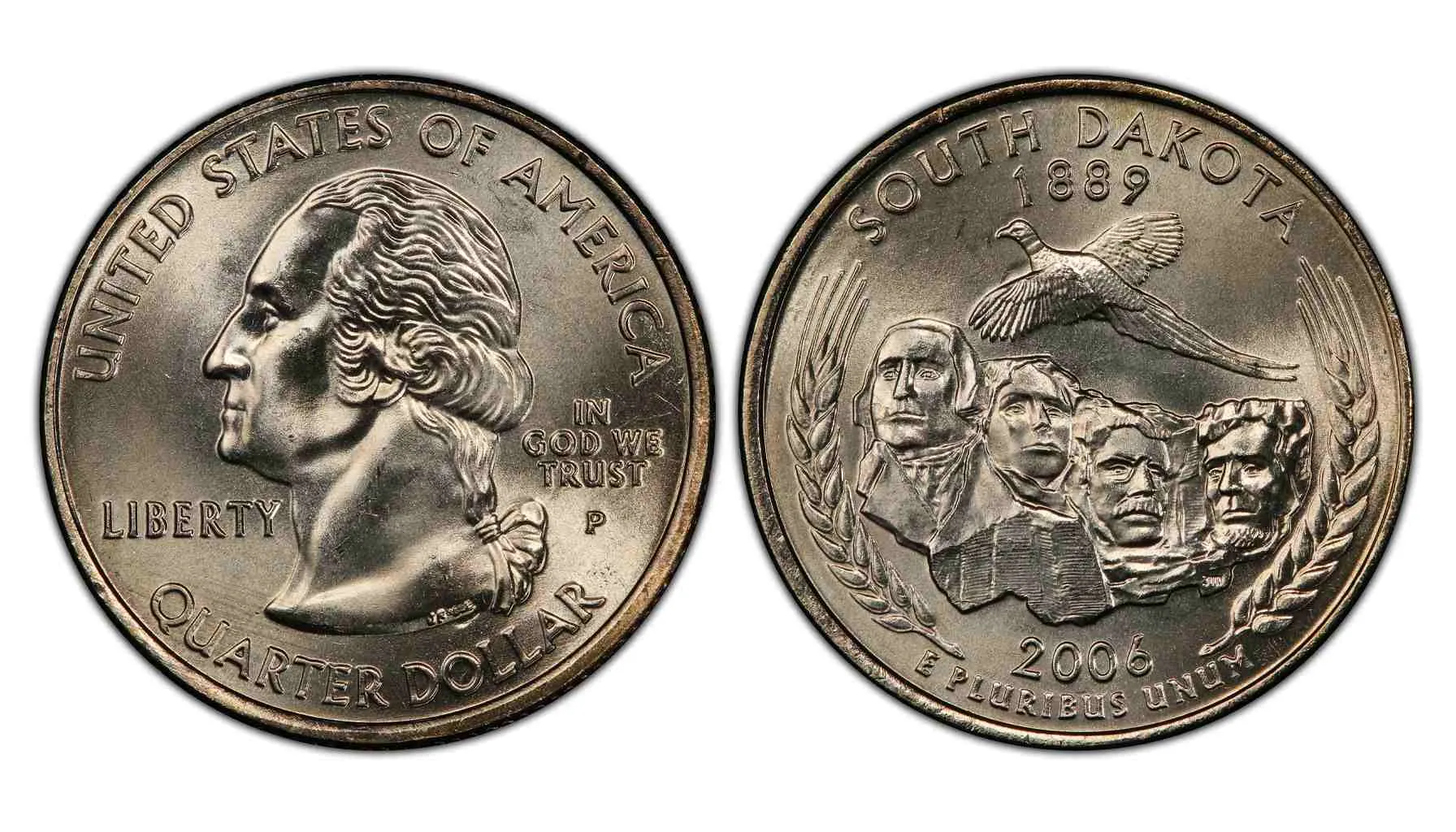
The value of a South Dakota quarter 2006 depends on the coin's condition, the mintage, and the rarity of any defects. Circulated pieces have almost no added value, but MS-grade coins are in demand.
Condition | Approximate Price |
Circulated | $0.25–$1 |
MS63–MS65 | $3–$6 |
MS66 | $10–$16 |
MS67 | $15–$30 |
MS68 (very rare) | $40–$80+ |
The 2006 P South Dakota quarter value is typically higher in the highest grades, as Philadelphia specimens exhibit more consistent die quality. The 2006 D South Dakota quarter value has a slightly wider range, with both very poor quality specimens and excellent early strikes.
What else determines the South Dakota 2006 quarter value?
Clarity of the pheasant’s feather lines;
Absence of surface scratches;
Consistency of field luster;
Defined contours of the faces on Mount Rushmore;
Presence of manufacturing defects.
When comparing South Dakota pieces, collectors often look at the price trends of adjacent years, including 2007 issues, such as the 2007 Wyoming quarter, to understand demand behavior within the later part of the series.
If you need to quickly determine the approximate price of a specific coin, the Coin ID Scanner app is useful. It compares the reverse and obverse images against a database, helps identify varieties, and provides benchmarks for market valuation.
South Dakota Quarter Error Identification
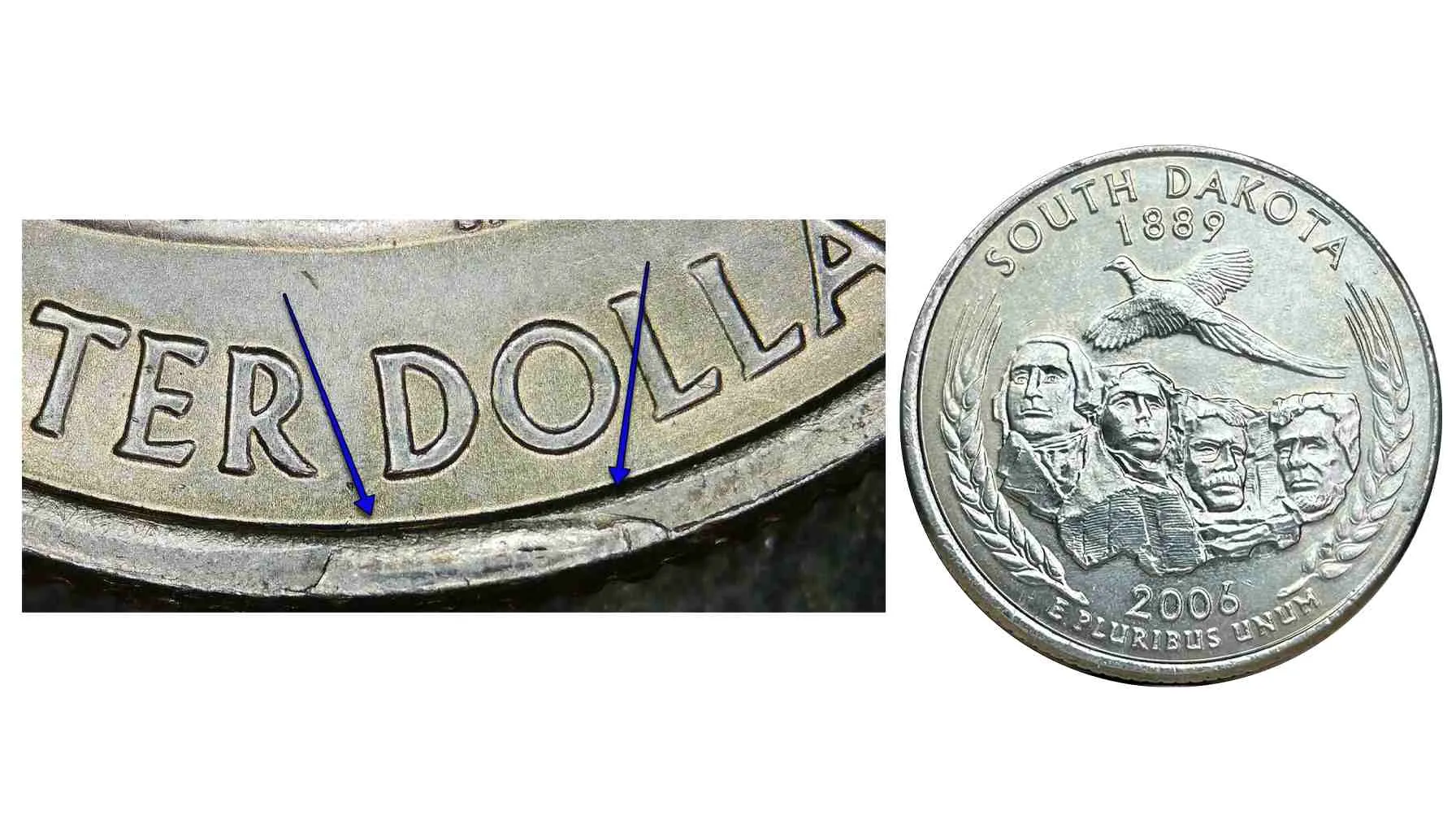
There is no confirmed widespread 2006 South Dakota quarter error, but certain types of defects do occur and increase the coin's value above face value.
The main types of errors are:
Off-Center Strike. If the blank is misaligned, part of the design is cut off. Such specimens are always valued higher, especially if the misalignment is 10% or more.
Die Cracks. Thin lines on the surface among the wheat ears or on the pheasant’s wings. The length and thickness of the crack determine the value.
Die Chip. Small metal protrusions, most often along the edge of the wing or in the area above the faces of the presidents. Collectors classify these coins as varieties.
Missing Clad Layer. If the top layer is missing, the piece has a copper tint and is significantly more valuable.
Strike-Through Error. If a particle of material is caught between the die and the blank, the relief appears "dented."

 Facebook
  X (Twitter)
  Pinterest
  LinkedIn