Contents:
The 2005 coin market interest remains on an upward trajectory as fresh analyses of strike quality, surface harmony, and rim precision emerge from examination of newly released rolls. The design honors natural landscape features and offers clear detail lines that support long-term attention to this State Quarters series.
Numismatists explore grade ranges and mint variations, while beginners learn the structure of this early release within the state series. Strong demand for distinct faults expands research within the full 2005 Quarter Oregon segment as analysts review new, unique items.
Oregon State Quarter Overview
“Crater Lake was selected as the state's iconic symbol. The tail side features Crater Lake as viewed from the south-southwest and includes Wizard Island, the Watchman, and Hillman Peak…Governor Ted Kulongoski credited his wife, Mary Oberst, with persuading him to choose the lake: “She told me, ‘You better get something unique to Oregon.’ ‘What’s that?’ She said, 'Crater Lake,' and she was right.” Other themes considered included the Oregon Trail, Mount Hood, and a Chinook salmon.”
– Lee Juillerat
The Oregon Encyclopedia
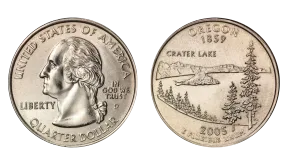
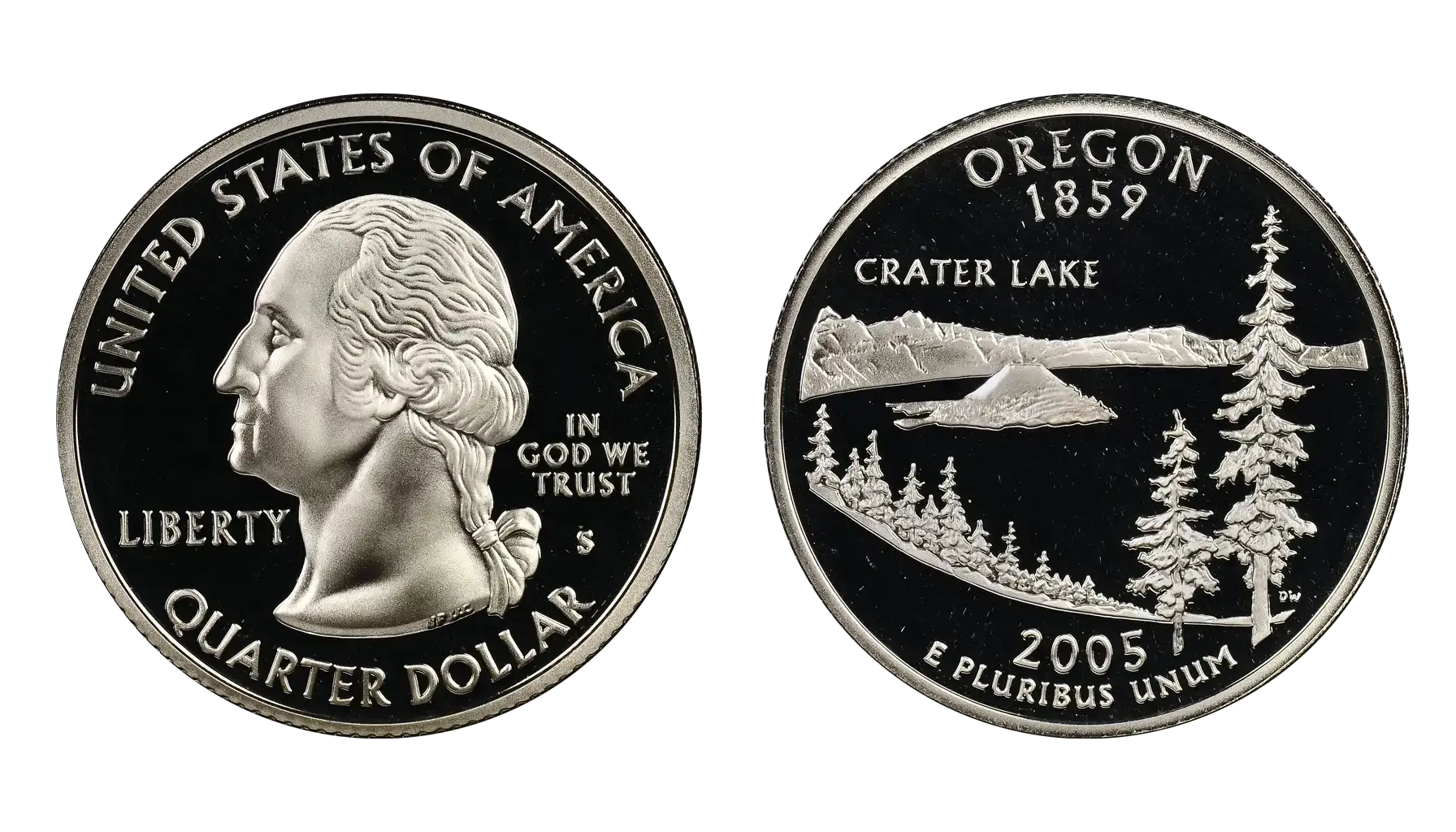
The coin’s reverse face presents a detailed rendering of a specific portion of Crater Lake. Prominently featured are Wizard Island and the adjacent Watchman and Hillman Peaks, which form part of the caldera rim surrounding the lake. The obverse carries the Washington portrait with strong line structure.
Philadelphia and Denver produced circulation strikes, while San Francisco released clad and silver proof versions for advanced collections. Such factors as surface tone, rim stability, and clarity of the island contour shape interest across the entire Oregon 2005 Quarter field.
Diameter | 24.3 mm |
Weight | 5.67 g |
Metal | Copper-Nickel Clad Copper |
Edge | Reeded |
Designer | John Flanagan / William Cousins |
The same obverse designer, John Flanagan, developed the Kansas coin.
2005 Oregon Quarter Value Guide
The market price of a coin typically fluctuates based on its assigned grade as well as the specific mint mark it bears. Numismatic groups follow price movement across current sales when strong surfaces appear within the 2005 Oregon Quarter P segment.
Collectors favor proof strikes because they show deeper contrast and clearer separation of fine lines. Silver proofs go a step further with brighter reflectivity and sharper island details, making them more valuable in serious collections.
Mint | Circulation | Mintage | MS-67 | MS-68 |
P | Standard | 316,200,000 | $10–$30 | $55 |
D | Standard | 404,000,000 | $12–$40 | $373 |
S | Collector Proof | 3,262,960 | $10–$20 | N / A |
S | Silver Proof | 1,678,649 | $30–$45 | N / A |
Note: Within the 50‑state quarter program, the 2005 West Virginia coin stands out for having the largest total mintage across all issues in the series.
Auction Records
Auction data helps define the wider field for the coin errors market. Performance is strongest for high‑grade pieces with sharp strike definition and uniform surface toning.
Slight faults that occur during early die states appear in premium sales and influence expectations for long-term growth within the 2005 coin segment. The next list reflects auction records across major venues:
2005-D, December 2015 – $373 (eBay)
2005-P, December 2016 – $446.50 (Heritage Auctions)
2005 Oregon Quarter Rare Errors
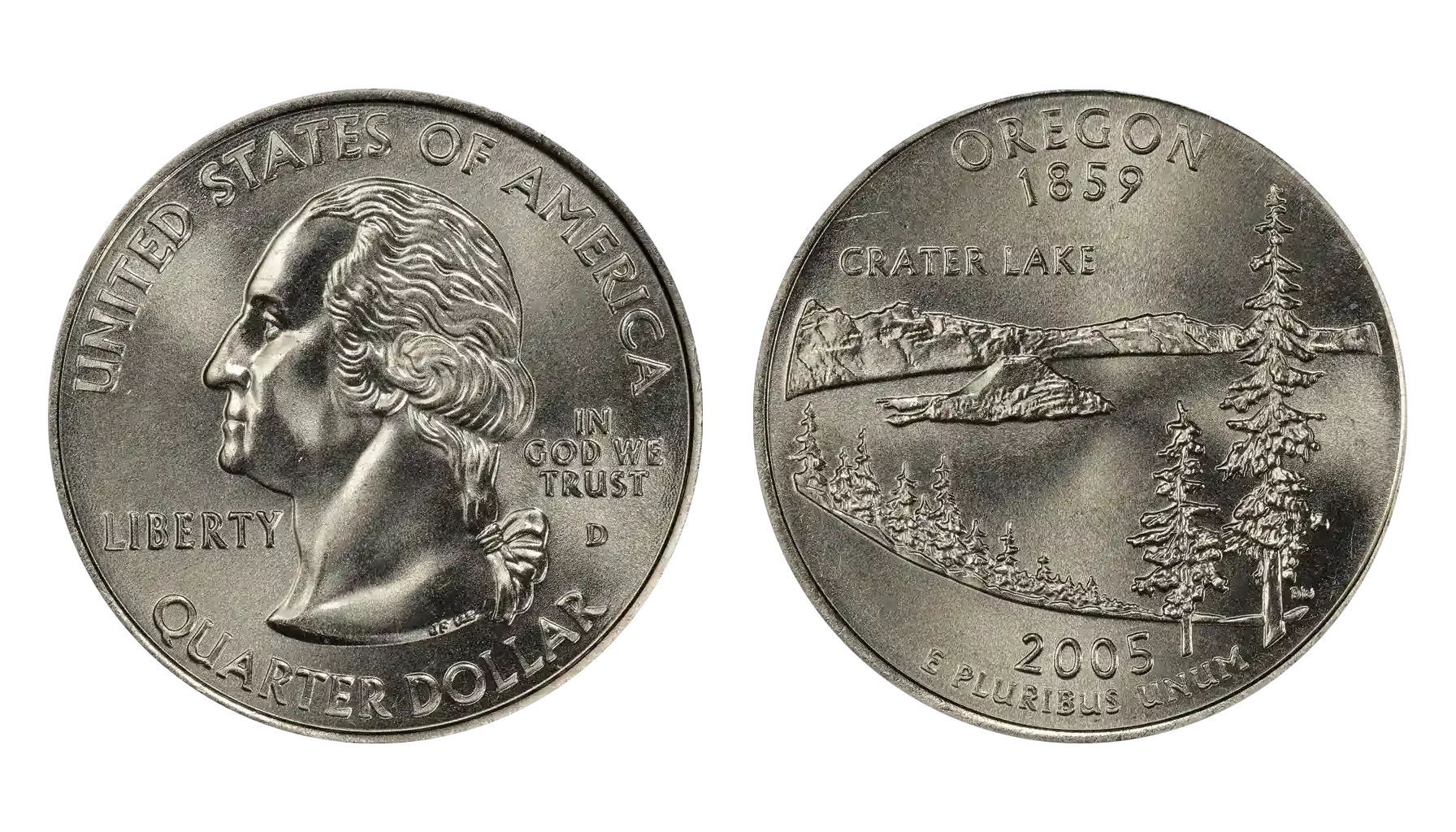
Some coins show minor doubling on parts of the forest line or along the island outline. Others display die chips on selected letters or near the lake edge. Certain strikes present thin strike-through marks that cut across shallow landscape zones. These traits enrich the full 2005 Oregon Quarter error list wit
h pictures category when analysts document variations.
A small group of coins shows wide metal distortion caused by die damage. These pieces stand out in the broader Oregon State Quarter error landscape because they create bold outlines that differ from the normal design. Off-center strikes rarely appear, though most remain slight and show only modest rim shift.

 Facebook
  X (Twitter)
  Pinterest
  LinkedIn