Contents:
The 2000 coin interest stays strong as traders explore fresh sales. The coin honors the Maryland State House dome and marks the seventh release in the State Quarter series.
This guide attracts new professional collectors who want clear information about 2000 Maryland Quarter error varieties and long-term demand across multiple grades. The series supports broad research on production stages and surface traits, which helps refine estimates across larger sets of state coins.
2000 Maryland Quarter Design Highlights
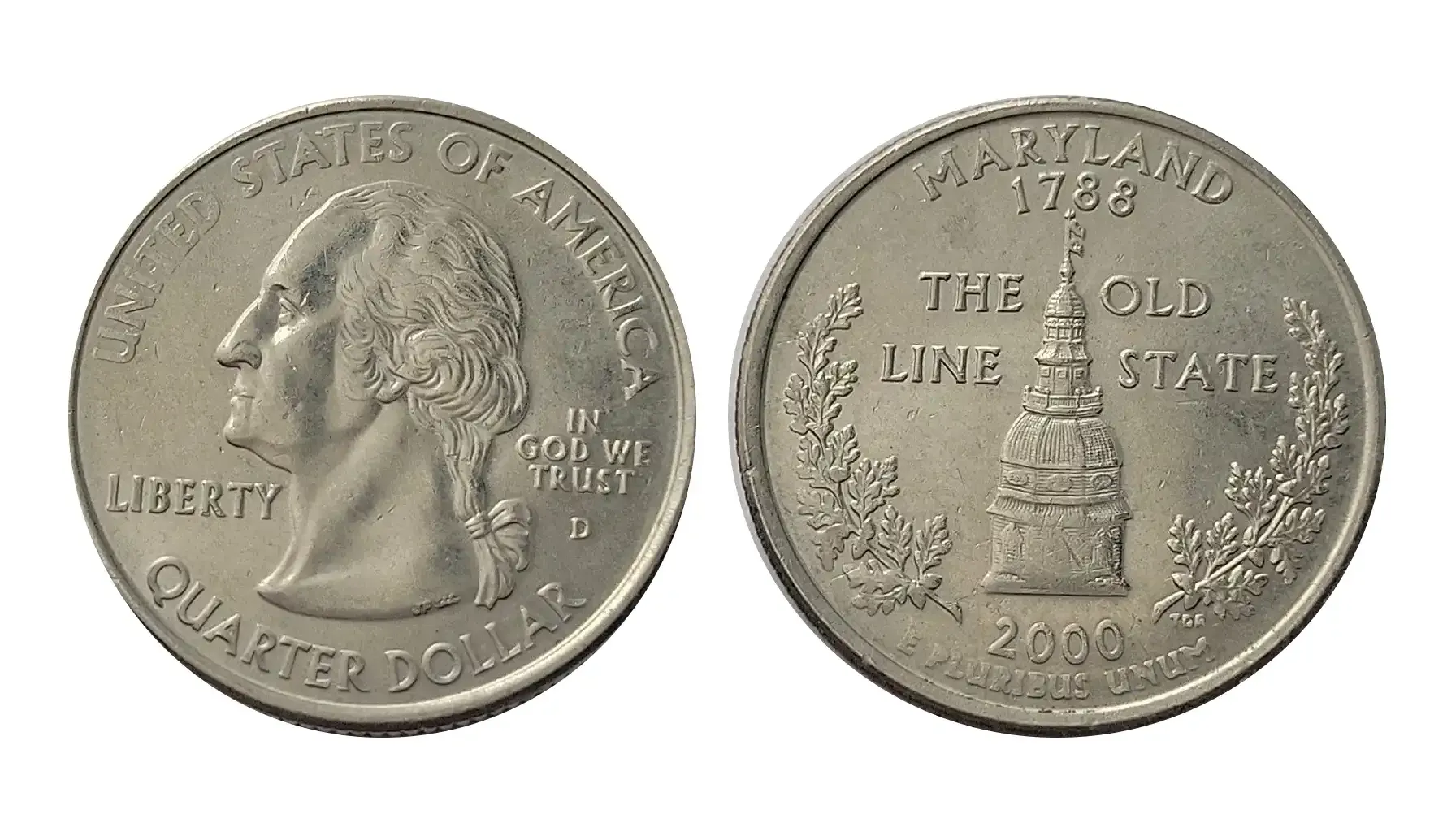
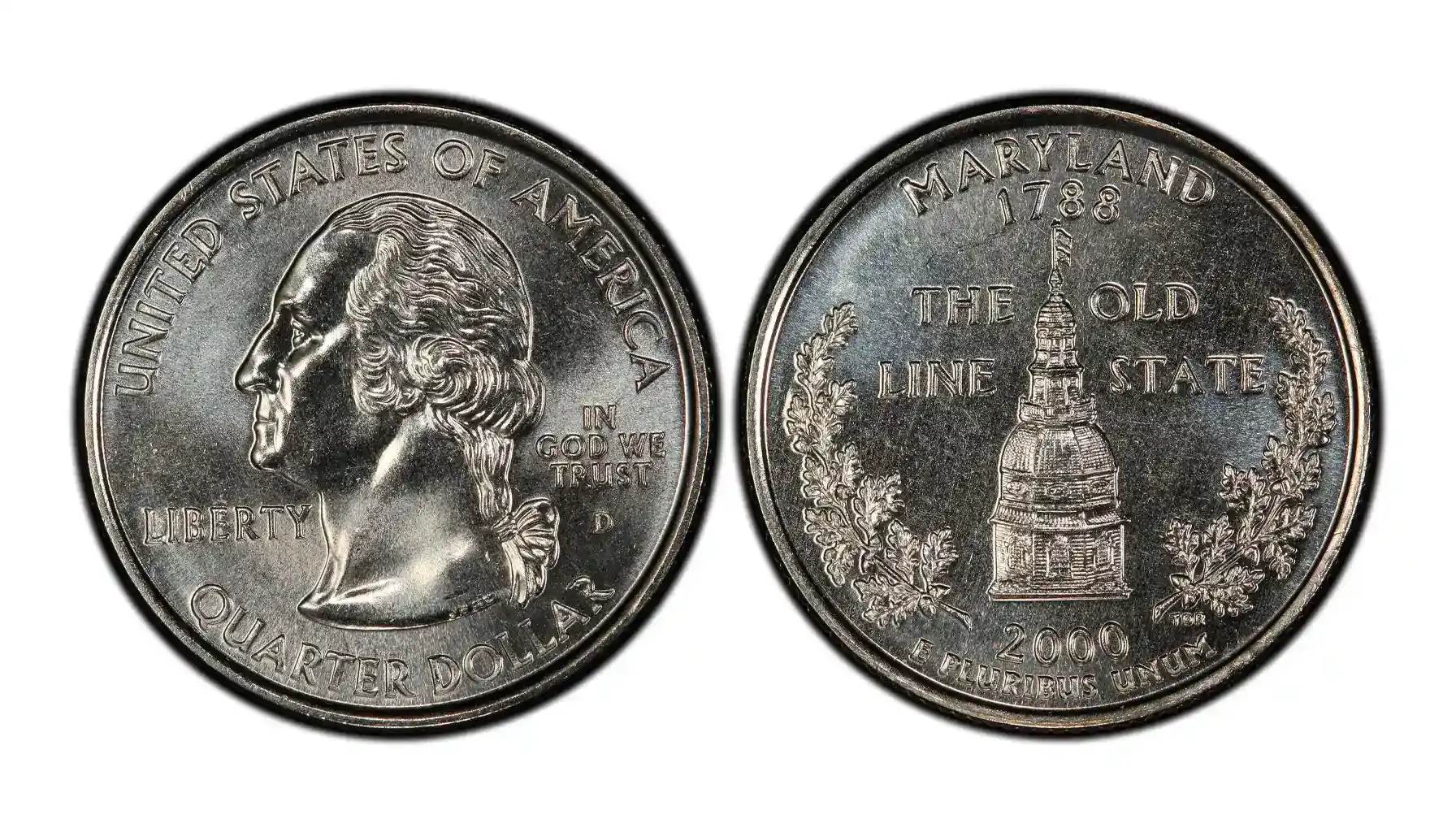
The design centers on the historic Statehouse dome, framed by branches of a white oak. Strong contrast and balanced layout support stable long-term interest. Raised letters and crisp field zones allow fast spotting of small faults or weakness from die fatigue.
“The Maryland state quarter design is the 6th design issued in the 50 State Quarters program. It is also the second design issued in the year 2000. The Maryland circulation strike quarters were officially released on March 13, 2000.”
– Jaime Hernandez, a numismatic expert
PCGS
Specialists who track the value trends review strike strength from mints and compare reverse detail across large batches. Early strikes show sharp branch outlines, while later strikes show slight softness near the dome base.
The Maryland 2000 Quarter series includes proof issues with stronger reflectivity and deeper contrast. These pieces show heightened clarity along all raised segments and help researchers compare mint processes across the national program.
Coin Overview
The table below outlines standard retail ranges for this coin and helps traders follow current patterns for errors that show measurable influence on market outcomes.
Diameter | 24.3 mm |
Weight | 5.67 g |
Metal | Copper-Nickel |
Edge | Reeded |
Mintage | 678,200,000 |
Designer | John Flanagan / Thomas D. Rodgers |
The same designer, John Flanagan, developed the 2000 South Carolina coin.
2000 Maryland Quarter Value Guide
Price levels depend on:
Grade
Overall surface quality
Letters
Rim
Light Doubling
Although circulated examples are widely available, high‑quality Mint State coins continue to command steady attention from collectors due to their superior condition. Market observers track 2000 P Maryland Quarter error varieties, such as light doubling on small letters or faint fragments near the rim.
Because these faults appear only in modest numbers, they continue to attract significant attention from specialist collectors who value their relative scarcity. The broader segment of Maryland the Old Line State Quarter proof issues shows steady demand. Clad proofs bring moderate prices, while silver proofs attract higher bids when they show haze-free surfaces.
Mint | Circulation | Mintage | MS-67 | MS-68 |
P | Standard | 678,200,000 | $18–$40 | up to $1,495 |
D | Standard | 556,532,000 | $22–$40 | up to $626 |
S | Collector Proof | 4,020,172 | $10–$20 | N / A |
S | Silver Proof | 965,421 | $30–$60 | N / A |
Note: Compared to the values presented in the 2000 New Hampshire coin price table, the current price range is notably higher, a difference attributable to the increased rarity of this particular coin.
Auction data helps define the wider field for the Maryland State Quarter errors market. Performance is strongest for high‑grade pieces with sharp strike definition and uniform surface toning.
Slight faults that occur during early die states appear in premium sales and influence expectations for long-term growth within the 2000 coin segment. The next list reflects auction records across major venues:
2000-P, January 2015 – $1,495 (Heritage Auctions)
2000-D, July 2011 – $250 (eBay)
Silver Proof Item
Mint Mark: San Francisco
Composition: 90% silver / 10% copper
Weight: 6,25 g
Reverse Design: Maryland State House
Source: Collector Sets Only (2000 Silver Proof Set)
In the premium market, coins must display full frost (cameo) on fine details like the acorn and lightning rod to secure a PF‑70 designation. Even minor frosting deficiencies in these areas will disqualify a piece from top‑tier grading.
Maryland “Old Line State” Quarter Collecting Tips
Strong collecting strategies focus on:
Surface clarity
Mint origin
Accurate fault identification
Buyers who track early production phases gain an advantage when they spot raised metal fragments, rim shifts, or outline distortions.
The market for 2000 Maryland State Quarter value pieces grows as traders compare new sales with earlier results. Higher grades from Denver often show cleaner fields, while Philadelphia coins show broader variation in dome detail.
Researchers following the 2000 P Maryland State Quarter notice that small die chips near letters form short raised points that attract focused interest. Such traits help monitor die wear and support a detailed study of the full state cycle.

 Facebook
  X (Twitter)
  Pinterest
  LinkedIn