Contents:
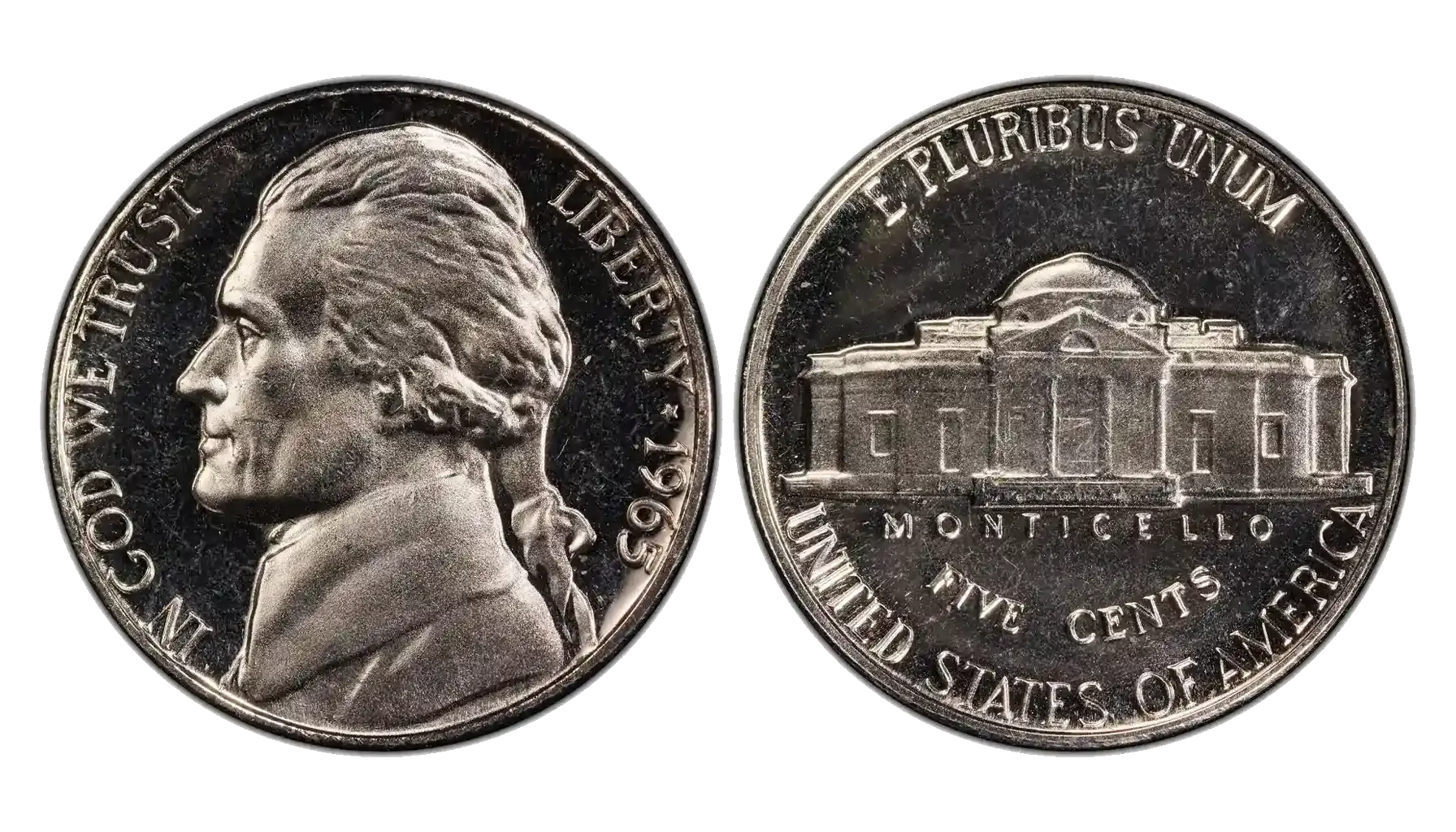
In 1965, the first year after mint marks were removed from US circulating coins, the United States Mint released two types of Jefferson nickels without any letter showing where they were made. As unique numismatic creations, their prices gradually rose: the highest 1965 Jefferson nickel value so far, i.e., $7,050, is reserved for a proof variety with the DCAM designation attributed by the Mint.
So, the 1965 Jefferson nickel lacked any indication of its origin (a deliberate decision by the Mint to stabilize the economy). But how does this impact the value, and which factors might identify this coin as rare and worthy? Let us check.
“The 1965 Nickel is a very common coin in all grades, including Gem Mint State. However, any 1965 Nickel with Full Steps is an extreme rarity. The finest non-Full Step 1965 Nickel certified by PCGS is a single MS67.”
— Ron Guth, recognized authority on United States and German coins
PCGS CoinFacts
Overview of the 1965 Jefferson 5C
One of the defining economic issues of this period refers to notorious inflation, which was triggered by post-war initiatives and the growing expenses of the Vietnam War. Federal budgets could not withstand the ambitious "Great Society" initiatives of President Lyndon B. Johnson, which presupposed the improvement of healthcare and education in the country. The nation's financial resources were strained, that is the thing.
Besides, apart from inflation, the United States had to deal with a growing shortage of coins. The intrinsic value of silver in dimes, quarters, and half dollars began to approach (in certain instances, surpass) its face value. As a result, many people hoarded coins with the hope that their silver content would increase their value over time. This led to serious consequences and the introduction of the first coins without mint marks on them. This is how the 1965 no mint mark nickel appeared.
The Main Specifications of the 1965 5C | |
Country | United States |
Face value | 5 cents |
Year | 1965 |
Obverse design | Thomas Jefferson |
Reverse design | Monticello |
Designer | Felix Schlag |
Composition | 75% copper, 25% nickel |
Weight | 5.00 grams |
Diameter | 21.20 mm |
Thickness | ~1.95 mm |
Edge | Plain/smooth |
Mint marks | None |
Strike type | Business strike Special Mint Set strike |
Mints involved | Philadelphia Denver San Francisco |
The 1965 Jefferson nickels got a simple yet elegant design; the one that people would soon call “iconic”. However, something may distinguish this iteration from the rest of the versions – the lack of mint marks.
Is a 1965 Nickel Silver?
A 1965 nickel is not silver, but it was made of 75% copper and 25% nickel instead. However, the appearance of the coin may seem misleading, as it looks silver in color, but that color comes from the nickel in the alloy. The only Jefferson nickels that contain silver are the wartime nickels from 1942 to 1945. Hence, the 1965 nickel silver content is zero.
Is a 1965 Nickel Worth Anything?
The value of 1965 nickel is a complex, phenomenal variable, as the coin was originally meant to lower the numismatic potential of these coins on their own. Over time, however, certain examples have become collectible because of their condition, strike quality, Special Mint Set status, or unusual mint errors anyway. But what is a 1965 nickel worth?
Factors That Affect the Value of a 1965 Nickel
Coin condition and amount of wear
Business strike or Special Mint Set strike
Sharpness of Jefferson’s portrait and Monticello details
Full Steps designation (on the reverse side)
Surface marks, scratches, or discoloration (the level of wear and stress)
Original luster (altered, cleaned, or pristine)
Certified grade from PCGS, NGC, or ANACS grading services
Mint errors, such as off-center strikes or doubled dies
Collector demand at the time of sale
1965 Nickel Value Today
Grade | Business Strike | SMS |
G | $0.05 | – |
VG | $0.12 | – |
F | $0.12 | – |
VF | $0.15 | – |
XF | $0.35 | – |
AU | $0.35 | – |
UNC | $0.65 | $1.71 |
Auction record | $6,325 for MS67 | $7,050 for SP67 |
Most Valuable 1965 Nickel Errors and Varieties
Off-Center Strike Error
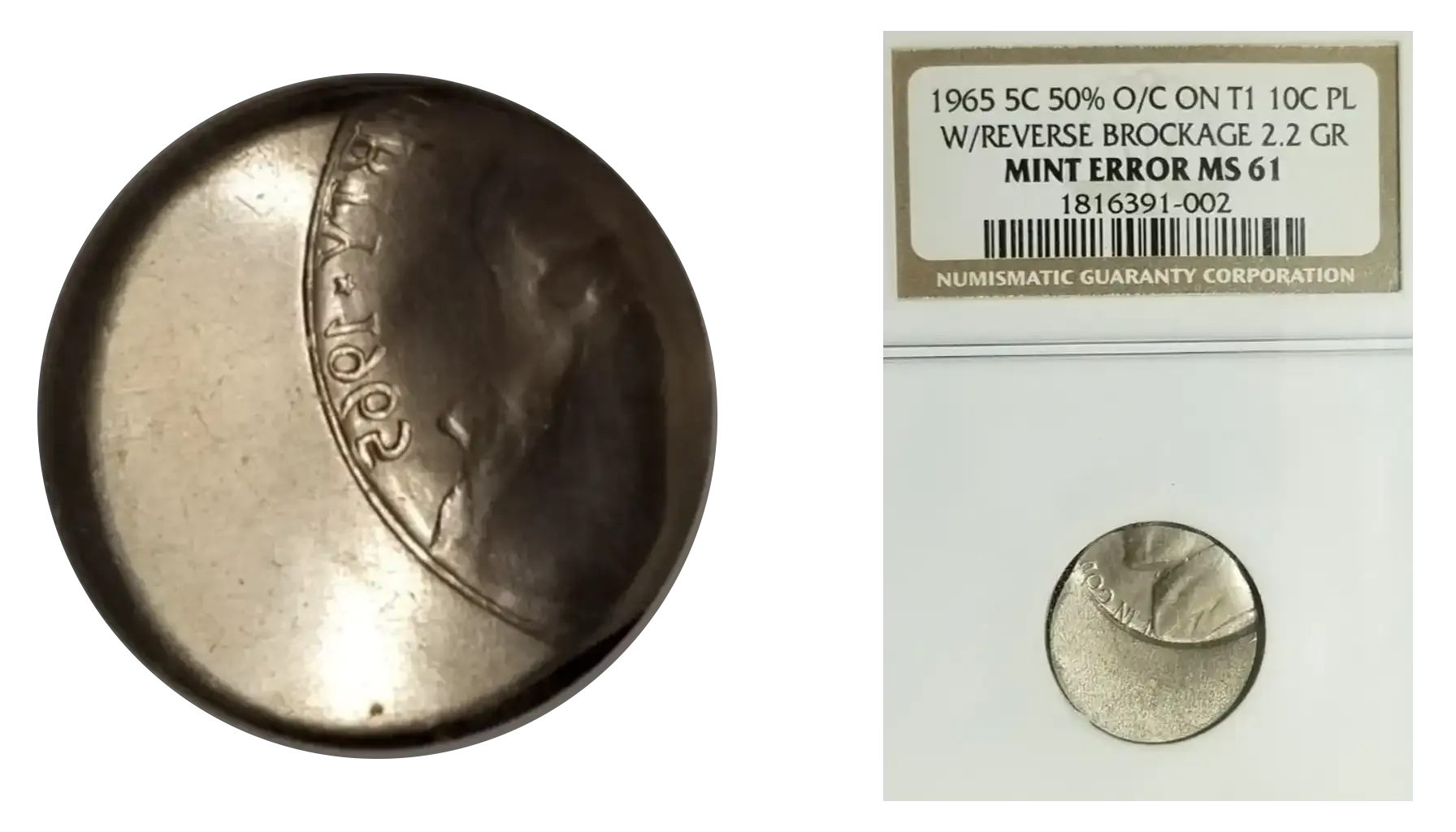
Estimated value: $1,400
This is one of the most valuable deviations, for it can be easily visible and appreciated by collectors. As a rule, such an imperfection happens when the nickel planchet is not properly aligned between the dies at the moment of striking. Hence, the design moves, and part of it might be missing (the level of absence varies – the more, the better).
Struck-Through Cloth Error
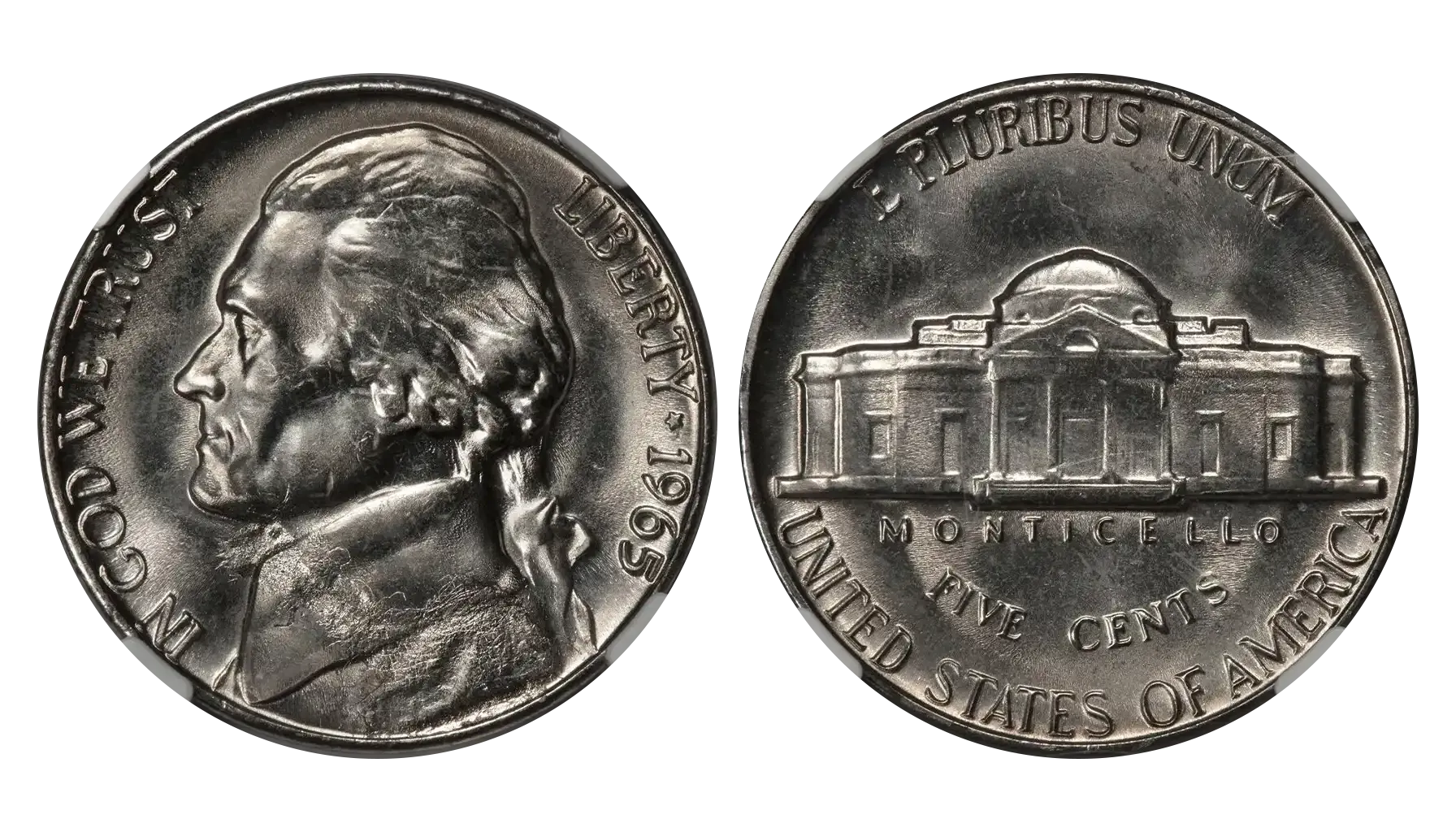
Estimated value: $999
A struck-through cloth error is another deviation that may occur should a piece of cloth or fabric come between the planchet and the die during the production procedures. Instead of a clean, standard design, the coin bears the marks of the foreign material – the unusual texture or woven impression on the surface
45% Indent Broadstrike “Mushroom” Error
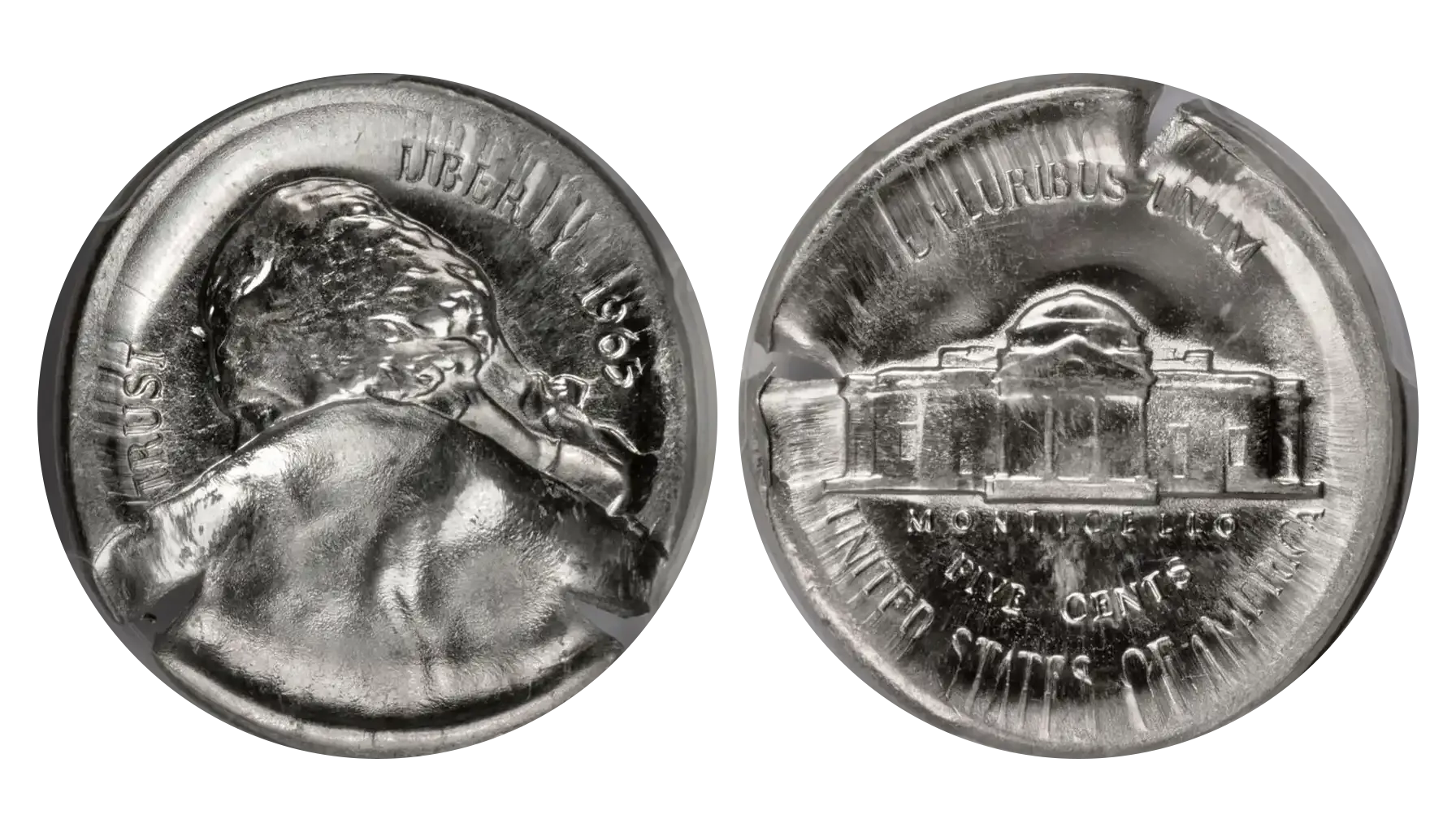
Estimated value: $500
At times, the most valuable coins are those that bear a few errors at the same time. In this case, the 1965 D nickel value is defined by the features of an indent and a broadstrike. In a 45% indent broadstrike, nearly half of the coin may show distortion or missing design detail, which inevitably creates a “mushroom” shape as the metal expands.
Clashed Dies Error
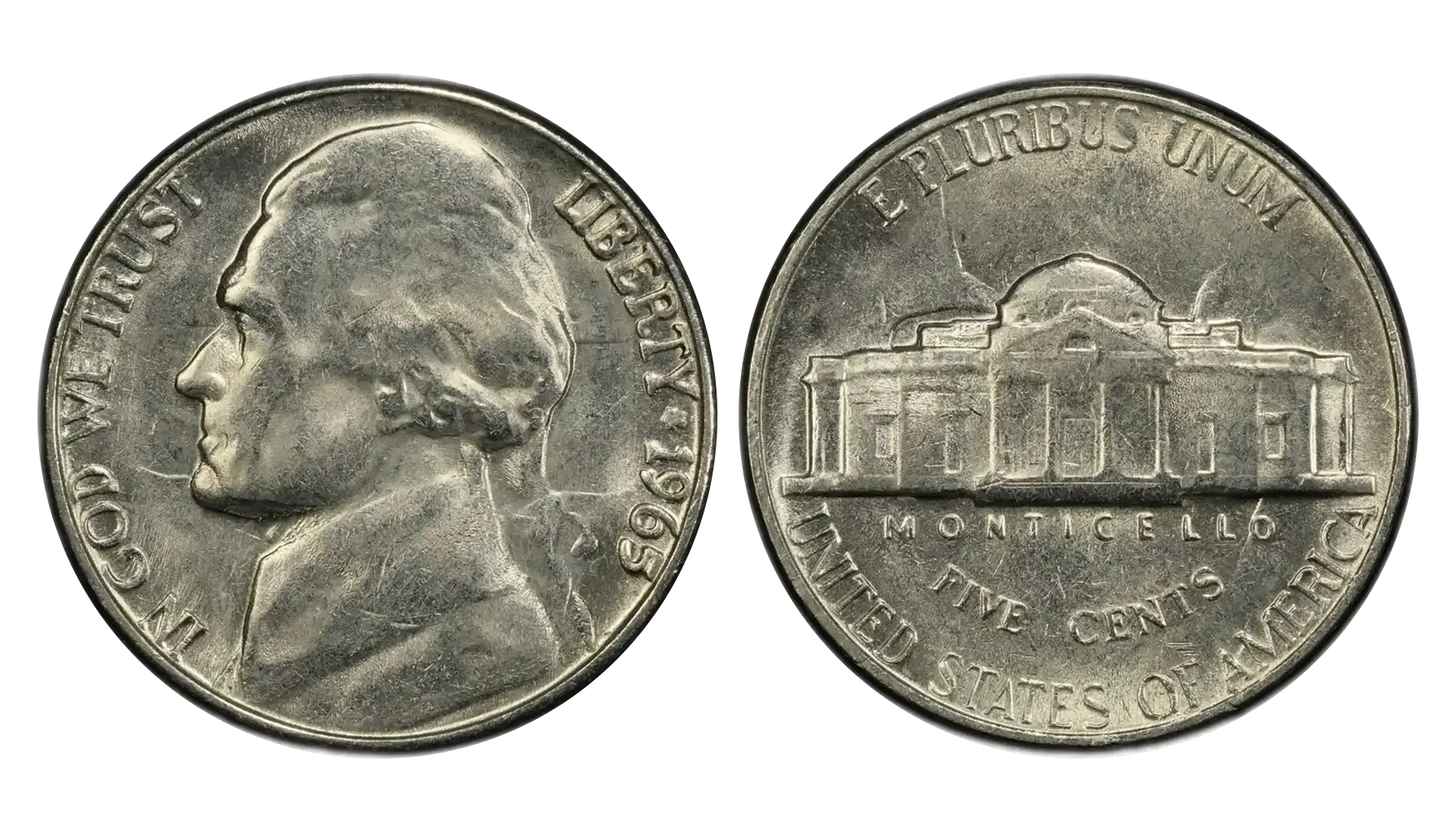
Estimated value: $392
A classic 1965 nickel error list with pictures may also include a clashed die error that forms when the obverse and reverse dies strike each other without a planchet in between. Hence, the design transfers from one die onto another, so that later coins may show faint, misplaced design elements from the opposite side.
How to Tell If Your 1965 5C Is Valuable
So as to understand if the coin is valuable, one should be able to check its condition, strike quality, and possible errors on the spot. The most effective way is to employ tools like Coin ID Scanner, as certain examples may be too intricate to be analyzed without additional tools and equipment involved.
Anyway, look for these value signs:
Uncirculated condition, i.e., bright original luster, sharp details, little to no wear
Full Steps on Monticello, i.e., clear, complete step lines on the reverse
Special Mint Set finish, i.e., smoother surfaces, sharper details, cameo contrast
Major mint errors, e.g., off-center strikes, broadstrikes, indents, struck-through errors, or clashed dies
Visible date (especially important on dramatic error coins)
No damage (do not confuse real errors with post-mint scratches, dents, or corrosion!)

1965 Nickel vs Pre-1965 Nickel Value
There is no major difference between coins of the pre-1965 period and 1965 nickels in terms of basic composition: the 1965 nickel no mint mark value remains practically the same. However, when it comes to wartime 5C coins from 1942 to 1945, which were made of silver, the prices significantly vary.
Note that the melt value of the 1942 to 1945 nickels is approximately $4.14, which is ~83 times higher than the face value of a regular 1965 25-cent type.
Type | Composition | Typical value factor |
1965 5C | 75% copper, 25% nickel | Condition, SMS status, Full Steps, and errors |
Pre-1965 5Cs | 75% copper, 25% nickel | Date, mint mark, condition, and survival rates |
1942–1945 5Cs | 56% copper, 35% silver, 9% manganese | Silver content, condition, mint mark, and demand |
Explore coins from different periods – do not hesitate to find all the answers and join a numismatic society to make your experience more fruitful and captivating.
FAQs
Is a 1965 nickel pure silver?
A 1965 5C contains no silver, as it was the prerogative of the wartime types.
Are pre-1965 nickels 90% silver?
Pre-1965 nickels are not 90% silver. Only wartime Jefferson nickels from 1942 to 1945 contain silver (only 35%).
Where is the mint mark on a 1965 nickel?
There is no mint mark on the surface of these coins. These were removed from US circulating units from 1965 to 1967.
Do pre-1965 nickels have any value?
Just like any other coin, they certainly do. The base value usually comes down to 25 cents (or a bit less), but key dates, high-grade coins, Full Steps examples, and 1942–1945 silver wartime 5C coin can be worth more.
What are pre-1965 nickels made of?
It depends on the period. In general, the typical composition included 75% copper and 25% nickel. During World War II, nickels contained 56% copper, 35% silver, and 9% manganese.
What is a nickel in 1965 worth today?
In general, the value range is $0.05 to $0.35. However, higher prices are also possible (especially at auctions).

 Facebook
  X (Twitter)
  Pinterest
  LinkedIn