Contents:
- How Much Is a 1940 Nickel Worth Today?
- 1940 Nickel Value by Mint Mark
- 1940 Nickel Value Chart
- Is a 1940 Nickel Silver?
- Where Is the Mint Mark on a 1940 Nickel?
- 1940 Jefferson Nickel Error List
- Is a 1940 Nickel Worth Anything?
- How Much Is a 1940 Nickel Worth in Circulation?
- How to Identify a Valuable 1940 Nickel
- FAQ
The XX century was one of the most intense and flabbergasting periods, and the sphere of numismatics could not but respond to the call and introduce a product of its time, i.e., the nickel 1940. The price peak starts from $2,500 and more $.
How Much Is a 1940 Nickel Worth Today?
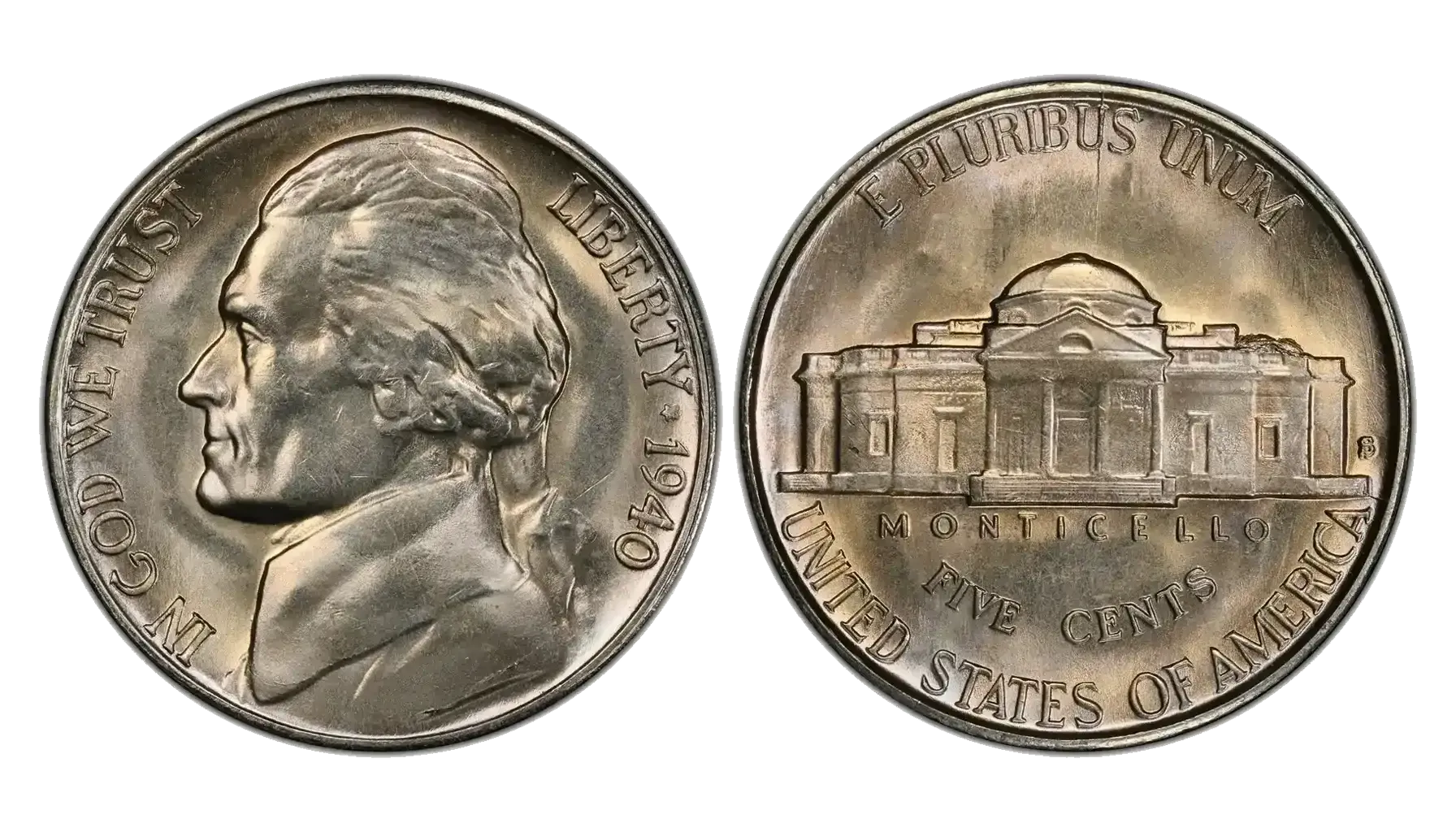
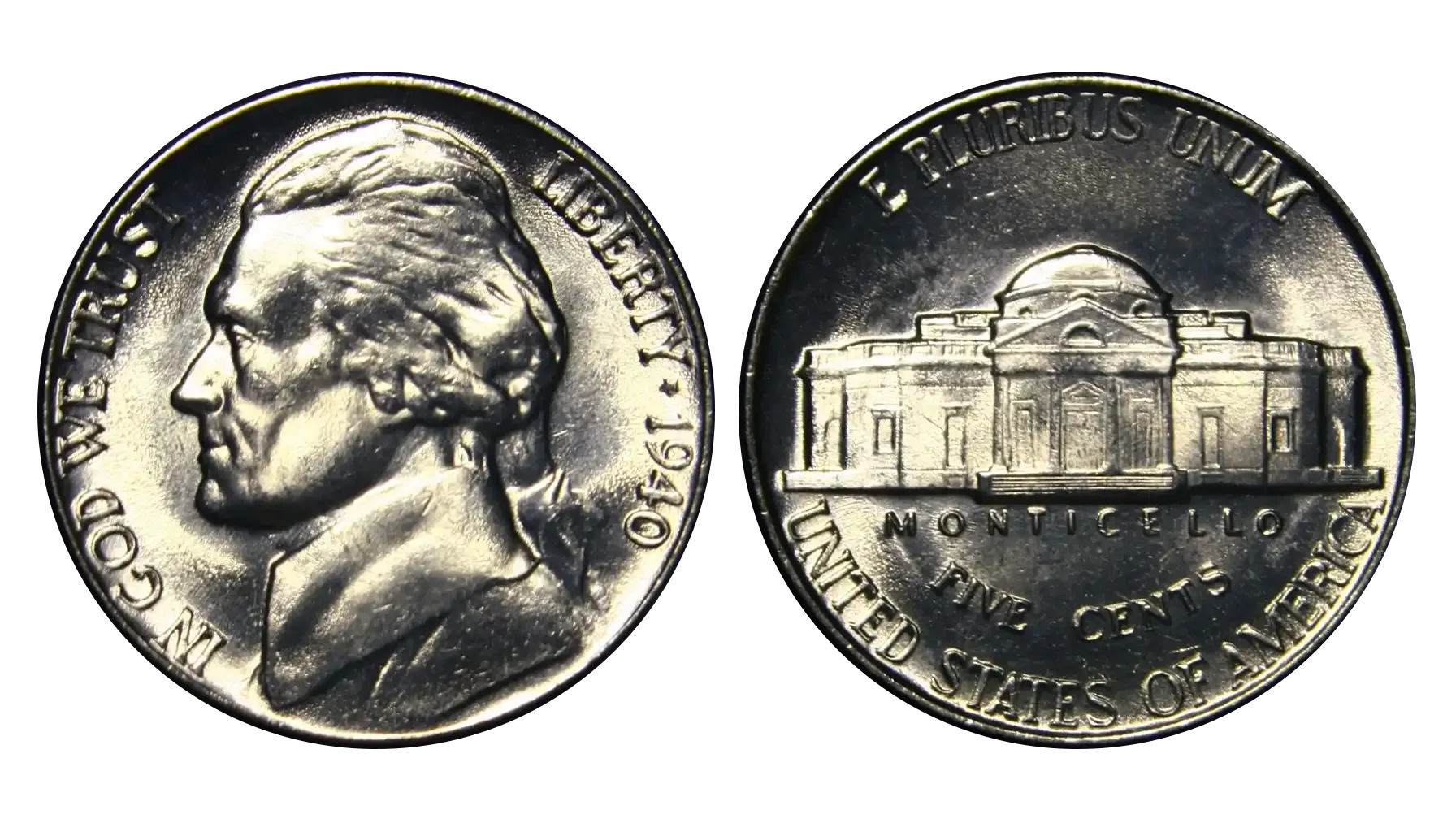
The currency was designed by Felix Schlag, and it displays a noble picture of President Thomas Jefferson on the front (facing left), and his famous Virginia house, Monticello, on the reverse.
Designer | Felix Schlag |
Obverse Image | Portrait of Thomas Jefferson |
Reverse Image | Monticello |
Composition | Copper / Nickel |
Weight | 5.00 g |
Diameter | 21.2 mm |
Edge | Plain |
Attention: Compare characteristics with the 1941 item.
After its official appearance in 1938, this design was used for decades with slight changes. The pre-war composition of 75 % copper and 25 % nickel was used to manufacture the 1940 piece in considerable quantities at three mints: Philadelphia, Denver, and San Francisco.
Item History
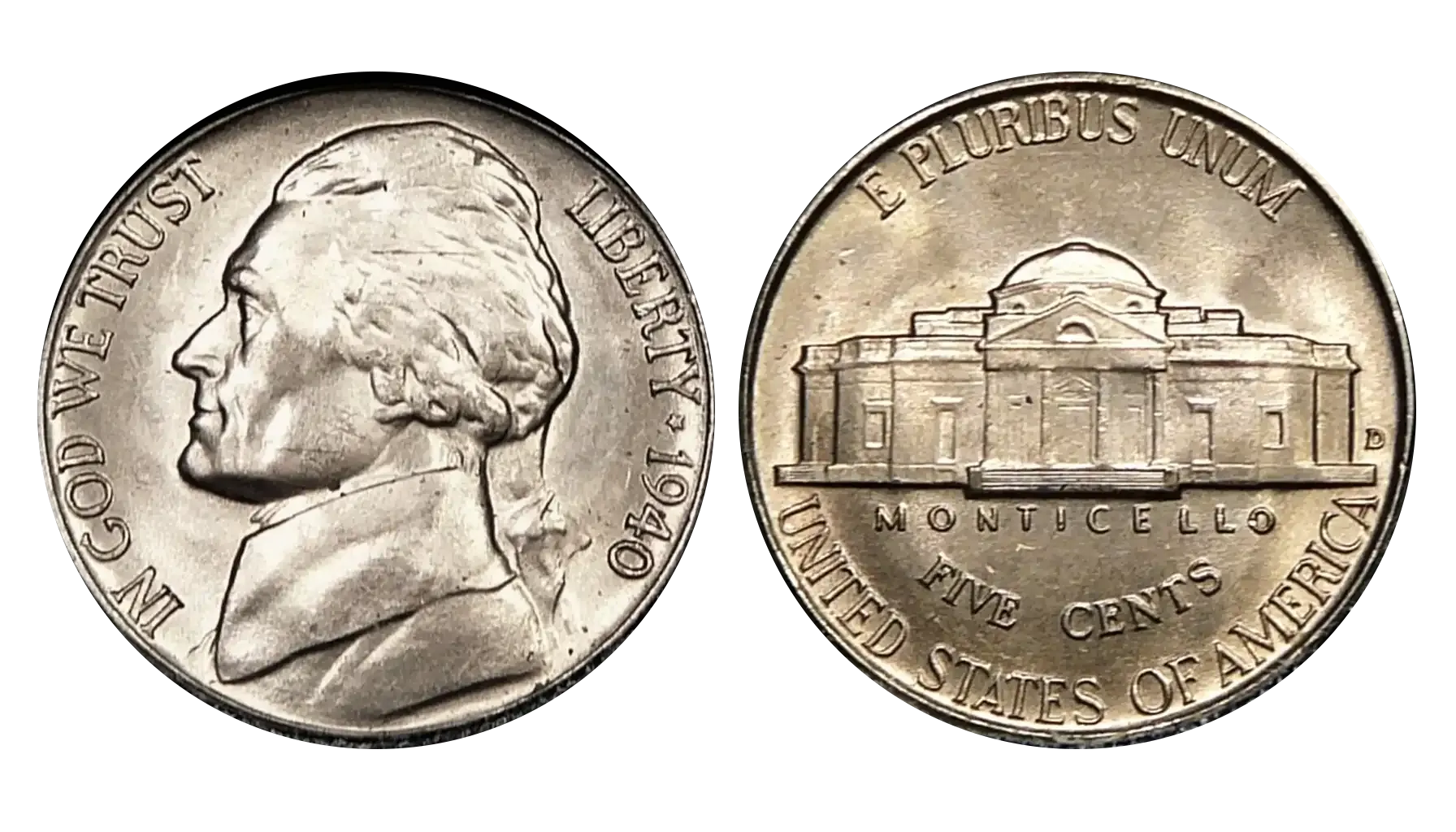
The US Mint produced the items right before America entered World War II. The country was still dealing with the financial drop of the Great Depression. This historical shift directly affected everyday currency.
The old Buffalo series was retired. The new Jefferson five-cent piece replaced it starting in 1938. The reverse shows Monticello, Jefferson’s home. These early minting years established the standard design for the modern US coin.
1940 Nickel Value by Mint Mark
As usual, the US Mint produced the 1940 Jefferson piece in three different locations. To understand the value of 1940 nickel, it is vital to be aware of these mintage figures and the main differences.
Philadelphia
Denver
San Francisco
1940 No Mint Mark Nickel
With a mintage of 176,485,000 coins, the 1940 Nickel no mint mark was the most fruitful site among the three major coin producers. Due to their widespread distribution and lack of mintmark, these 1940 items are rather easy to locate in average circulated conditions.
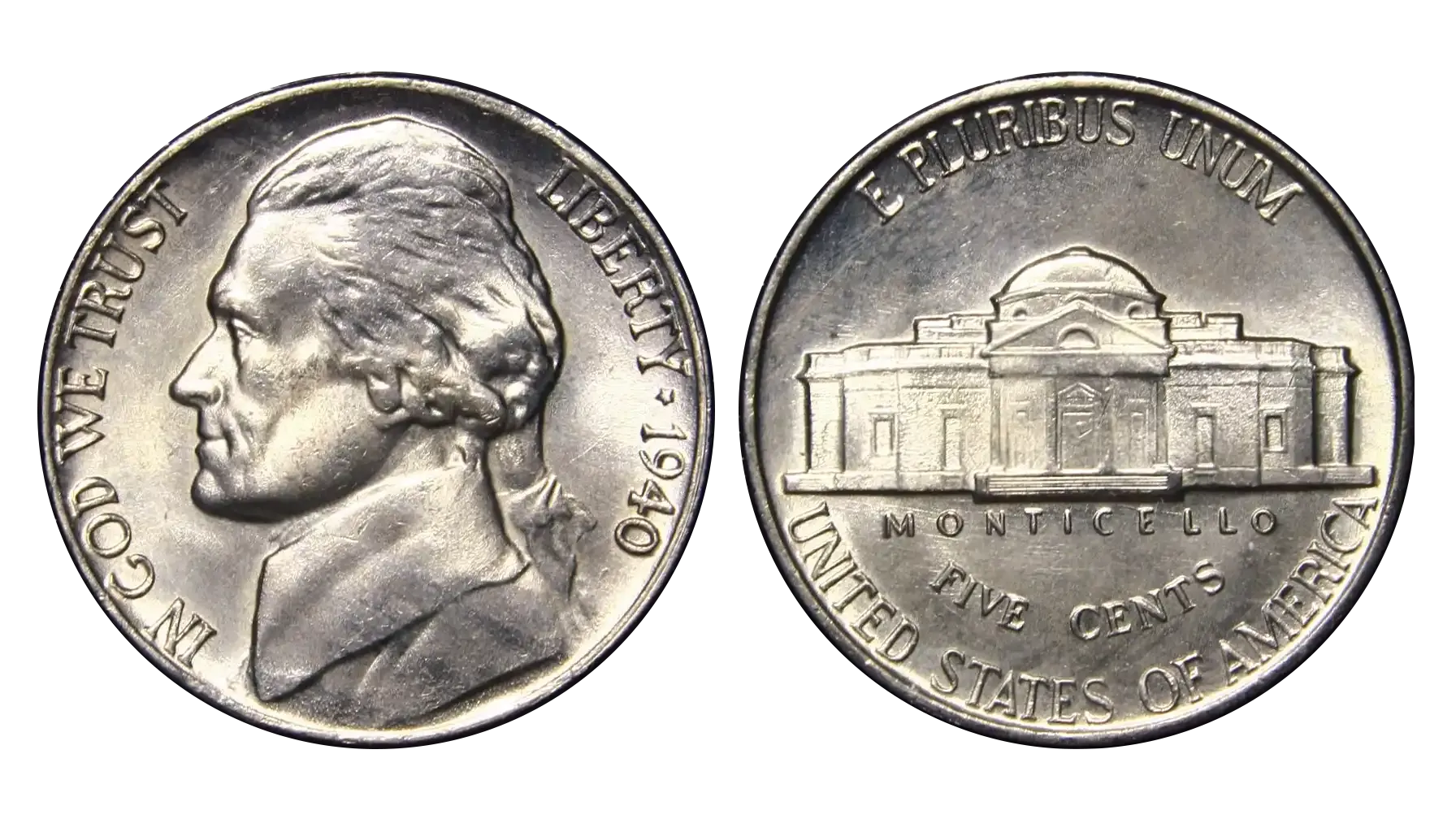
Proof coins (14,158 pieces) were also minted in Philadelphia and bear no mint mark. They were intended specially for collectors, and have mirrored fields and matte frozen relief. When discussing the 1940 nickel value no mint mark, condition is the main factor.
1940-D Nickel Value
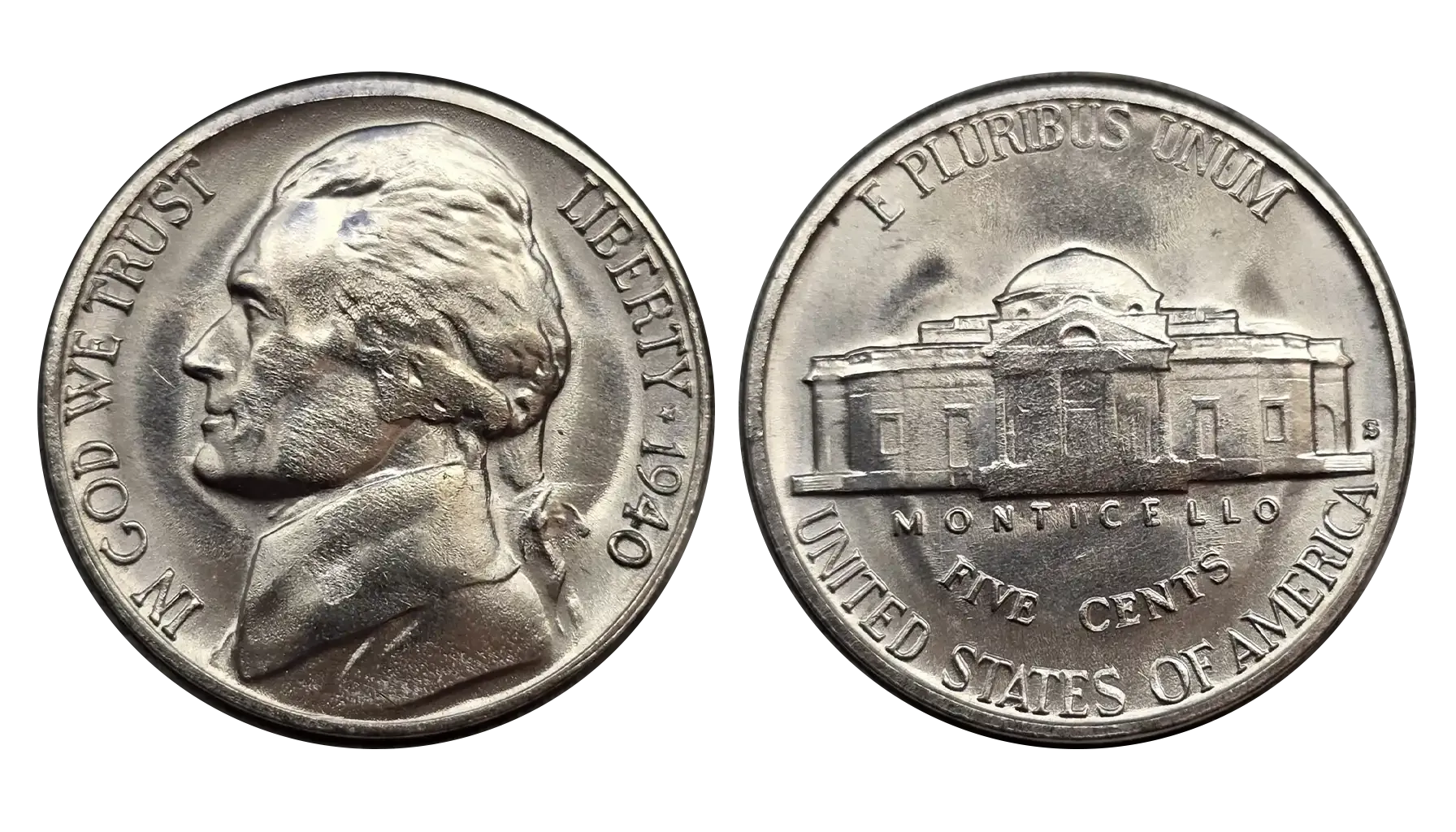
The Denver Mint produced 43,540,000 1940 D nickels in 1940. By the way, what is a 1940 nickel worth, and where is the mark? These may be recognized by the tiny D mintmark on the reverse (to the right of Monticello in particular). The 1940 D can still be a rare find, especially when in better grades. Yet it is more common than some of the early Jefferson items.
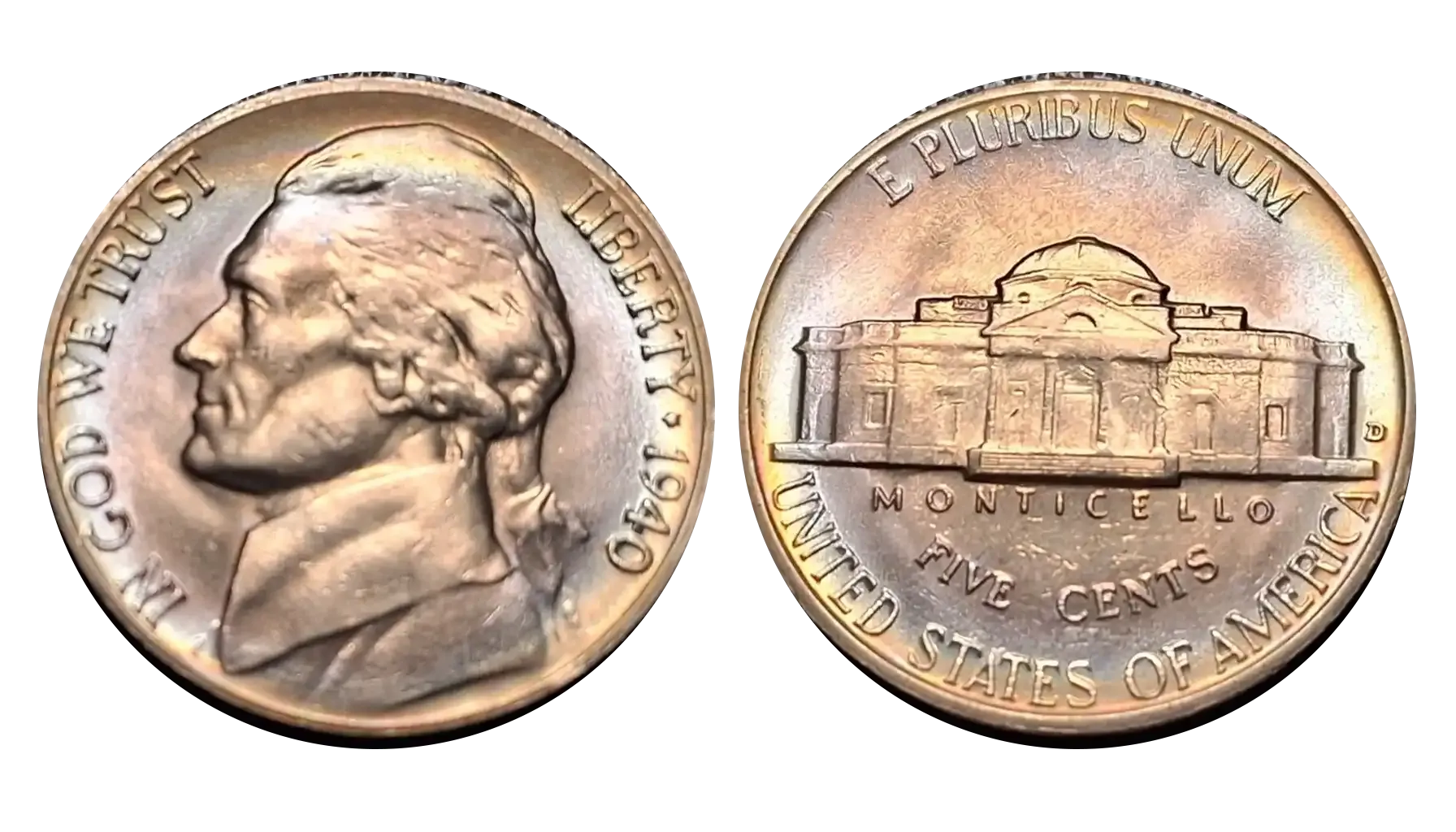
Value follows the same grading pattern, but premiums appear sooner in Mint State. Typical ranges start from $0.30–$3 for circulated ones and reach $70+ for uncirculated examples (and even $120 for FB pieces).
1940-S Nickel Value
The San Francisco Mint produced 39,690,000 pieces. The coins were identified by a tiny S on the back, and, because of their reduced mintage and relative rarity in Mint State, collectors may strive to obtain this version and nothing else instead.
The 1940 S nickel value increases quickly once original luster and sharp steps are present. Circulated coins remain affordable, but Mint State pieces attract steady collector demand.
1940 Nickel Value Chart
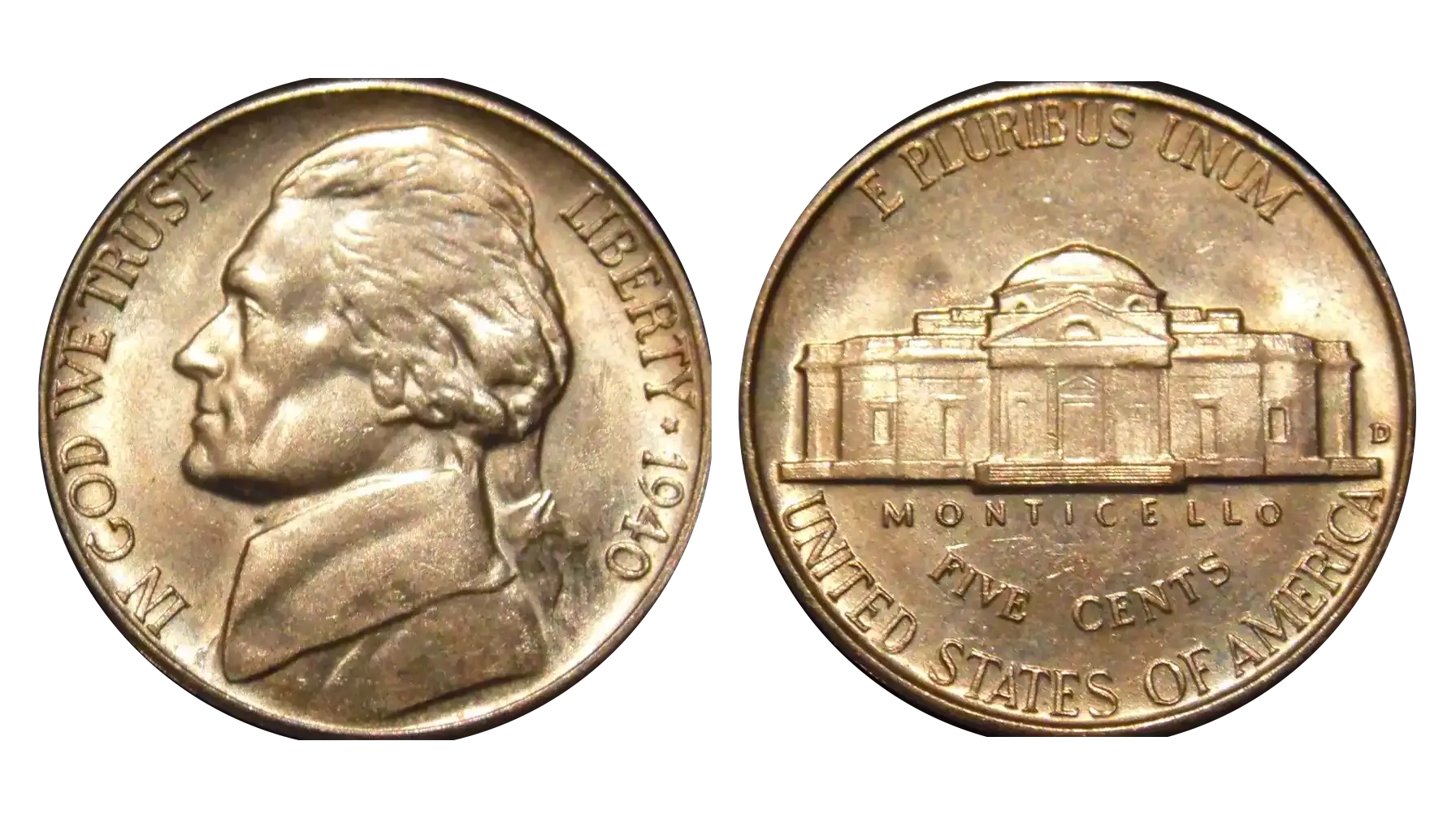
The historical significance of the 1940 Jefferson item cannot be underestimated, but in most cases, the value of a 1940 nickel is affected by its elements in the first place.
In fact, numismatists are able to estimate a 1940 nickel no mint mark value more precisely if they are aware of its mintage, condition, top versions, and unique marks. A detailed explanation of the factors influencing the 1940 Jefferson nickel value may be found below.
Condition and Grading
What's a 1940 nickel worth? To understand the possible price, it is reasonable to appeal to the Sheldon Scale to grade coins, as higher grades may fetch higher rates:
Grade | Description | Marker Ranges |
Circulated (G-4–VF-30) | Visible wear | $0.25–$2 |
Uncirculated (MS-60 / MS-65) | No wear | $6–$45 |
High Grade (MS-66+) | Strong strike & luster | $60–$400+ |
Full Steps MS-65 | Clear steps visible | $120–$250 |
Full Steps MS-67 | Exceptional quality | $900–$2,500+ |
Sometimes, people might wonder what affects the worth of a coin and if it is possible for a price to fluctuate over time. Yes, the 1940s item value cannot be stable, so it is necessary to always check the 1940 nickel value today chart by year to see current trends and market situation. Let us briefly cover which aspects to pay attention to and why it is worth doing it regularly.
Is a 1940 Nickel Silver?
Similar to nearly all U.S. pieces minted since 1866, the 1940 edition is made of cupronickel. It does not contain any precious metals. How much silver is in a 1940 nickel?
The only Jefferson pieces that contain silver are the Wartime Silver pieces produced from mid-1942 through 1945, and not the 1940 silver nickel. These were created to conserve pieces for military use during World War II. Is 1940 nickel silver?
Feature | Standard Item | Silver War Item |
Composition | Copper 75 % | Silver 35 %, Copper 56 %, Manganese 9 % |
1940 Nickel Mint Mark Location | To the right of Monticello | Above the dome of Monticello |
Mint Marks Types | D / S | Philadelphia / D / S |
Appearance | Shiny, yellowish-grey | Greasier feel, darker grey or greenish |
While you are looking at the mint mark area, keep an eye out for Repunched Mint Marks (RPMs). Look for a secondary S peeking out from behind the primary one (S/S). A common variety where the D was struck twice, creating a shadowed or thicker appearance (D/D).
In today's market, an uncirculated 1940-S with a strong Full Steps strike can be worth significantly more than its Philadelphia counterpart due to the lower mintage in San Francisco
39 million vs. Philadelphia's 176 million
Where Is the Mint Mark on a 1940 Nickel?
On a 1940 Jefferson item, the mint mark is located on the reverse of the coin. You should look at the right side of Thomas Jefferson's estate, Monticello. The mint mark is a small letter located in the space between the building and the rim of the coin, just to the right of the building.
How to Identify Your Mint Mark
In 1940, the Philadelphia Mint did not use a "P" mint mark. Depending on where the coin was made, you will see one of the following:
D – a small D to the right of Monticello
S – a small S to the right of Monticello
No Mint Mark – If that area is blank, your coin was struck in Philadelphia
Why the Location Matters
Since you've been tracking technical grading and varieties, it's important to remember that this location changed during the war years. 1938–1942 has a small mint mark to the right of Monticello.
1942–1945 War items have a large P, D, or S that was moved to the top of the dome of Monticello to signal the coin's 35 % silver content. From 1946 to 1964, the mint mark returned to the small spot on the right of Monticello. 1968–Present item’s mint mark was moved to the obverse, near the date.
1940 Jefferson Nickel Error List
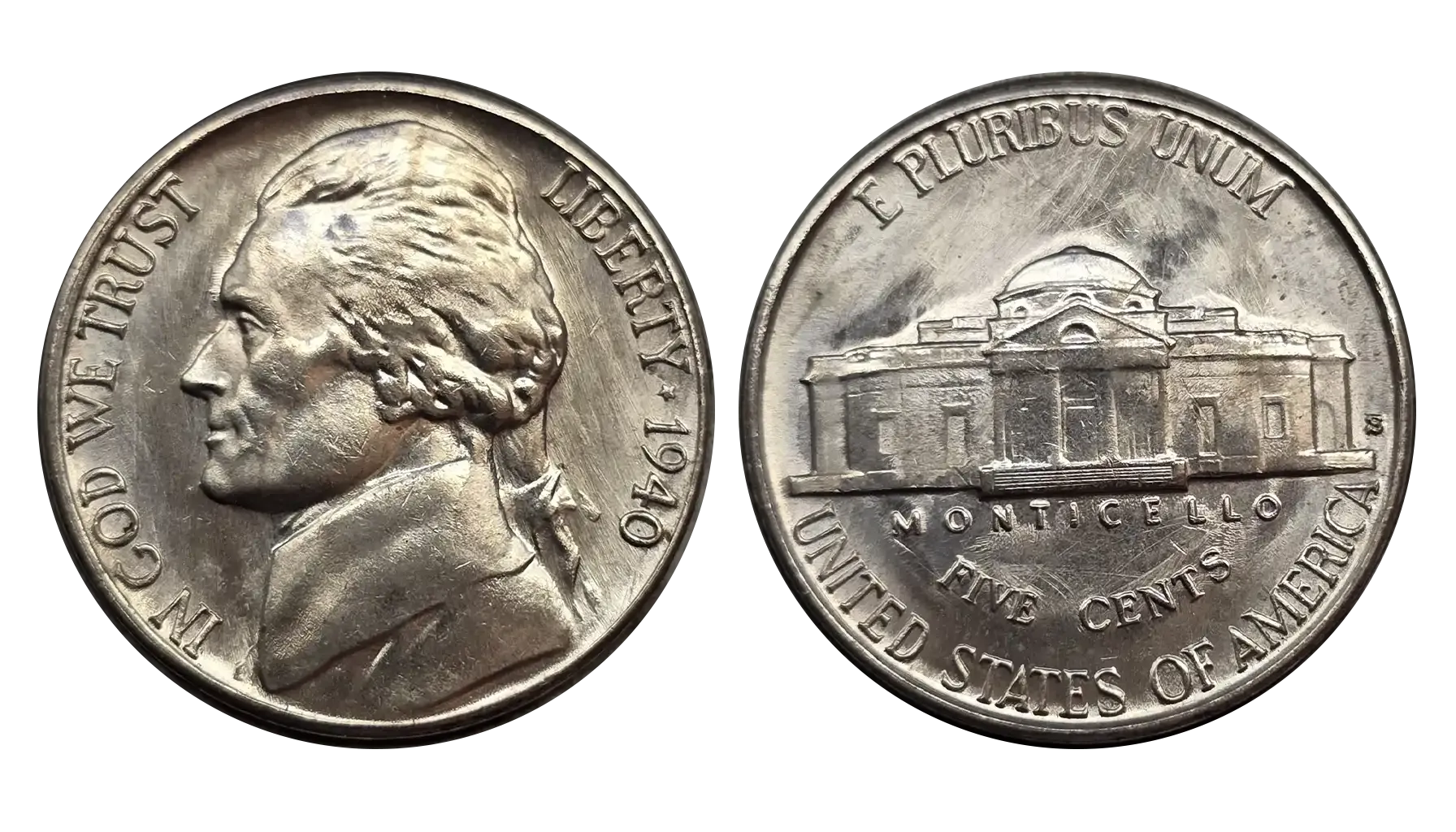
Consistency (=uniformity) always goes hand in hand with numismatics. However, deviations may occur. Here are the most variations (or 1940 nickel error list, if you like) that one may find intriguing to obtain.
Repunched Mintmarks (RPM): Known examples are 1940-S/S; 1940 D nickel value D are among the list of rare errors, 1940 items are worth money. When there appears a little doubling effect caused by the "D" or "S" being stamped more than once, it is usually called a repunched mintmark. These can definitely raise a coin's value and represent a popular variety sought after by collectors worldwide.
Full Steps Varieties: Not actually an error. The "Full Steps" variation is a must-have option for those who appreciate quality over anything else. A 1940 cent featuring "Full Steps" means that Monticello's steps are distinct, with at least five (ideally six) lines running continuously. Since it is difficult to strike Jefferson pieces with clearly defined steps, these coins are uncommon in high grades and tend to fetch a premium price in the market.
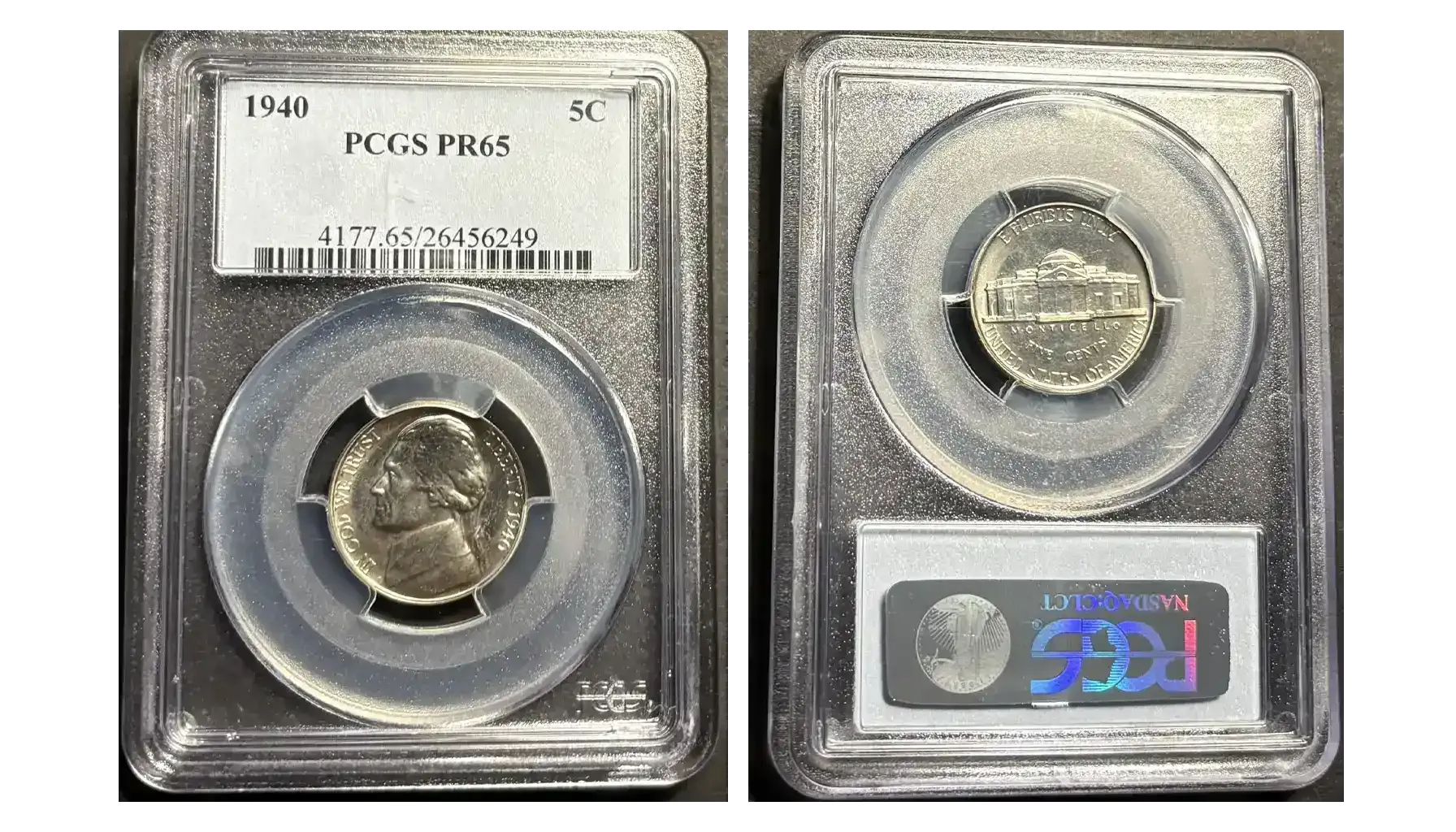
Die Cracks and Minor Errors: While not as common as other types of errors, clashed dies or die cracks may add a character to a coin collection and become your local fascination to experienced collectors.
Lamination errors: areas where the metal separates or peels due to flaws in the alloy strip before striking.
Struck-through errors: caused by a foreign object or debris between the die and the planchet during striking, leaving an unusual impression.
Clipped planchets: coins struck on incomplete blanks where part of the metal disc was missing before minting.
Most of these errors are not unique to 1940 issues. They are typical of coins produced during the era when mintmarks were punched by hand, and quality control relied more on manual inspection than modern automation.
If you like to find an error specimen, read also about other misprinted coins.
Is a 1940 Nickel Worth Anything?
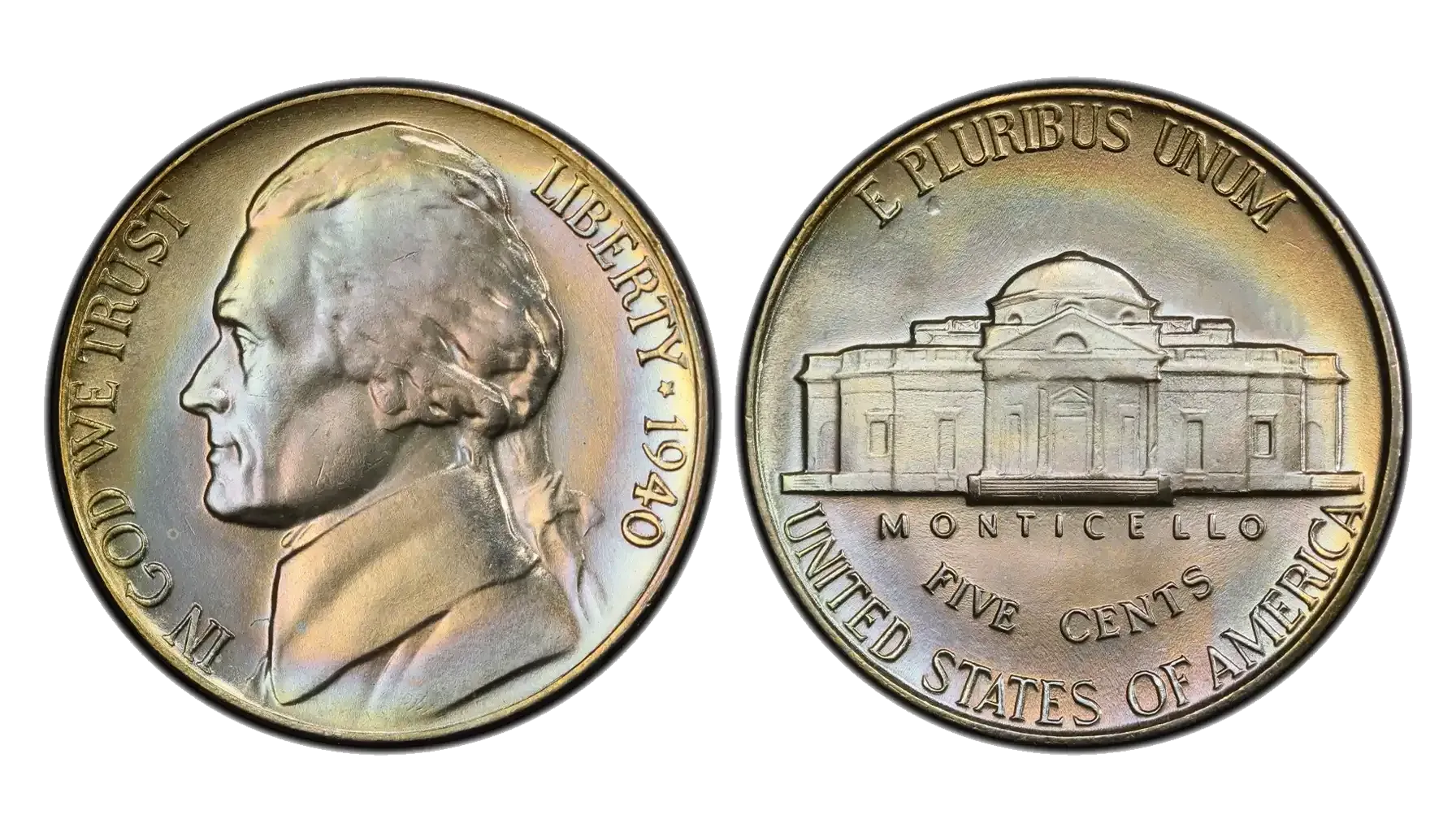
Historical Significance: The 1940 item was struck shortly before the US entered World War II, though this could have been predicted ahead of these devastating events. This coin, as well as other relics of that time, portrays the last years of serenity before the needs of war changed the normal order of things (the coinage's composition included). This puts it among the last items made with the conventional copper-nickel alloy before the introduction of war pieces in 1942.
Classic Design by Felix Schlag: In 1938, it was announced the winner in the national competition of the Jefferson item design, and it was Felix Schlag. This work honors Thomas Jefferson's legacy by artfully featuring a left-facing face of Jefferson on the obverse and his residence, Monticello, on the reverse.
“German émigré and American artist Felix Oscar Schlag was the winner, receiving $1,000 for his effort.”
– Charles Morgan and Hubert Walker, Authors
CoinWeek Notes
Transition in Coinage: In terms of US coinage, the 1940 Jefferson nickel represents an important moment of transition. Although the proportions remained at 75% copper and 25% nickel, the demands of World War II would soon require a brief change in composition. The 1940 issue is one of the final ones made before the US Mint switched from nickel to manganese and silver in order to preserve vital metals for the course of the war effort.
Accessibility and Affordability: Surprisingly enough, the 1940 nickel is still widely available and reasonably priced. For sure, it is a great place for collectors to start because it is comparatively easy to find in circulated grades. At the same time, experienced numismatists have the chance to seek out well-preserved FS instances thanks to the presence of higher-grade samples.
How Much Is a 1940 Nickel Worth in Circulation?
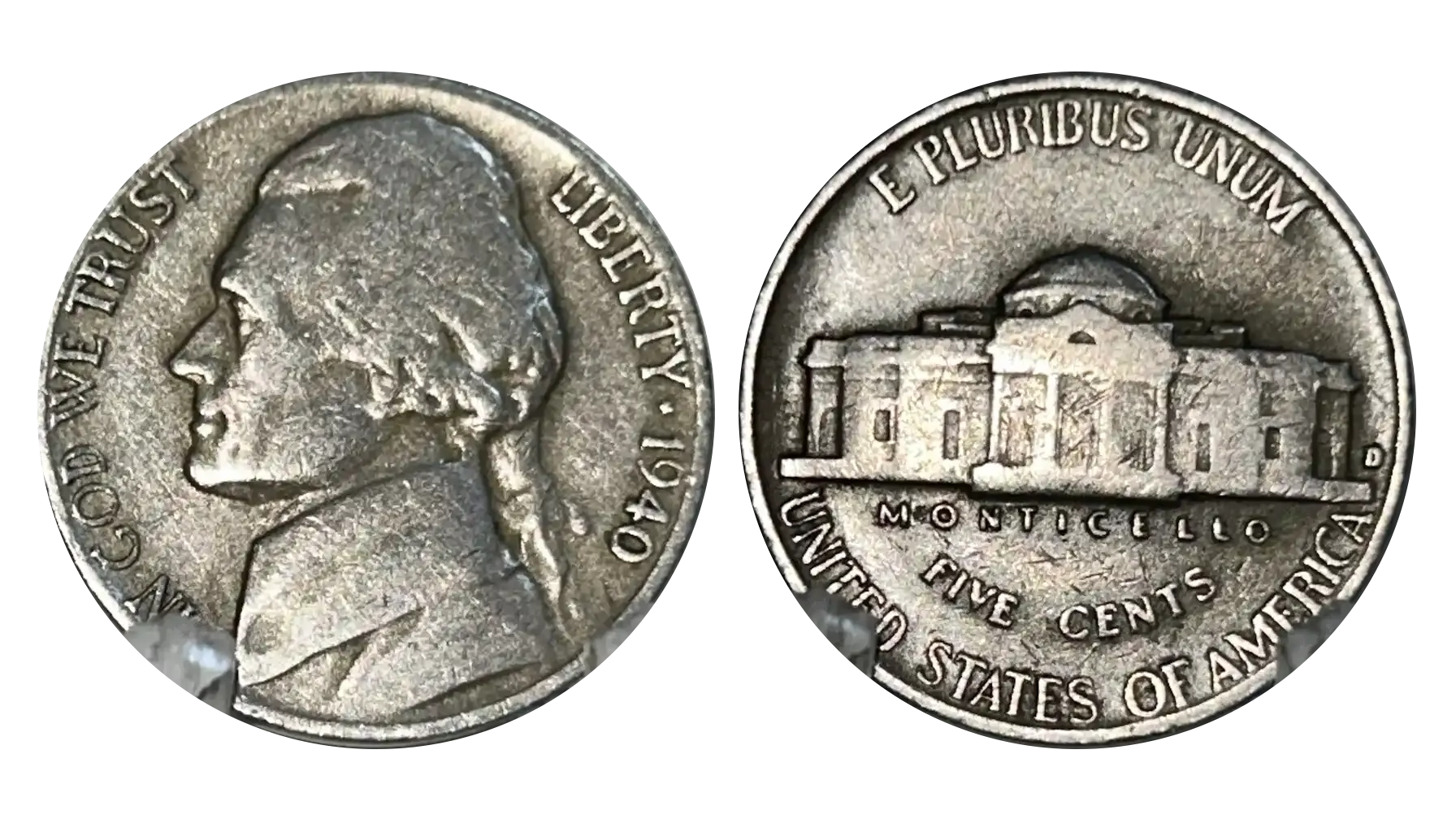
A 1940 Jefferson Nickel that shows average signs of circulation is usually worth between $0.15 and $1.00. The price varies depending on which mint made the coin. Over 250 million of these nickels were minted, so they are not considered a rare type of coin. The market value is still higher than the coin’s face value of five cents.
Philadelphia – 176.4 Million ($0.15–$0.40)
Denver – 43.5 Million ($0.25–$0.90)
San Francisco – 39.6 Million ($0.40–$1.25)
Since you are tracking the 2001 date errors and other minute anomalies, check your D nickels for a Repunched Mint Mark (RPM). There is a specific variety where the D is clearly doubled. In the current market, these minor errors are becoming more popular with collectors who use high-definition digital magnification to verify their finds.
How to Identify a Valuable 1940 Nickel
Check the Full Steps defect immediately. The skyrocket value factor for a 1940 nickel is the strike quality on the reverse. Locate the steps at the base of Monticello. To earn the Full Steps designation from services like PCGS or NGC, you must see 5 or 6 crisp, horizontal lines that are not interrupted by scratches or strike weakness.
How to Manage Your Collection?
A coin collection grows faster than expected. At some point, simple notes stop working. Collectors return to coins again and again to confirm details, compare pieces, or recheck data such as the 1940 nickel silver content. Doing this through catalogs or scattered web pages takes time and often leads to confusion.
Many collectors now use digital tools to keep everything organized. A quick scan replaces long searches and helps avoid misidentification, especially when comparing close dates or researching topics like 2021 quarters or the 1949 nickel value no mint mark, where small differences matter.
FAQ
Are 1940 nickels made of silver?
The item composition contains nickel 25 % and copper.
Do all 1940 nickels have mint marks?
Only the mints that do not have a mint mark are Philadelphia items.
What is the value of a 1940 D Jefferson nickel?
The ordinary item has a cost ranging from $0.25 to $1.25 USD.
Is there a rare 1940 nickel?
The extraordinary piece has a Reverse of 1938 defect and Full Steps.
What errors can be found on 1940 nickels?
A lot of traditional anomalies can be found, for example, DDO or RPM.
Is there a rare 1940 nickel?
The rarest one defect is Reverse 1938 and Full Steps.
Why is a 1940 nickel worth so much?
Some of them have a flawless condition with Full Steps, or your item is Proof.
What is my 1940 nickel worth?
The shiny one can be worth $15 USD.

 Facebook
  X (Twitter)
  Pinterest
  LinkedIn