Contents:
- 1964 Penny Value Chart (Updated Prices)
- How to Find the Value of Your 1964 Penny
- Value by Mint Mark: Denver (D), Philadelphia (P), and San Francisco (S)
- Rare 1964 Penny Varieties and Errors to Look For
- How Condition and Grade Drastically Affect 1964 Penny Value
- The Story Behind the 1964 Penny: A Unique Year in US Mint History
- 1964 Lincoln Penny Specifications
- Composition: Are 1964 Pennies Copper?
- Mintage Figures and Collector Tips for the 1964 Penny
- Was There a 1964 Wheat Penny?
- FAQ: 1964 Penny Value
A rare 1964 Special Mint Set SMS penny in top grades sold for over $40,000 at auction.
"For 1964 cents, the jump from MS-65 Red to MS-67 Red is where rarity really kicks in. Population drops sharply, and prices can triple or more. Don't assume all reds are equal—check certified populations and recent auction comps." — Laura Bennett, Senior Numismatic Analyst, Coin ID Scanner
1964 Penny Value Chart (Updated Prices)
Values show current market data from PCGS, NGC, and Greysheet from late 2025.
| Mint Mark | Grade | Average Value |
|---|---|---|
| 1964 No Mint Mark | Good-Fine | $0.02-$0.10 |
| 1964 No Mint Mark | MS-63 | $1-$3 |
| 1964 No Mint Mark | MS-65 Red | $10-$25 |
| 1964-D | Good-Fine | $0.02-$0.10 |
| 1964-D | MS-63 | $1-$3 |
| 1964-D | MS-65 Red | $10-$25 |
Expanded Grade Matrix:
| Type | MS-60 | MS-63 | MS-65 | MS-66 | MS-67 |
|---|---|---|---|---|---|
| 1964 (P) BN | $0.30 | $1 | $5 | $25 | $400 |
| 1964 (P) RB | $0.50 | $1.50 | $8 | $40 | $750 |
| 1964 (P) RD | $1 | $3 | $15 | $75 | $1,500 |
| 1964-D BN | $0.30 | $1 | $4 | $15 | $200 |
| 1964-D RB | $0.50 | $1.50 | $6 | $25 | $400 |
| 1964-D RD | $1 | $3 | $12 | $50 | $800 |
| 1964 Proof PR-65 | — | — | $5 | — | $15 |
| 1964 Proof PR-69 | — | — | — | — | $75 |
| 1964 SMS SP-65 RD | — | — | $9,600 | — | $19,200 |
Note: Prices change based on the coin color. Brown and Red-Brown coins in the same grade sell for less than full Red coins. MS-67 Red and higher grades are very rare. Prices reach $250-$7,931 or more at big auctions. SMS pennies in SP-67 Plus Red sold for $19,200 recently. PCGS lists the SP-68 Red value at $75,000 because the coin is very rare and collectors want it..
Sources: PCGS Price Guide (PCGS #2890 for 1964 RD, #2893 for 1964-D RD), NGC Price Guide, Heritage Auctions archives (January 2025 SP-67 RD SMS $19,200; February 2025 MS-67+ RD $6,356), Stack's Bowers sales data.
How to Find the Value of Your 1964 Penny
Determining value is straightforward if you follow these steps:
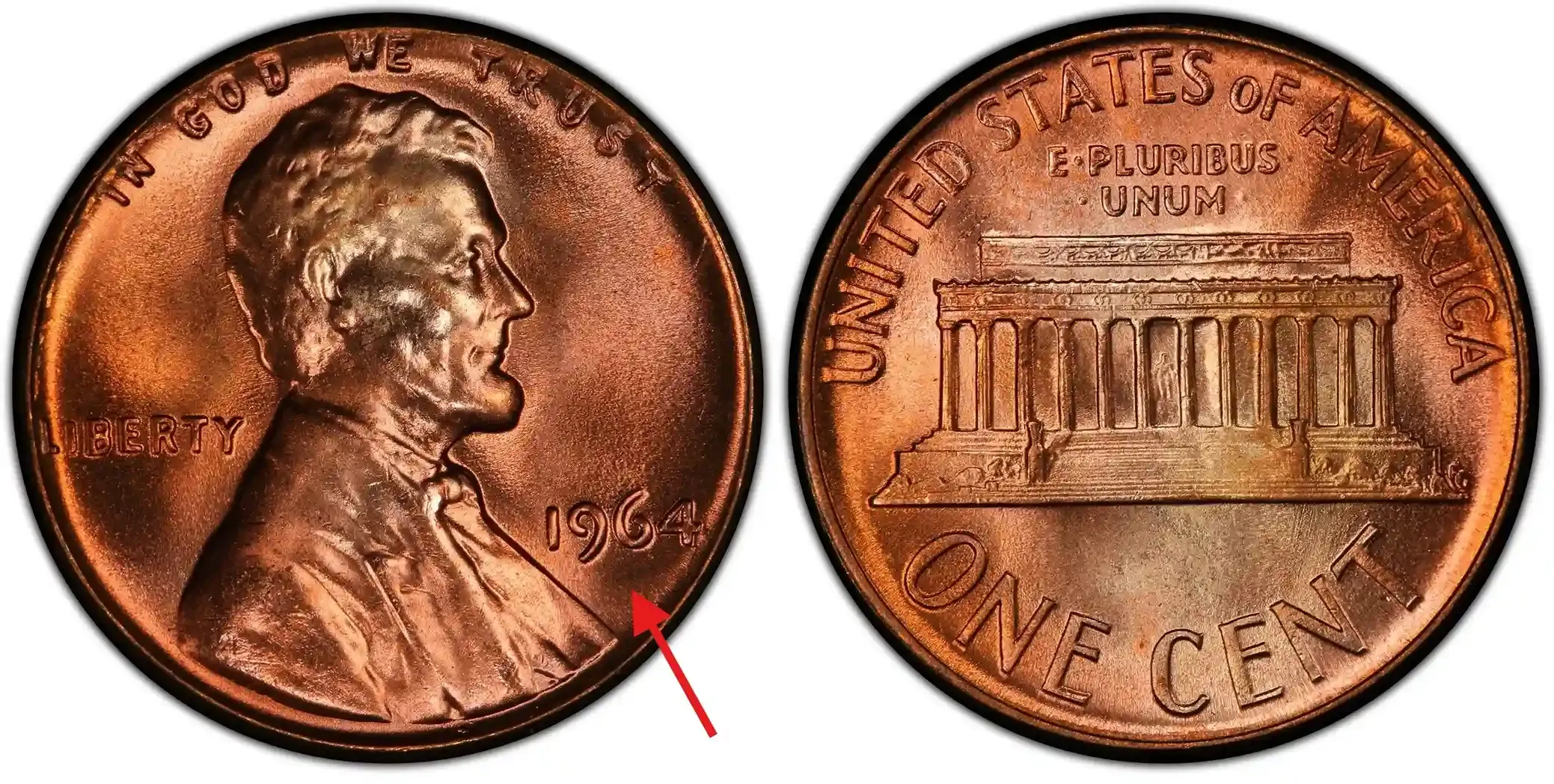
- Check the mint mark: Look below the date on the front of the coin. No mark means Philadelphia. A D mark means Denver.
- Assess condition: Is the coin worn or does it have full original shine? Red color means the coin has at least 95% of its original copper metal shine.
- Look for varieties and errors: Search for doubled dies, repunched mint marks, off-center strikes, or wrong metal blanks. These errors can add a lot of value.
- Compare to current price guides: Check PCGS CoinFacts, NGC Price Guide, or Greysheet for current values.
- Don't clean the coin: Cleaning removes the original metal shine and surface quality, reducing coin value. Professional grading companies easily see cleaned coins, giving them a Details grade. This grade hurts coin value and makes it hard to sell.
- Consider certified grading: For high value coins like MS-65 Plus Red, SMS coins, or big errors, professional grading from PCGS or NGC is important to get the best price.
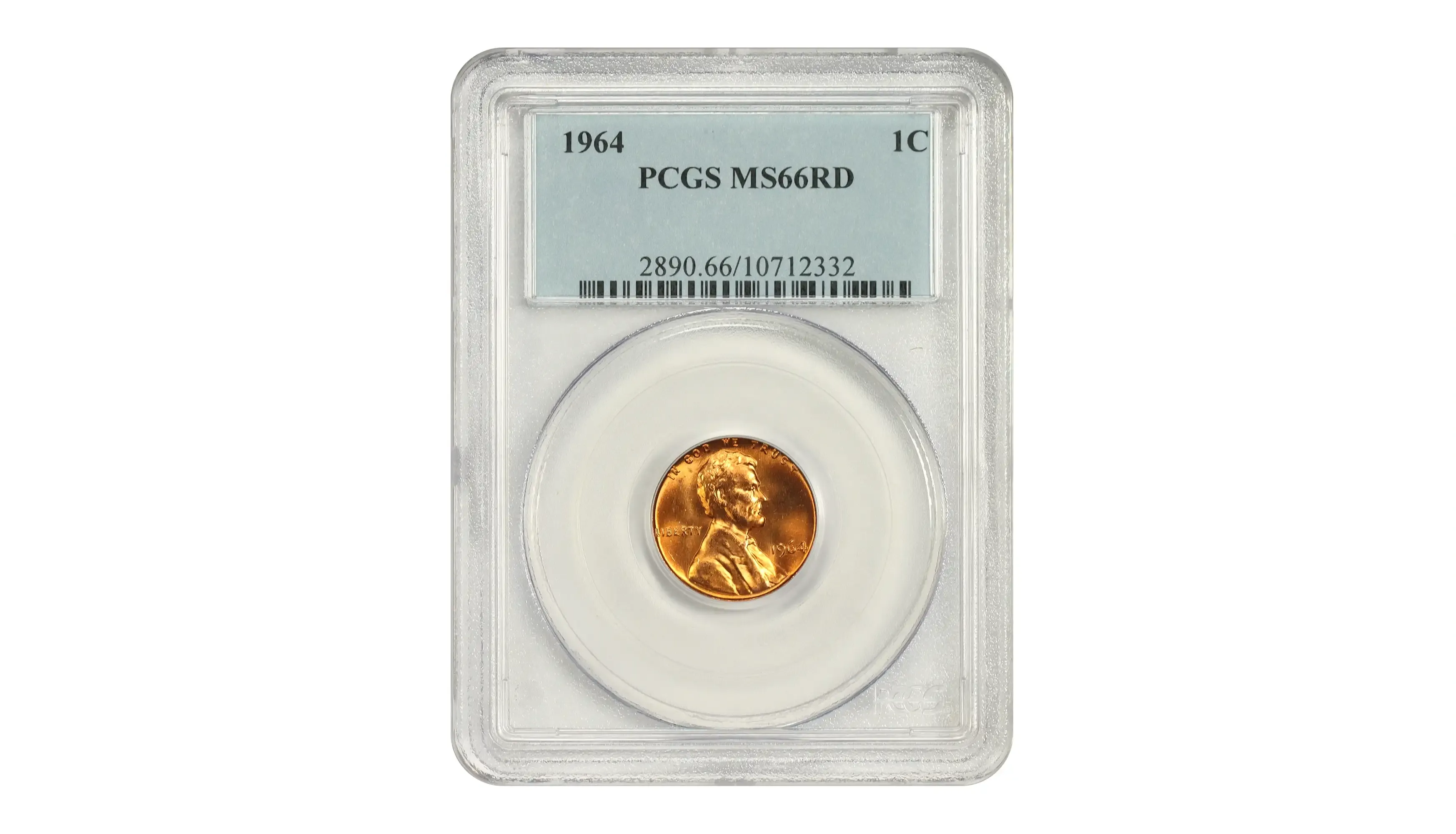
Value by Mint Mark: Denver (D), Philadelphia (P), and San Francisco (S)
1964-D Penny Value
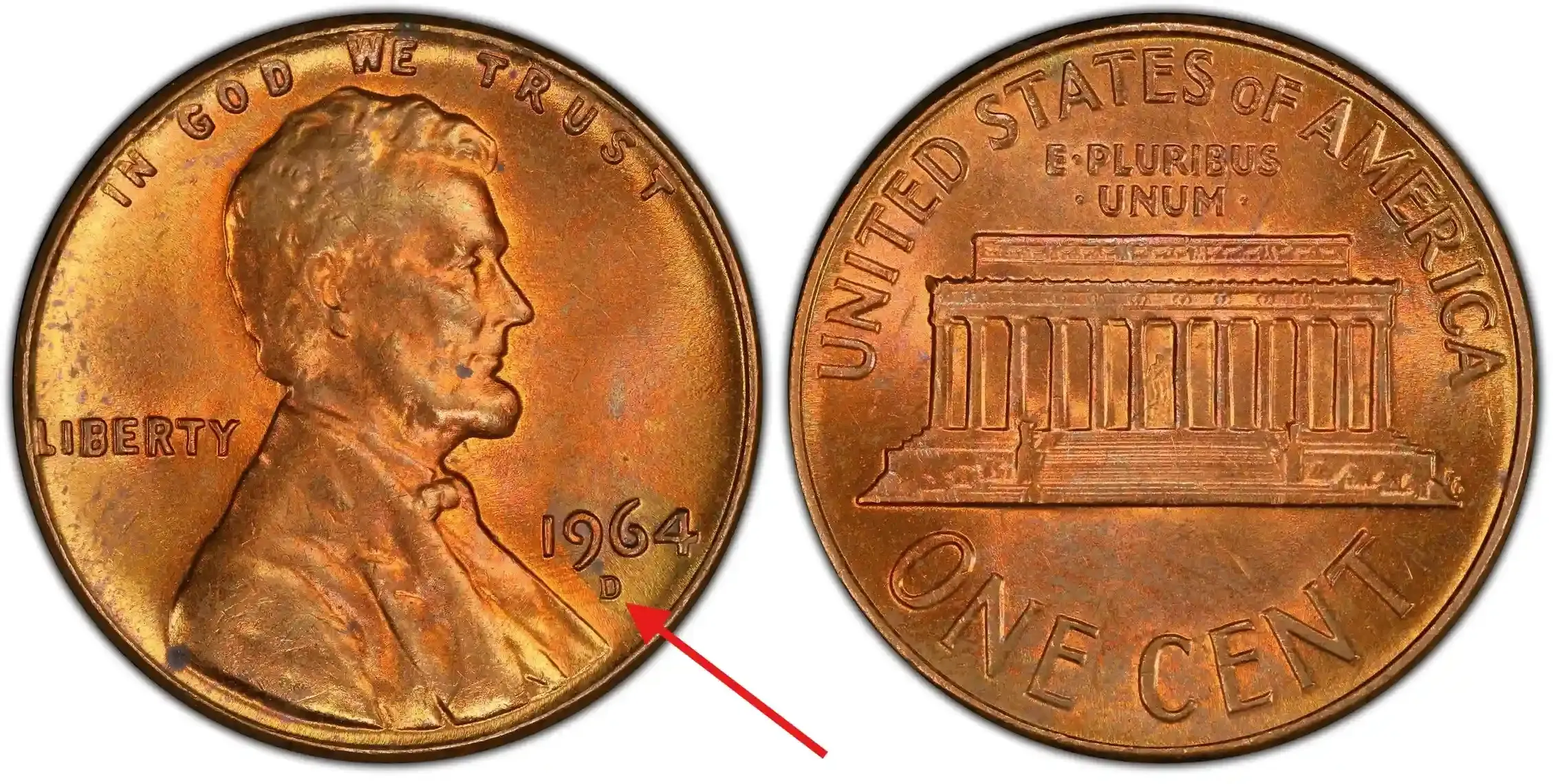
The 1964-D penny from Denver has a small D mint mark on the front side, just below the date. Denver made nearly 3.8 billion cents in 1964, according to official U.S. Mint data. This high production keeps the value of worn coins very low.
Most sell for $0.02-$0.10 based on the copper metal content. Uncirculated coins sell for $1-$3 in MS-63 grade, and strong red coins in MS-65 Red grade can reach $15-$25.
High grade coins in MS-67 Red and higher are very rare. PCGS reports show very low numbers of these coins. In January 2026, PCGS recorded 26 coins in MS-67 Red and only 9 coins in MS-67 Plus Red. This low supply drives prices to hundreds or thousands of dollars for certified top coins.
Look for repunched mint marks on Denver cents. These small errors can add $5-$50 depending on how clear they are and the coin grade. For details about these errors, check the Variety Vista or CONECA databases. Exact error numbers like FS-501 or CONECA DDO-001 are listed in those sources but are not included in this guide.
Professional grading helps with high grade Denver pennies. A raw MS-67 Red coin is hard to sell, but a PCGS or NGC holder proves the coin is real and has the correct grade.
Population Snapshot (PCGS, January 2026):
| Grade | Population |
|---|---|
| MS-67 RD | 26 |
| MS-67+ RD | 9 |
Source: PCGS CoinFacts #2893.
1964 Penny Value No Mint Mark
A 1964 penny with no mint mark comes from the Philadelphia Mint. The mint made over 2.6 billion of these coins, making them the most common Lincoln cents from this time. Worn coins have a value of $0.02-$0.03 based on the copper metal price. Uncirculated coins in MS-63 grade sell for $1-$3.
Red coins in MS-65 grade sell for $10-$20. MS-67 Red coins can sell for $250-$1,000 depending on the look of the coin and the grading company. Philadelphia cents usually cost less than Denver cents in top grades. The difference is small because both mints made massive numbers of coins. High rarity only exists for coins in top condition.
To find the value, compare the coin surfaces, shine, and errors to recent auction sales instead of simple price guides. The true coin value depends on market timing, buyer interest, and the grading company.
Population Snapshot (PCGS, January 2026):
| Grade | Population |
|---|---|
| MS-67 RD | 37 |
| MS-67+ RD | 3 |
Source: PCGS CoinFacts #2890.
The 1964-S Penny Mystery
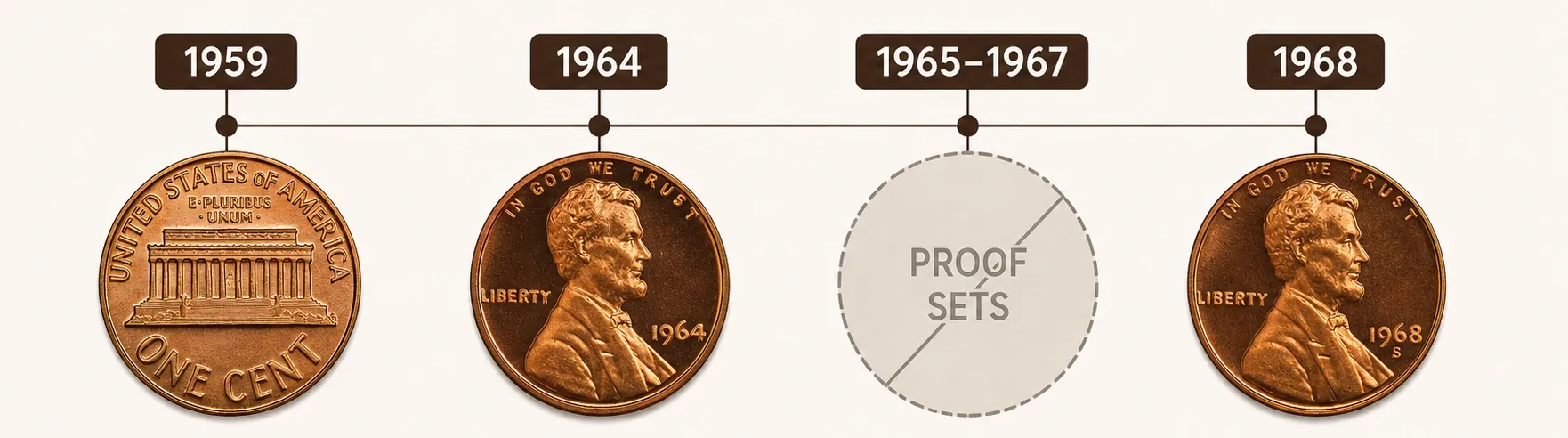
San Francisco did not make regular 1964 pennies for daily circulation. All regular coins came from Philadelphia and Denver. Any 1964-S coin shown online is an error, an altered coin, or a mistake about proof coin production.
Myth vs Fact:
| Myth | Fact |
|---|---|
| "1964-S proof/regular exists" | 1964 proofs in Philadelphia (no mark); S resumes 1968 |
| "1964 — last year 95% copper" | 1962-1982 — 95% copper; composition change mid-1982 |
| "Small/Large Date 1964 varieties" | No confirmed Small/Large Date for 1964; this is a 1960 variety |
Do not trust claims about a 1964-S regular coin. The U.S. Mint historical records, PCGS CoinFacts, and the book named A Guide Book of United States Coins also called the Red Book confirm that San Francisco made no regular coins in 1964..
Sources: U.S. Mint historical documentation, PCGS CoinFacts, Red Book (A Guide Book of United States Coins).
Rare 1964 Penny Varieties and Errors to Look For
The Ultra‑Rare 1964 SMS Penny
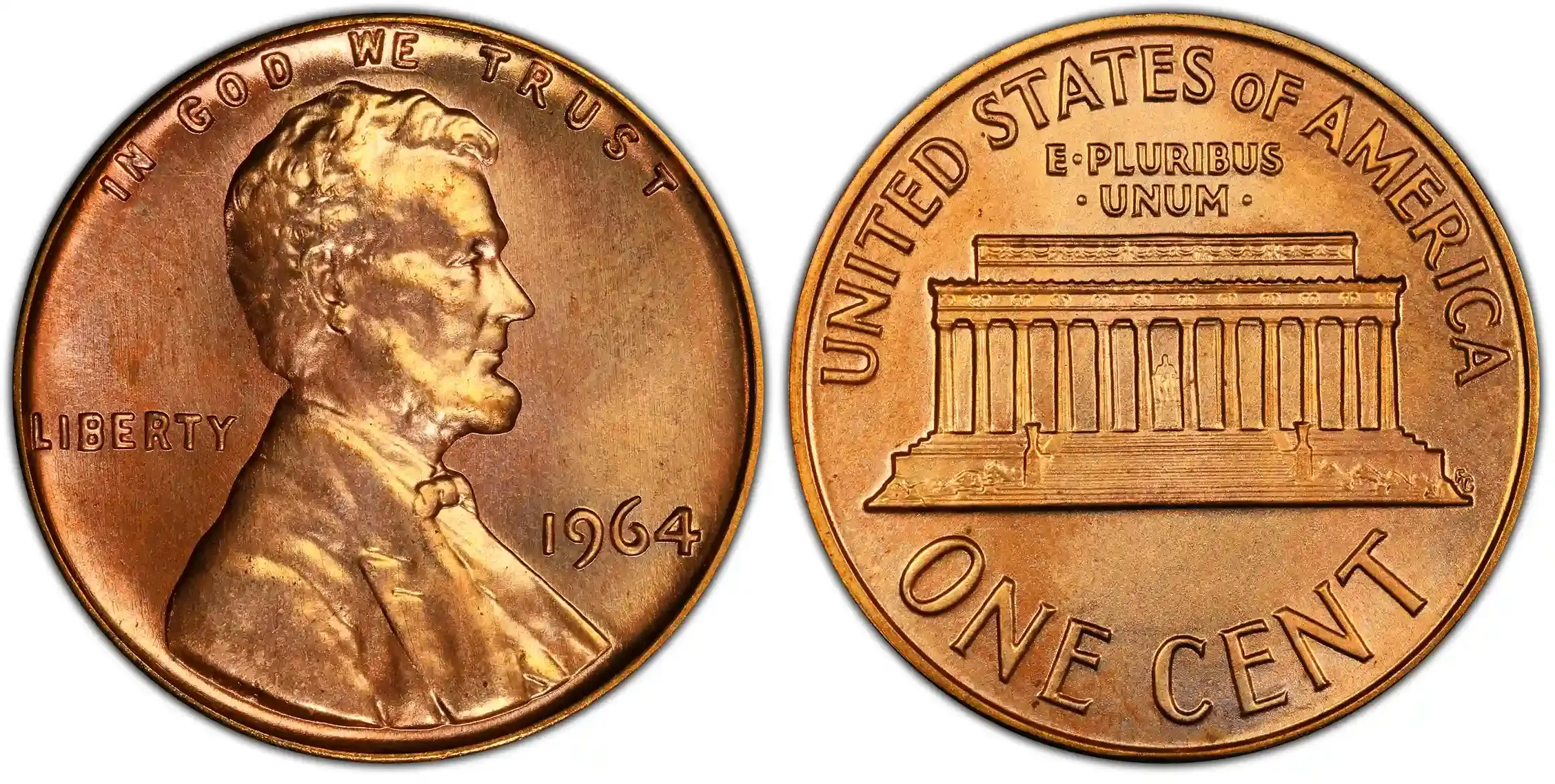
The 1964 SMS Special Mint Set penny is one of the rarest and most valuable types in the Lincoln cent group. SMS coins have a satin-like shine, sharp edges, strong design details, and polished coin dies.
These details are different from regular coins and traditional proofs. Only 20 to 50 complete sets exist, and PCGS certified 20 SMS cents up to January 2026. This small number makes any 1964 SMS penny very rare.
Certified SMS pennies sell for over $10,000 at auctions. In August 2025, a 1964 SMS SP-65 Red coin sold for $9,600 at Heritage Auctions.
A January 2025 auction sold an SP-67 Red coin for $19,200. PCGS values top SP-68 Red coins at $75,000 because they are very rare and collectors want them.
To find an SMS coin, look for a smooth satin finish, sharp square edges, and clean coin surfaces with very few marks. Professional certification is very important because many people mistake regular coins in great condition for SMS coins. Send suspected SMS cents to PCGS or NGC for expert checking.
Important: People have never found SMS cents in daily change or standard 1964 sets. A clear history showing the coin came from the estate of Mint Director Eva Adams is required to prove the coin is real.
SMS Diagnostic Checklist:
- Satin surfaces, not mirrored
- Squared, sharp rims with a wire edge effect
- Great strike detail showing Lincoln hair strands and Memorial steps
- No mint mark
- History from the Adams estate
Sources: Heritage Auctions (January 2025, SP-67 RD $19,200; August 2025, SP-65 RD $9,600), PCGS CoinFacts (SP-68 RD valuation $75,000).
1964 Proof Penny Value
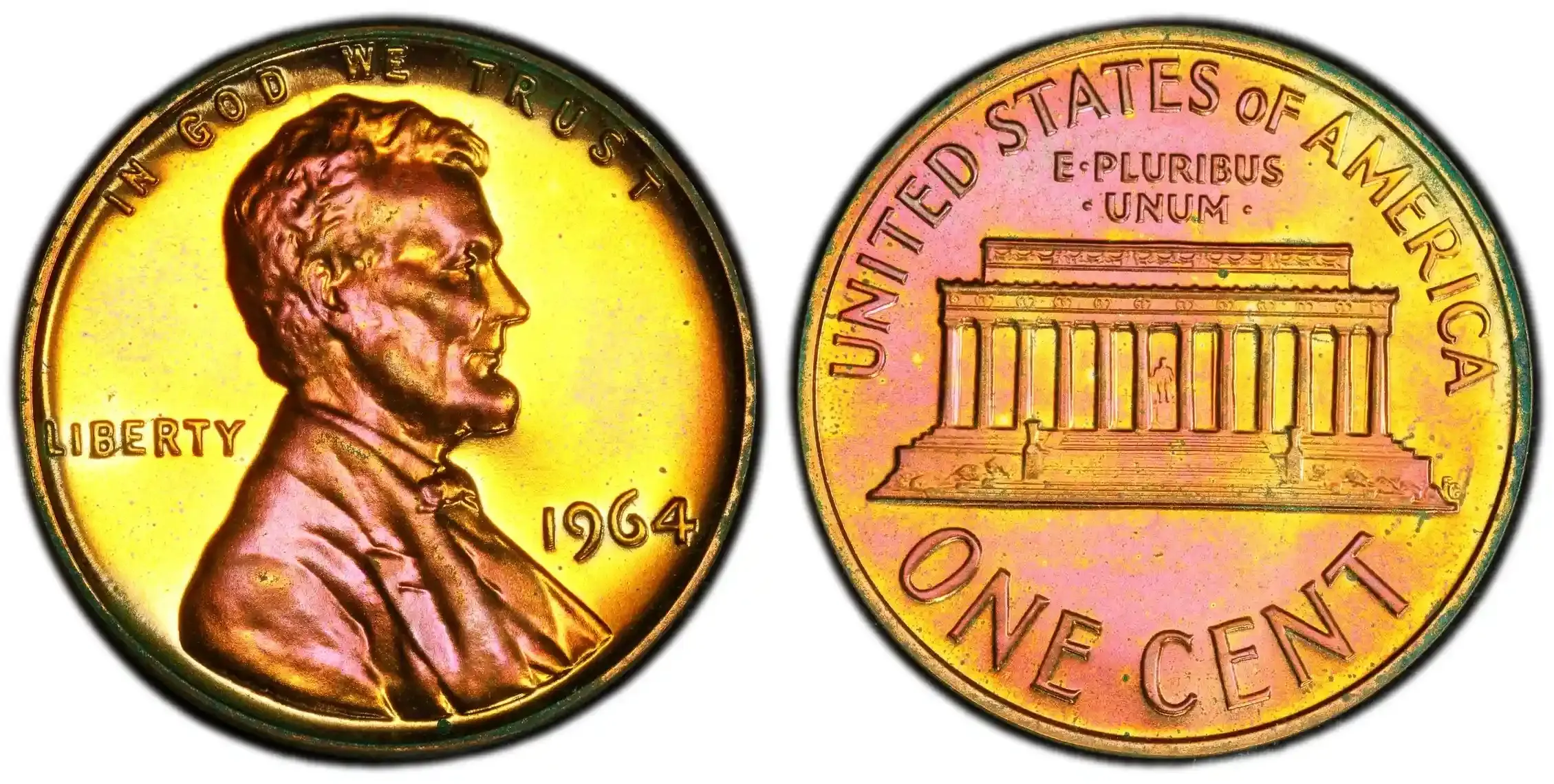
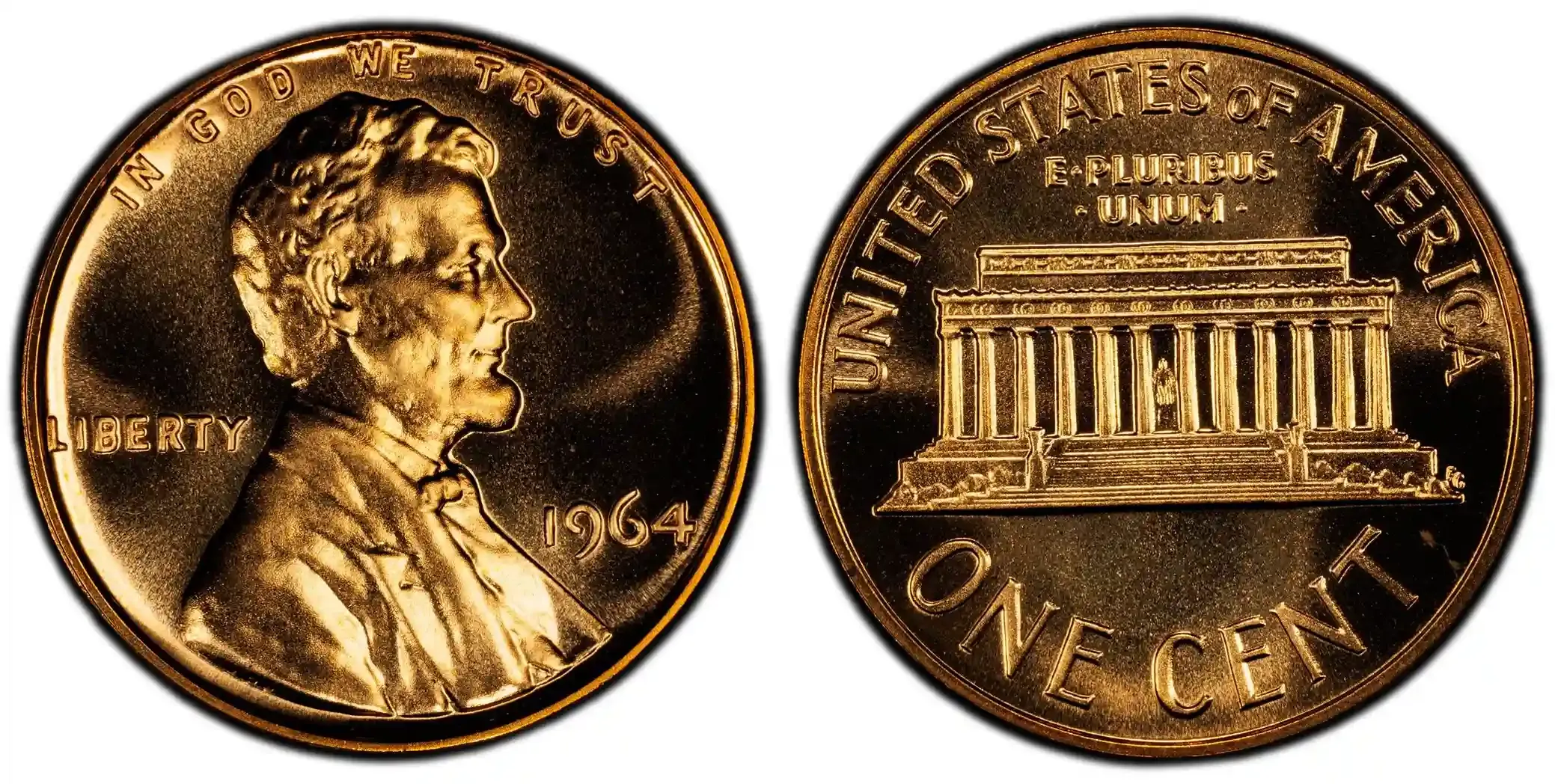
The mint made 1964 proof pennies in Philadelphia with no mint mark. These coins have shiny mirror surfaces and frosted design parts.
Standard proofs have a low value, selling for $5-$15 in PR-65 grade and $20-$50 in PR-67 grade. Proofs with a Cameo or Deep Cameo status sell for much higher prices because they have a very clear difference between the frosty design and the mirror background.
A PR-68 Deep Cameo coin can sell for $75-$100 or more, and high grades or rare types can sell for over $200. Check the coin under good light. If you see a strong contrast between the Lincoln portrait and the mirror background, the coin can get a Cameo rating.
Always get high grade proofs certified to get this extra value.
Valuable 1964 Penny Errors
Error coins can significantly increase value. Look for these varieties:
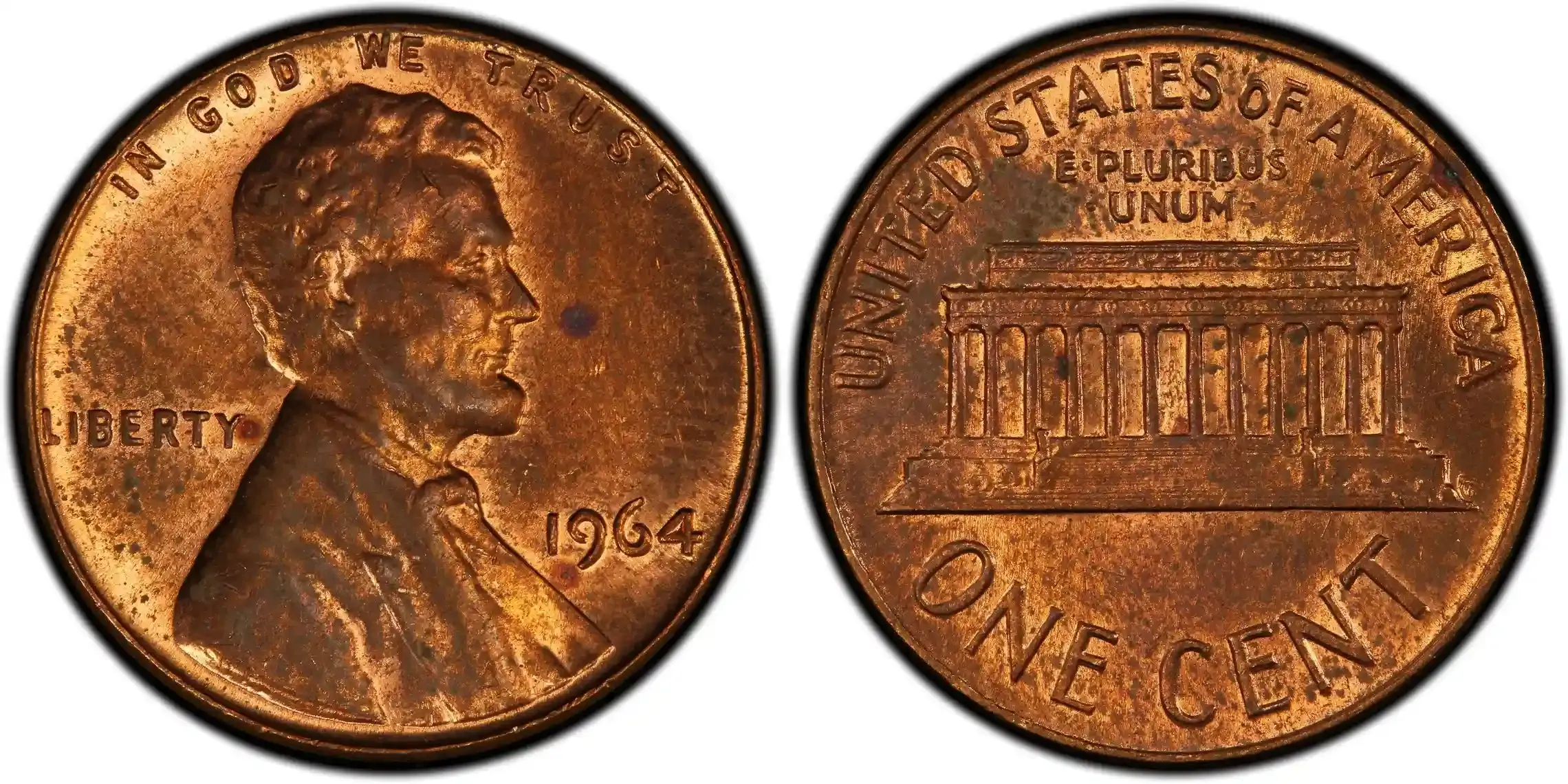
- Doubled Die Obverse: You can see doubling on the word LIBERTY, the words IN GOD WE TRUST, or the date. The extra price changes based on how clear the doubling is. Small doubling adds $25-$50, while a major double strike can add $100-$200 or more.
- Doubled Die Reverse: Look for doubling on the words UNITED STATES OF AMERICA or ONE CENT. Clear errors sell for $50-$150.
Example: MS-64 DDR sold for $187 at Great Collections (2012).
- Repunched Mint Marks on 1964-D: The D mark shows second lines. Common repunched marks add $5-$50. For exact error types, check the Variety Vista or CONECA databases.
- Off‑Center Strikes: Coins struck 5% to 50% off-center with the date visible sell for $10-$100 or more. A reported sale of $41,250 for an off-center strike in 2016 does not have official proof. Normal off-center sales are $100-$500 depending on how off-center the coin is and its look.
- Clipped Planchets: Curved, straight, or bowtie clips add $10-$50.
- Die Breaks and Cuds: Major die breaks can bring $5-$50 or more if dramatic.
- Wrong Planchet Errors: A 1964 penny made on a silver metal dime blank with a light weight, partial design, and lined edge is very rare. For example, a verified sale of an MS-62 Red wrong planchet coin sold for $1,351.25 at Heritage Auctions in 2017. Claims of sales between $10,000 and $12,500 need official proof.
Top Varieties & Errors Index:
| Error | Description | Price Range | Example Sale |
|---|---|---|---|
| DDO | Doubling on LIBERTY/date | $25-$200 | — |
| DDR | Doubling on UNITED STATES OF AMERICA | $50-$150 | $187 MS-64 (2012, GC) |
| RPM 1964-D | Repunched "D" | $5-$50 | — |
| Off-Center | 5-50% off-center, date visible | $10-$500 | Verify claims >$1,000 |
| Wrong Planchet | Struck on dime planchet | $1,000-$2,000 | $1,351 MS-62 RD (2017, Heritage) |
To identify errors, look at the Variety Vista, CONECA, or PCGS CoinFacts databases. Professional grading is very important to get the best coin value because many buyers will not pay high prices without a PCGS or NGC label.
For a comprehensive look at the most valuable mint mistakes across the Lincoln cent series, see our Top 20 Error Pennies List.
How Condition and Grade Drastically Affect 1964 Penny Value
A worn 1964 penny is worth $0.02-$0.03, while an uncirculated MS-67 Red coin can sell for $250-$7,931. The difference comes from the coin grade and color.
Grading scale basics:
-
Worn grades from Good to About Uncirculated: Show wear on high areas, flat details, and low metal shine. The value is usually limited to the copper metal price.
-
Uncirculated Mint State grades from MS-60 to MS-70: Show no wear and have full original metal shine. MS-63 is common, MS-65 is hard to find, and MS-67 Plus is very rare.
Color designations:
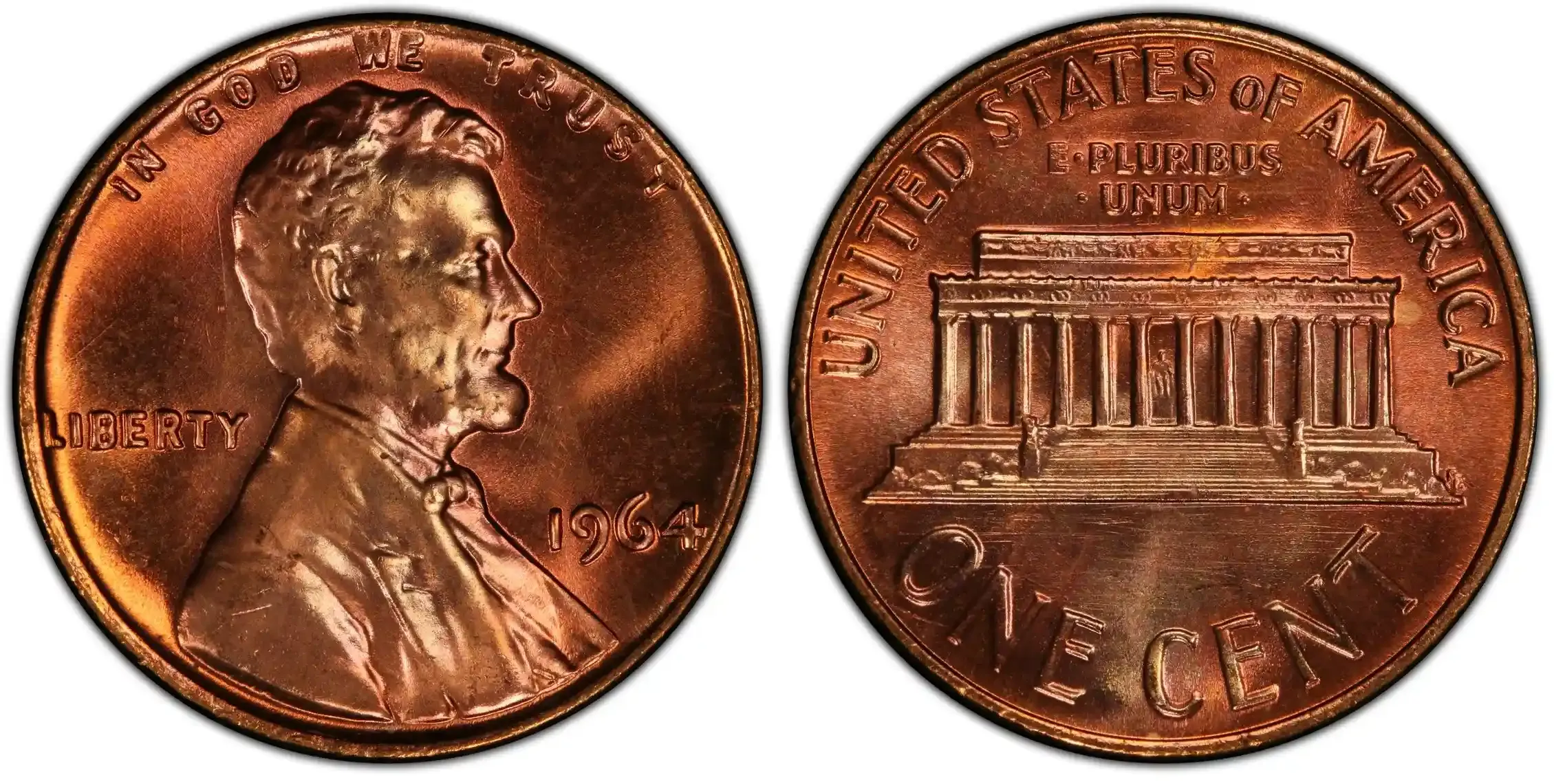
- Red: At least 95% of original copper metal shine is present. This color gets the highest price, especially in MS-65 Plus grade.
- Red Brown: Between 5% and 95% of red color remains on the coin. This has a medium value.
- Brown: Less than 5% of red color remains. This has the lowest price, even in high grades.
Example price jumps:
- MS-63 Brown: $1-$2
- MS-63 Red: $6-$8
- MS-65 Red: $15-$25
- MS-67 Red: $250-$1,000+
Strike and eye appeal also matter. Sharp details on Lincoln's hair, coat, and the Memorial steps, combined with clean surfaces and strong luster, push coins into top‑tier grades and prices.
Professional grading proves these details. A claim that a raw coin is MS-67 Red means very little without a PCGS or NGC label. Certified coins reduce buyer risk and bring higher prices at auctions.
The Story Behind the 1964 Penny: A Unique Year in US Mint History
The 1964 Lincoln Memorial cent belongs to a time of change in American money history. Several facts make this coin different:
High Production Numbers: The U.S. Mint made over 6.4 billion Lincoln cents in 1964 at Philadelphia and Denver combined to help with a nationwide coin shortage.
Production of coins with the 1964 date continued into 1965, allowed by the Coinage Act of 1965. These high production numbers keep most worn and medium grade uncirculated coins common and cheap.
The 1960s Coin Shortage: In the early 1960s, rising prices for silver metal made dimes, quarters, and half dollars made before 1965 worth more as metal than as money. People storing silver coins created a nationwide coin shortage.
Mint Director Eva Adams blamed collectors for making the shortage worse. She removed mint marks from all 1965 to 1967 coins except Denver pennies to stop people from hoarding them.
Metal Mix: Pennies made in 1964 were the last ones containing 95% copper metal before the 1982 change to copper-plated zinc metal. This makes 1964 pennies attractive to metal buyers and collectors.
Historical Link: The 1960s coin shortage is similar to modern worries about inflation and money losing its value, pushing investors to buy metals to protect their money.
1964 Lincoln Penny Specifications
Quick reference for attribution and authentication:
| Specification | Details |
|---|---|
| Composition | 95% Copper, 5% Zinc |
| Weight | 3.11 grams |
| Diameter | 19.00-19.05 mm (PCGS: 19.00 mm; manufacturing tolerance) |
| Edge | Plain |
| Designer Obverse | Victor D. Brenner |
| Designer Reverse | Frank Gasparro (Memorial design) |
Notes:
- The 95% copper / 5% zinc composition ran from 1962-1982. In 1982, the Mint switched to copper‑plated zinc (97.5% zinc core).
- Any 1964 cent deviating significantly from 3.11 grams or 19.00-19.05 mm diameter may indicate a wrong‑planchet error or counterfeit—verify with a scale and caliper.
Sources: U.S. Mint, Red Book (A Guide Book of United States Coins), PCGS CoinFacts #2890/#2893.
Composition: Are 1964 Pennies Copper?
Yes. Pennies made in 1964 contain 95% copper metal and 5% zinc metal. This metal mix was used from 1962 to 1982.
This mix gives the coin a current metal value of about $0.023 which is over two times the face value. Melting or sending pennies out of the country for profit is against the law under the official U.S. Mint rule from 2006 and 2007. The metal value is just a price guide for collectors and dealers, not a permission to melt coins.
For comparison, modern pennies made after 1982 are zinc metal with a thin copper metal cover, having a metal value of only $0.0065.
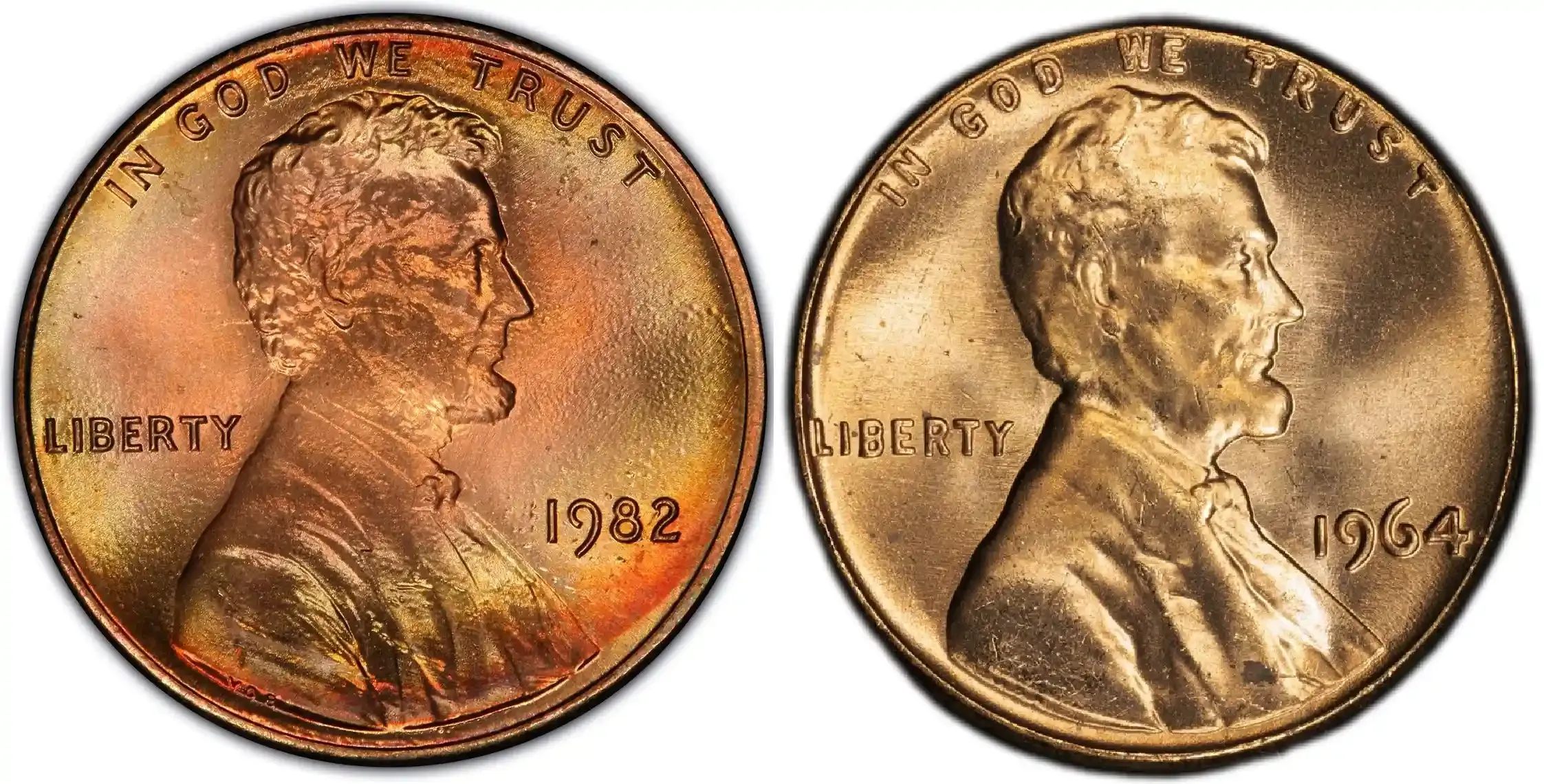
Source: U.S. Mint historical records; U.S. Mint interim rule on melting/export of cents and nickels (2006/2007).
Mintage Figures and Collector Tips for the 1964 Penny
The U.S. Mint made over 6.4 billion Lincoln cents in 1964 at Philadelphia and Denver, while San Francisco made only proof sets. This high production was done to help with a nationwide coin shortage. Making coins with the 1964 date continued into 1965. This high production keeps most worn and medium grade uncirculated coins common and cheap.
Collector tips:
-
Buy rare types and high grade red coins only after professional grading. Claims about uncertified high grade coins are risky without third-party proof.
-
To sell: Compare prices from local dealers, reliable online sites like eBay, and coin auction houses like Heritage, Stack's Bowers, and Great Collections. Coins with high values such as MS-67 Plus Red, SMS coins, and large errors sell best at auctions.
-
Know recent auction prices: Do not use simple price guides only. Check Heritage Auctions archives, Stack's Bowers sales prices, and PCGS data to see real market prices.
-
Never clean coins: Cleaning makes small scratches, removes original metal shine, and turns an MS-67 Red coin into a cleaned coin worth much less.
Quick-Sell Routes:
| Coin Type | Recommended Channel | Notes |
|---|---|---|
| MS-67 RD/Errors/SMS | Heritage/Stack's/GC | Auction consignment; 10-20% commission |
| MS-65 RD | eBay/Great Collections | Strong photos; accurate descriptions |
| Circulated | Local Coin Shop (LCS) | Quick sale; expect 10-30% under retail |
Investment note: High‑grade red coins and SMS pennies are where value and rarity intersect. Original surfaces drive outcomes—certification and clean, untampered coins maximize returns.
Sources: U.S. Mint historical notes on 1960s coin shortage, PCGS/NGC mintage data.
Was There a 1964 Wheat Penny?
No. The wheat back side design ended in 1958. Starting in 1959, all Lincoln cents had the Memorial back side designed by Frank Gasparro. Any sale post claiming a 1964 wheat penny is wrong. All 1964 cents have the Lincoln Memorial design on the back side.
To read about Wheat Pennies and find valuable dates, check 50 Valuable Wheat Pennies guide.
FAQ: 1964 Penny Value
How much is a 1964 D penny worth today?
Circulated 1964-D pennies are worth $0.02-$0.10 (copper melt value). Uncirculated examples typically sell for $1-$3 in MS-63 and $15-$25 in MS-65 Red. High‑grade specimens (MS-67+ Red) can bring $250-$7,931 or more at auction, depending on certification and eye appeal. Rare errors or varieties add value beyond standard pricing.
What makes a 1964 penny rare?
High grade MS-67 Red condition, certified cameo proof style, doubled dies, off-center strikes, or wrong metal errors make this coin rare. Special Mint Set pennies are also rare. Rare examples can cost $100 to over $10,000.
How do I know if I have a 1964 SMS penny?
SMS coins have satin luster, sharp details, squared rims, and no mint mark. These coins never appear in circulation. Professional certification is necessary to prove the coin history from the Adams estate. Uncertified coins have no high value.
Where is the mint mark on a 1964 penny?
Below the date on the obverse. No mark = Philadelphia; "D" = Denver. There is no "S" mint mark on circulation 1964 cents.
Was There a 1964 Wheat Penny?
No. The wheat reverse ended in 1958. Beginning in 1959, all Lincoln cents featured the Memorial reverse designed by Frank Gasparro. Any listing claiming a "1964 wheat penny" is incorrect. All 1964 cents have the Lincoln Memorial on the reverse.
Is There a 1964 Steel Penny?
No. The only steel pennies were struck in 1943, when copper was diverted for World War II efforts. All 1964 pennies are 95% copper and 5% zinc.

 Facebook
  X (Twitter)
 ) Pinterest
Pinterest  LinkedIn