Contents:
The 1949 Half Dollar came right after the debut of the Franklin design. The design was simple and honest, much like Franklin himself. The coin has just a politician-philosopher and a bell.
Collectors love this year because it’s early in the series and still struck in solid 90% silver before coins became alloyed. If you have a silver coin, you may want to check it with a coin identifier online.
"The 1949-P Franklin Half Dollar is common in all circulated grades. In uncirculated grades it also easily obtainable with thousands of examples still available. In MS65 condition it becomes a little scarcer but yet there are still a few thousand examples available. In MS66 condition it becomes scarce with probably less than 500 examples available and less than a handful known higher."
— Jaime Hernandez, a numismatic writer
from the PCGC page
The Second Year of the Franklin Half Dollar Series
John R. Sinnock’s portrait of Benjamin Franklin stayed the same: clean profile, furrowed brow, slightly distant gaze. The reverse has the Liberty Bell with a small eagle to the right; it shows federal authority.
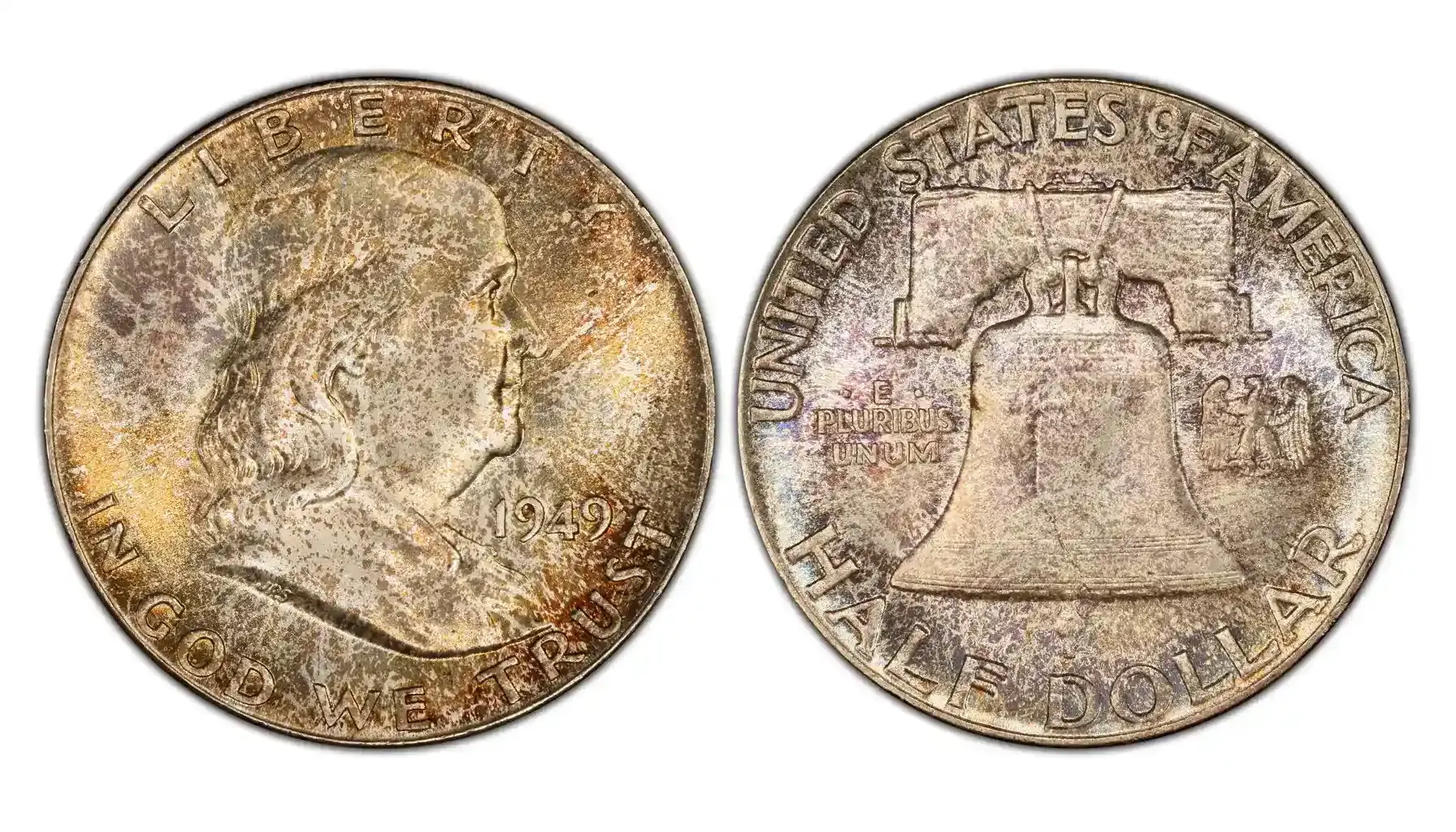
This year’s strike quality was better compared to the 1948 one, though some mints still produced soft bell lines. The 1949 Ben Franklin Half Dollar stays collectible because it’s part of the early years when mintages were relatively low and production standards varied. Not much, but enough to affect the value.
Minting and Varieties of the 1949 Half Dollar
There were three runs: Philly (without a mint mark), San Francisco (S.), and Denver (D.). Even combined, they actually struck fewer coins than in 1948, which also affects value. The San Francisco mint produced about 3.7 million, famous now for the 1949 S Franklin Half Dollar, with a sharp but sometimes uneven strike.
Each coin:
weighs 12.5 grams
made of 90% silver and 10% copper
diameter of 30.6 mm and a reeded edge
These specs are actually literally the same as for 1948 coins. The silver content equals about 0.3617 troy ounces, giving a melt value near $17-18 in 2025б yes, same as 1948. Look for the mint mark just above the Liberty Bell on the reverse, right under the word E PLURIBUS UNUM.
Mint | Mintage | Common Traits |
5,164,000 | Typically clean surfaces, few marks | |
Denver | 4,120,600 | Strong details, fewer weak strikes |
San Francisco | 3,744,000 | Often lighter bell lines, attractive toning |
1949 Half Dollar Value and Collectibility
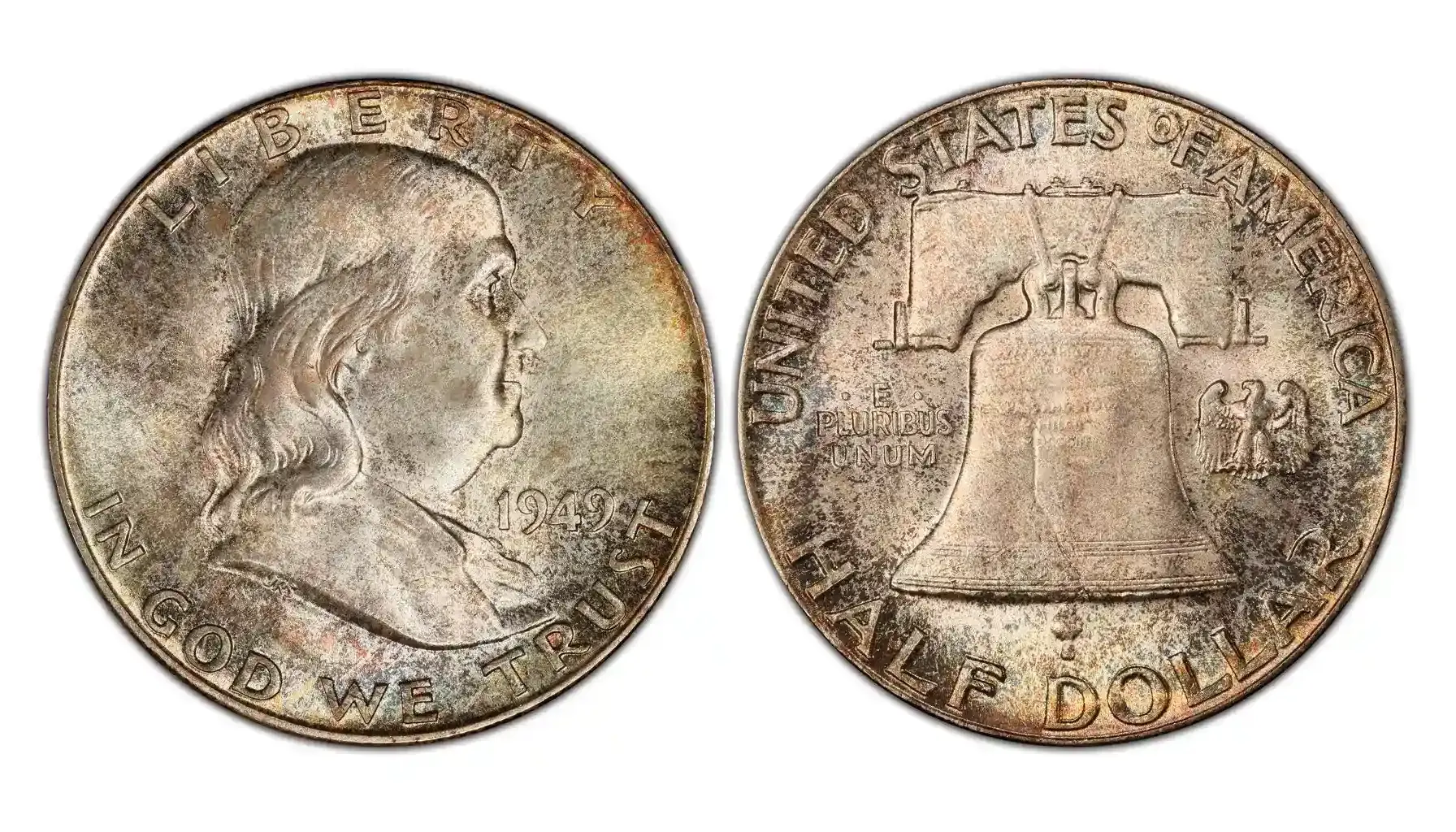
Like with any coin, the 1949 Half Dollar Value depends on mint and condition A LOT. Coins with “Full Bell Lines” (FBL) are usually the rarest and most expensive finds. They have crisp horizontal lines at the base of the Liberty Bell.
Regular mint state examples already have some real value, but FBLs can cost even more. But don’t forget, condition is still important, even for the FBLs.
1949 (No Mint Mark) | 1949-D | 1949-S | |
Good (G-4) | $22 | $22 | $23 |
Fine (F-12) | $25 | $25 | $25 |
Extremely Fine (XF-40) | $26 | $27 | $30 |
Almost Uncirculated (AU-50) | $40 | $45 | $50 |
Mint State 63 | $78 | $85 | $90 |
Mint State 65 | $107 | $130 | $150 |
Mint State 67+ | $800+ | $2,500+ (FBL up to $31,000) | $9,000+ (FBL) |
The 1949 Franklin Half Dollar Value has shown stable growth, especially for higher grades. Serious collectors try to get Denver FBL coins because they are rarer and more expensive. San Francisco issues with deep natural toning are also quite popular.
Even commonly circulated examples of the 1949 Liberty Half Dollar Value stay above melt thanks to steady demand.
Conclusion
The Half Dollar was the second run that only lasted 15 years, showing one of the most influential characters of the 18th century. Both lightly worn and mint 1949 Franklin Half Dollar coins can cost quite a lot now. Besides that, it’s just nice to have a tiny piece of history in your pocket, right?

 Facebook
  X (Twitter)
  Pinterest
  LinkedIn