Contents:
How much is a 1908 nickel worth? And what is the best app to check coin value?
1908 Liberty Head Nickel Overview
The series was introduced in 1883 and remained in use until it was replaced by the Buffalo Nickel in 1913.
When it debuted, the first version lacked the word “CENTS” on the reverse. This led to gold-plating scams. That issue was corrected the same year, and the design remained essentially unchanged for the next 30 years.
By 1908, the series was nearing the end of its lifespan. Public taste was shifting toward more expressive designs, and the U.S. Mint was preparing for change. Even so, the coin was still used in everyday commerce. Most 1908 specimens entered circulation immediately, which explains why worn examples are common and sharply preserved pieces are not.
Although the series technically continued until 1913, 1908 represents the last year of large production.
Later issues were struck in smaller numbers and are often collected for different reasons.
Denomination | Five cents |
Series | Liberty Head Nickel |
Year | 1908 |
Designer | Charles E. Barber |
Composition | 75% Cu, 25% Ni |
Weight | 5.00 grams |
Diameter | 21.2 mm |
Thickness | ~1.95 mm |
Edge | Plain |
Identifying the 1908 V Nickel
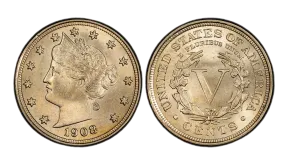
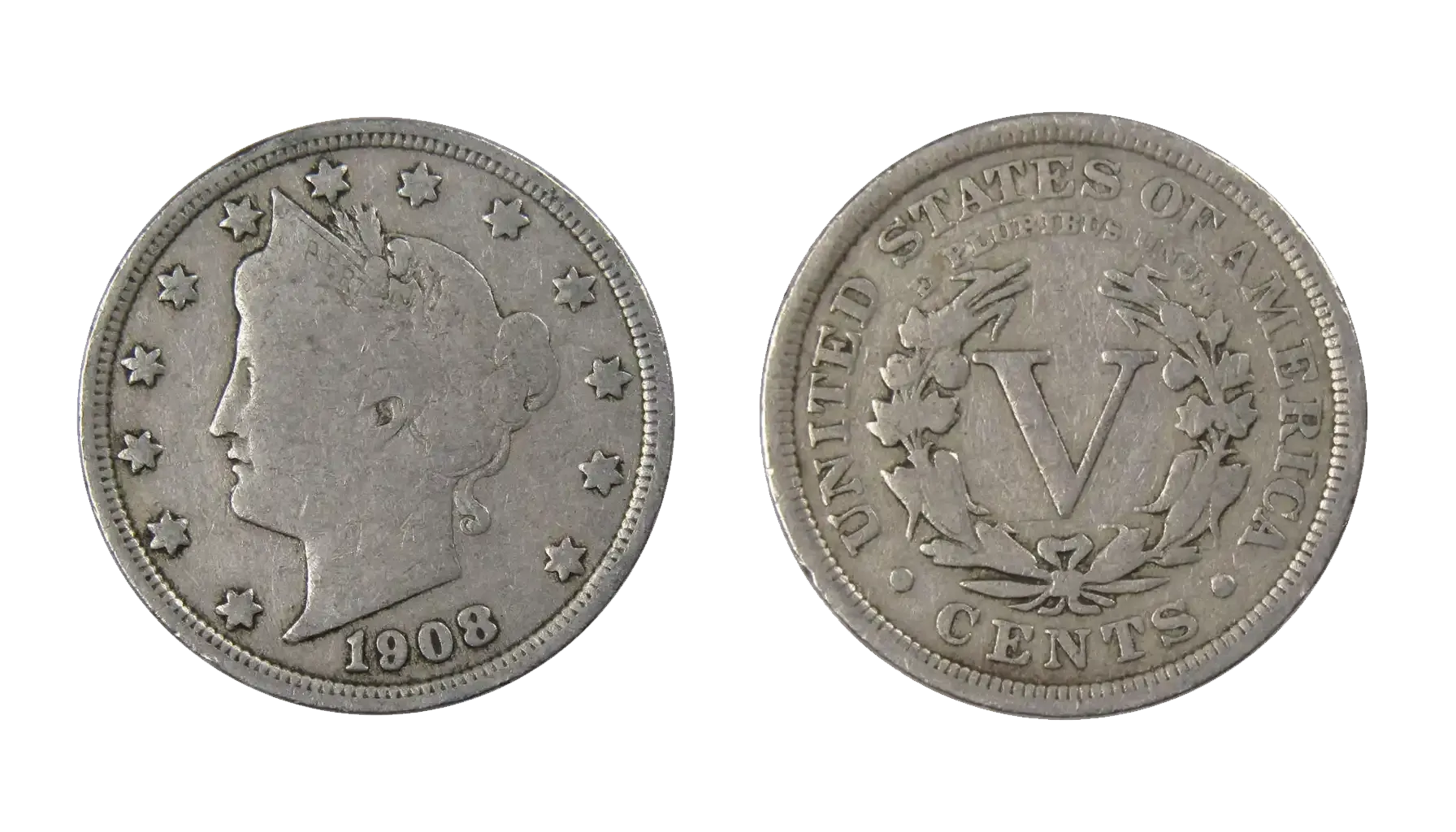
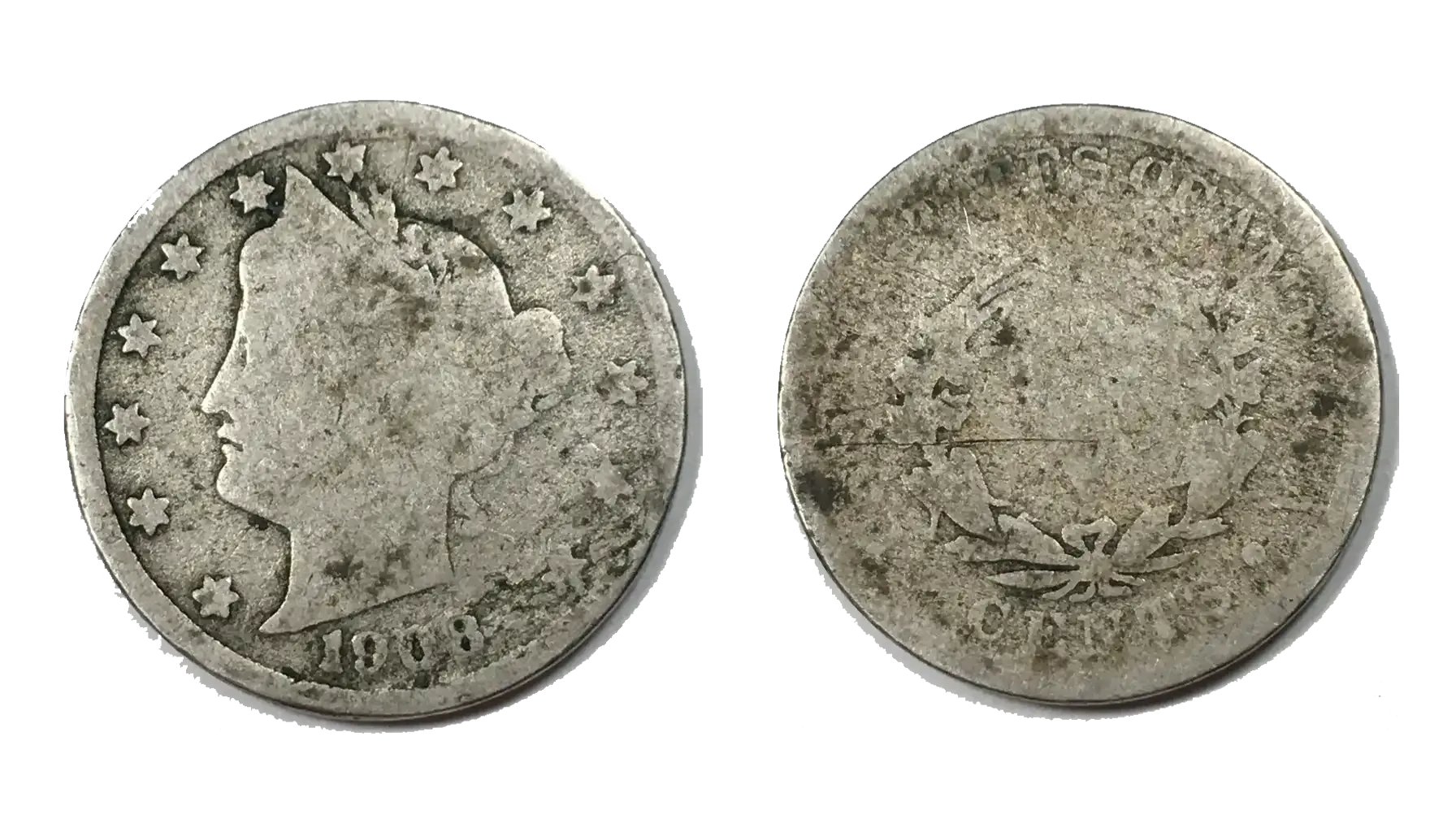
Start with the obverse. Look for Liberty facing left with a coronet clearly reading LIBERTY. On worn coins, the letters may be faint but should remain partially visible. The 13 stars around the portrait help confirm the type and rule out later designs.
Flip to the reverse. The large Roman numeral V is the identifier. It sits inside a wreath and is surrounded by UNITED STATES OF AMERICA and E PLURIBUS UNUM. If the wreath and rim are still defined, the coin likely falls into mid-circulated grades or better.
For a faster and more precise check, collectors often use Coin ID Scanner. A clear photo allows the app to match the coin against verified references and return:
Realistic value range
Digital collecting opportunities
… and even more!
Design Features and Metal Composition of the 1908 Nickel
Obverse: Liberty faces left, wearing a coronet inscribed LIBERTY, surrounded by 13 stars. The shallow relief helped the design last in circulation. The letters of LIBERTY are usually the first detail to wear down and are often used to estimate grade.
Reverse: It’s a 1908 nickel with V on back. So, a large Roman numeral V marks the denomination, framed by a wreath. The compact layout reduced rim damage and striking issues.
Metal composition:
75% Cu, 25% Ni
5.00 grams
The hard alloy resisted bending and corrosion but shows contact marks easily. That toughness explains why worn coins are common and sharply preserved examples are much harder to find.
1908 Liberty Head Nickel Value by Condition
Look at the 1908 nickel value today in standard business strike form below. These reflect recent guides and auction/market data; actual prices vary with certification, eye appeal, and market trends.
Condition / Grade | 1908 V Nickel Value Range (USD) |
Good (G-4) | ~$2–$5 |
Very Good (VG-8) | ~$3–$8 |
Fine (F-12) | ~$4–$10 |
Very Fine (VF-20) | ~$10–$25 |
Extremely Fine (XF-40) | ~$30–$60 |
About Uncirculated (AU-50) | ~$40–$90 |
Uncirculated MS60 | ~$80–$140 |
Uncirculated MS62 | ~$130–$200 |
Uncirculated MS63 | ~$200–$300 |
Uncirculated MS64+ | ~$230–$500+ |
High MS65 and above | Significant premiums (many hundreds to thousands) |
Circulated coins dominate the market; the 1908 Liberty nickel value stays modest in lower grades. Uncirculated examples rise sharply in value, especially with strong luster and eye appeal.
Proof examples and rare 1908 'V nickel error examples, if genuine and verified, can be more expensive.
“According to the NGC Price Guide, as of January 2026, a Liberty Head Nickel from 1908 in circulated condition is worth between $1.50 and $100. However, on the open market 1908 Nickels in pristine, uncirculated condition sell for as much as $10000.”
– Coin Explorer
Factors That Affect the Value of a 1908 Nickel
Condition (grade): The strongest factor of influence. Light wear and full details increase the 1908 Liberty nickel value.
Surface quality: Original, uncleaned surfaces with natural color bring higher prices.
Strike strength: Weakly struck hair details or wreath elements reduce the 1908 Liberty Head nickel value.
Luster: Surviving mint luster is critical on higher-grade coins.
Damage or cleaning: Harsh cleaning, scratches, or corrosion lower market interest.
Certification: Coins graded by PCGS or NGC are easier to sell and value accurately.
Also read: Confoederatio Helvetica Coin Value.
Tips for Collectors and Investors
Quality Is a Must
The coin is not rare by date, so condition matters more than ownership. A single piece with strong details and clean surfaces is usually a better choice than several heavily worn examples.
Look for Original Surfaces
Coins with natural color and untouched metal are far more desirable. Cleaning, polishing, or artificial shine reduces collector interest and limits future resale options.
Judge Overall Appearance
Luster, strike sharpness, and balanced toning often separate average coins from premium ones. Coins with similar grades can sell for very different prices based on eye appeal.
Use Certification Wisely
For higher-grade 1908 Liberty V nickel specimens, third-party grading adds market confidence and makes valuation easier. Certified coins are also more liquid when selling.
Think in Years, not Weeks
This coin rewards patience. Long-term value comes from careful selection and preservation, not short-term trading.

 Facebook
  X (Twitter)
  Pinterest
  LinkedIn