Contents:
- What's Your 1982 Penny Worth?
- Why 1982 Is Special: Seven Official Varieties
- How to Identify Your 1982 Penny in Three Steps
- Small Date vs Large Date: Visual Differences You Can Spot
- Copper or Zinc? The Weight Test Is Definitive
- Catalog of 1982 Lincoln Cent Varieties: Attributes, Rarity, and How to Spot Them
- 1982 Penny Value Chart: Pricing All Seven Varieties
- Rare and Valuable Errors on 1982 Pennies (Beyond the Transitional Copper)
- What to Do If You Find a Potentially Rare 1982 Penny
- FAQ:
In 1982, the Mint shifted from 95% copper pennies to zinc-core planchets with copper plating. The process created a mix of compositions, two date styles, and seven official varieties—plus one unique error now worth over $15,000.
"The 1982 penny teaches us that not every unusual coin is valuable—but when composition and date style align in the wrong way at the right time, you get a modern rarity that collectors will pay serious money for. The main thing is knowing how to tell them apart." — Laura Bennett, Senior Numismatic Analyst at Coin ID Scanner
Updated: January 2026. Prices verified against PCGS CoinFacts, NGC Price Guide, Heritage Auctions, and Stack's Bowers auction results.
What's Your 1982 Penny Worth?
Most 1982 Lincoln cents: $0.01–$0.05 in circulation; $1–$10 in high Mint State grades MS-63 to MS-65.
Rare 1982-D Small Date Copper (transitional error): Authenticated examples have sold for $8,400 to $18,800 at Heritage Auctions; high-grade specimens can exceed $50,000 with professional certification.
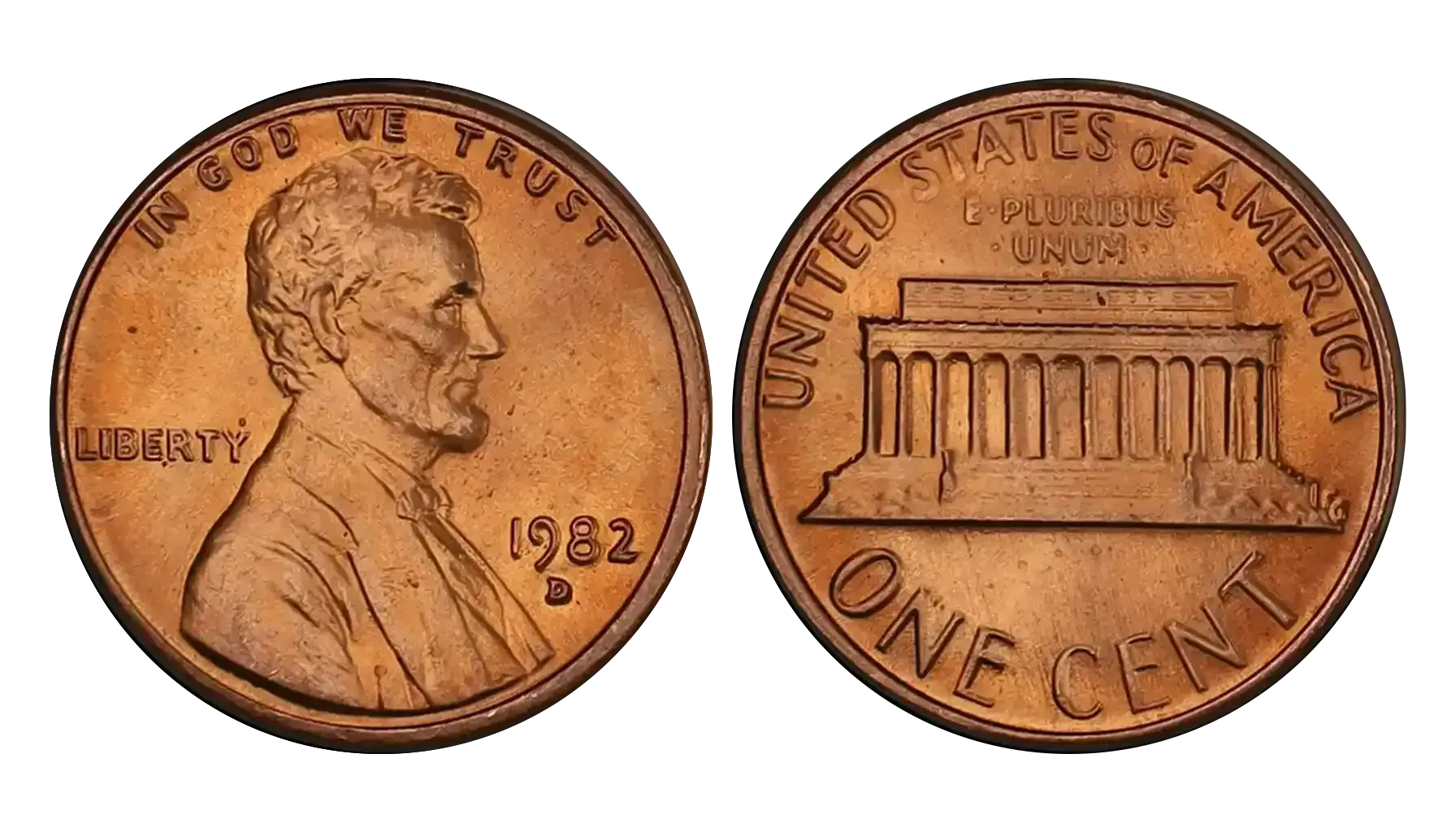
The difference hinges on three factors: metal composition (copper weighs 3.11g, zinc weighs 2.5g), date style (Small Date vs Large Date), and mint mark (D for Denver, no mark for Philadelphia, San Francisco, or West Point).
Why 1982 Is Special: Seven Official Varieties
The 1982 cent marks the year the U.S. Mint switched from bronze planchets (95% copper, 5% zinc) to copper-plated zinc (97.5% zinc core, 2.5% copper coating). That transition wasn't instant—both metals were used throughout 1982, and two different date hubs, Large Date and Small Date, were employed at Philadelphia and Denver mints. The result: seven intended varieties defined by composition, date style, and mint.
The seven official varieties:
- 1982 Large Date Copper (Philadelphia, no mint mark)
- 1982 Small Date Copper (Philadelphia, no mint mark)
- 1982-D Large Date Copper (Denver, D mint mark; coined through October 21st)
- 1982 Large Date Zinc (Philadelphia, no mint mark)
- 1982 Small Date Zinc (Philadelphia, no mint mark)
- 1982-D Large Date Zinc (Denver, D mint mark)
- 1982-D Small Date Zinc (Denver, D mint mark)
All seven are common in circulation. They're worth face value to a few dollars in common grades, with premiums kicking in only at MS-65 or higher.
"1982 cents with no mint marks were struck at Philadelphia, San Francisco, and West Point facilities. All coins struck at these three Mints did not carry a mint mark. Consequently, it is impossible to differentiate where 1982 cents with no mint marks originated from." — PCGS CoinFacts
The eighth variety is a 1982-D Small Date Copper. Denver was supposed to have fully transitioned to zinc before introducing the Small Date hub, but a few leftover copper planchets were struck accidentally. This transitional error is extremely rare, with only two confirmed issues known to exist as of early 2026.
According to Heritage Auctions records, authenticated examples have realized:
- AU-58 grade: $10,800 and $18,800 (2017 sales)
- Projected MS-65+ value: $50,000+
| Variety | Mint | Mint Mark | Composition | Date Type | Rarity |
|---|---|---|---|---|---|
| 1982 (P) Large Date Copper | Philadelphia | None | 95% Cu, 5% Zn | Large | Common |
| 1982 (P) Small Date Copper | Philadelphia | None | 95% Cu, 5% Zn | Small | Common |
| 1982-D Large Date Copper | Denver | D | 95% Cu, 5% Zn | Large | Common |
| 1982 (P) Large Date Zinc | Philadelphia | None | 97.5% Zn, 2.5% Cu | Large | Common |
| 1982 (P) Small Date Zinc | Philadelphia | None | 97.5% Zn, 2.5% Cu | Small | Common |
| 1982-D Large Date Zinc | Denver | D | 97.5% Zn, 2.5% Cu | Large | Common |
| 1982-D Small Date Zinc | Denver | D | 97.5% Zn, 2.5% Cu | Small | Common |
| 1982-D Small Date Copper | Denver | D | 95% Cu, 5% Zn | Small | Extremely Rare |
How to Identify Your 1982 Penny in Three Steps
Step 1 – Check the Date Style
Examine the alignment and shape of the numbers closely under a magnifying glass. The number two on the Large Date variety features a completely straight line along its bottom neck, while the Small Date variety displays a distinct, delicate curve in the center of that same bar.
"PCGS CoinFacts emphasizes that on the Small Date, 'the descender of the "2" shows a slight arch bowing up and to the left,' whereas the Large Date '2' is straight." — PCGS CoinFacts
Step 2 – Weigh the Coin
Place your penny on a precise digital scale that measures down to one-hundredth of a gram. A traditional, heavy copper issue will register a weight of 3.11 grams on the display screen. Conversely, a lighter, newer zinc planchet will show a weight of only 2.50 grams.
Step 3 – Look for the Mint Mark
Inspect the small field directly underneath the date to locate the origin of production. A prominent letter D indicates that the Denver facility struck the coin, while a complete absence of a letter indicates a Philadelphia or West Point strike. You must combine this final detail with your weight and date style observations to determine the exact variety of your find.
Small Date vs Large Date: Visual Differences You Can Spot
| Feature | Small Date | Large Date |
|---|---|---|
| "2" top | Curved, swooping | Flat, straight |
| "2" diagonal | Arched, crooked | Rigid, straight |
| "8" upper loop | Smaller, round ("snowman" shape) | Larger, oval |
| Numeral spacing | Open, delicate | Tight, crowded |
| Top alignment | All four align evenly | Middle numerals sit higher |
| Distance "2" to rim | Large gap (space for another "2") | Small gap |
The date style is the first visual checkpoint. Hold the coin under good light or use magnification to examine the "2" and "8" in "1982."
Large Date characteristics:
- Top of the "2" is flat and straight
- Diagonal stroke of the "2" is rigid, almost like a ruler edge
- Numerals "8" and "2" appear thicker, more crowded
- Tops of middle numerals ("9," "8," "2") sit higher than the "1"
Small Date characteristics:
- Top of the "2" has a downward swoop or curve ("swan neck" shape)
- Diagonal stroke of the "2" is slightly crooked/arched
- Numerals appear more delicate, better spaced
- All four numerals align along a single imaginary top line
Copper or Zinc? The Weight Test Is Definitive
Visual style alone won't tell you if the coin is valuable. You must confirm composition by weighing the coin.
Standard weights:
- Copper (bronze) pennies: ~3.11 grams (95% copper, 5% zinc)
- Zinc pennies: ~2.5 grams (zinc core with copper plating)
The 0.61-gram difference is large enough that even a basic digital kitchen or jewelry scale accurate to 0.1 grams can separate the two.
Procedure:
- Calibrate your scale on a stable surface; zero it out.
- Gently place the coin on the platform.
- Record the weight.
- ~3.05–3.15g → Copper
- ~2.45–2.55g → Zinc
Circulated coins may have slight wear, shaving a few hundredths of a gram off, but the composition gap is wide enough that you'll still get a clear read.
Why Not Use Sound or Magnets?
Some collectors suggest a "ring test" (drop the coin and listen for copper's "ring" vs zinc's "clunk/thud"). While this method has some merit—copper pennies produce a high, melodic "ding" when struck against a hard surface like granite, while zinc pennies produce a duller "thud" or "click"—Laura Bennett advises against it: dropping a potentially rare coin can cause nicks or scratches that lower its grade. The sound test is subjective and less reliable than weighing.
Magnets won't help either—neither copper nor zinc is strongly magnetic, though zinc has slight magnetic properties that are not definitive for identification.
Catalog of 1982 Lincoln Cent Varieties: Attributes, Rarity, and How to Spot Them
1982 Large Date (Copper, Philadelphia — No Mint Mark)
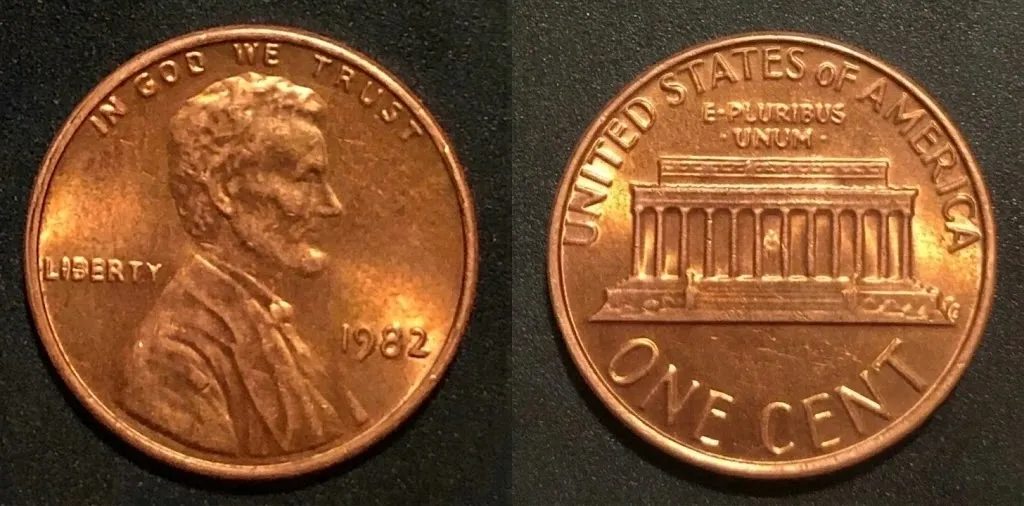
Composition: 95% copper, 5% zinc
Weight: ~3.11g
Date Type: Large Date
Mint Mark: None (Philadelphia, San Francisco, or West Point)
Identifiers: Weigh the coin to confirm copper composition. Check for flat-topped "2" and thicker numerals. No mint mark below the date.
Rarity: Common in circulation. Premiums emerge only in high Mint State (MS-65+).
1982 Small Date (Copper, Philadelphia — No Mint Mark)
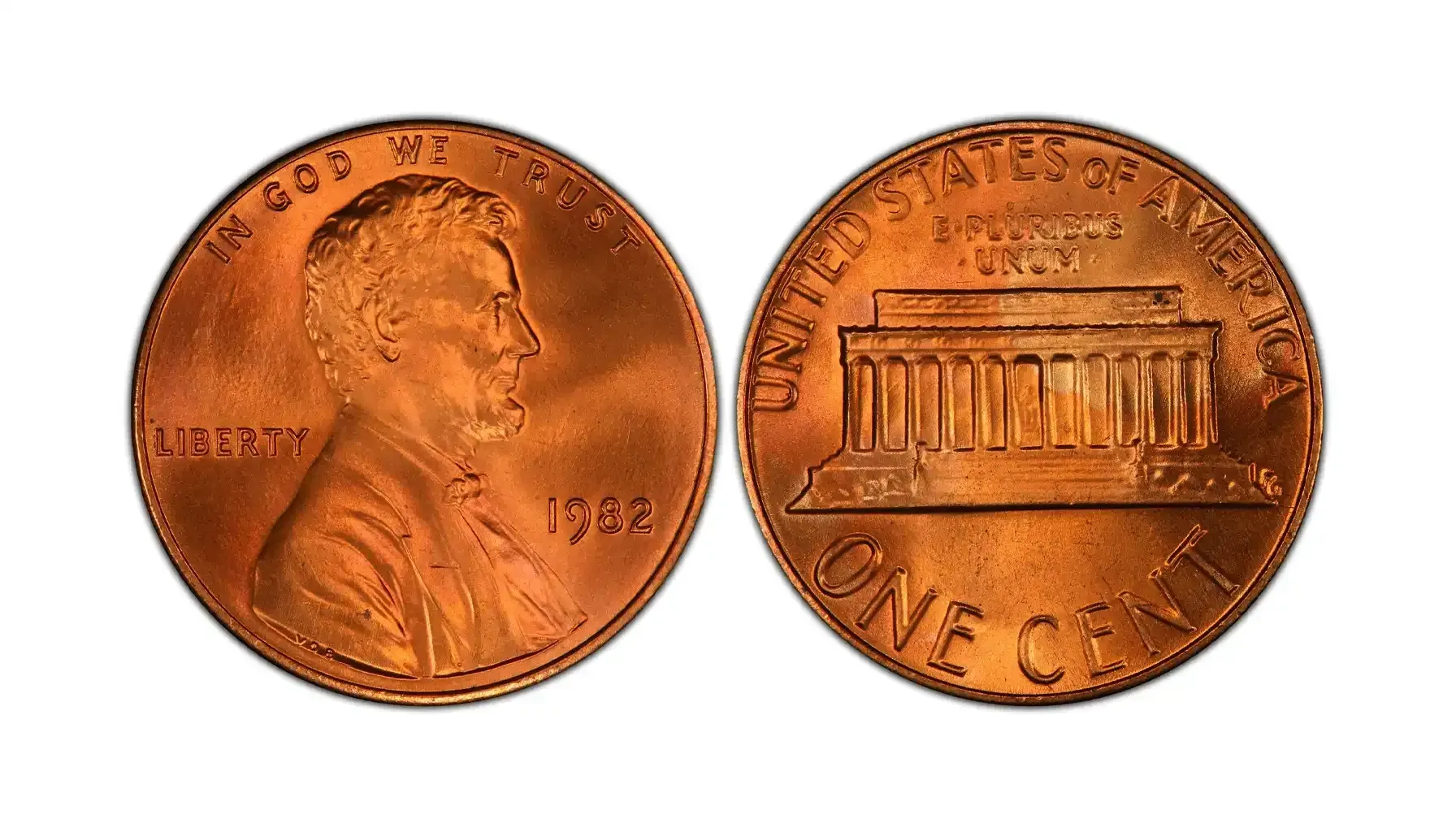
Composition: 95% copper, 5% zinc
Weight: ~3.11g
Date Type: Small Date
Mint Mark: None
Identifiers: Weight confirms copper. Curved top on "2," aligned numeral tops. No mint mark.
Rarity: One of the most difficult memorial cents to find in high grade condition. Scarce even in MS64 and MS65 grades. In MS66 grade and higher, extremely difficult to find. — Jaime Hernandez, PCGS
Value range:
- Circulated: $2–$5
- MS-63: $150–$300
- MS-65 Full Red: $600–$1,500
- MS-67+: $1,000–$3,000
1982-D Large Date (Copper, Denver — D)
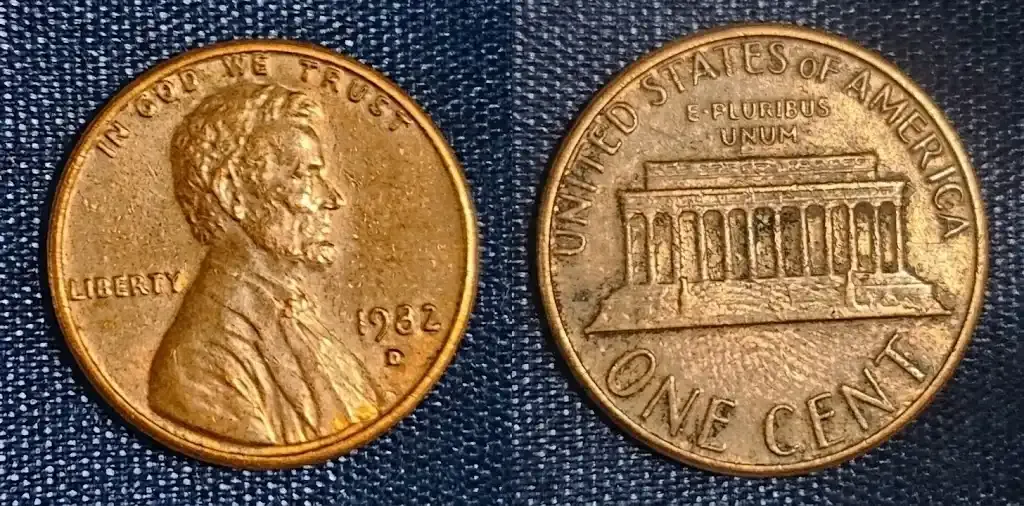
Composition: 95% copper, 5% zinc
Weight: ~3.11g
Date Type: Large Date
Mint Mark: D (below date)
Identifiers: "D" mint mark, copper weight, Large Date style.
Rarity: Common. Most Denver copper pennies from 1982 are Large Date. It was coined for a majority of the year, up until October 21st. — Old Money Prices
Value: 2–3 cents (copper content value only) in any grade.
1982 Large Date (Zinc, Philadelphia — No Mint Mark)
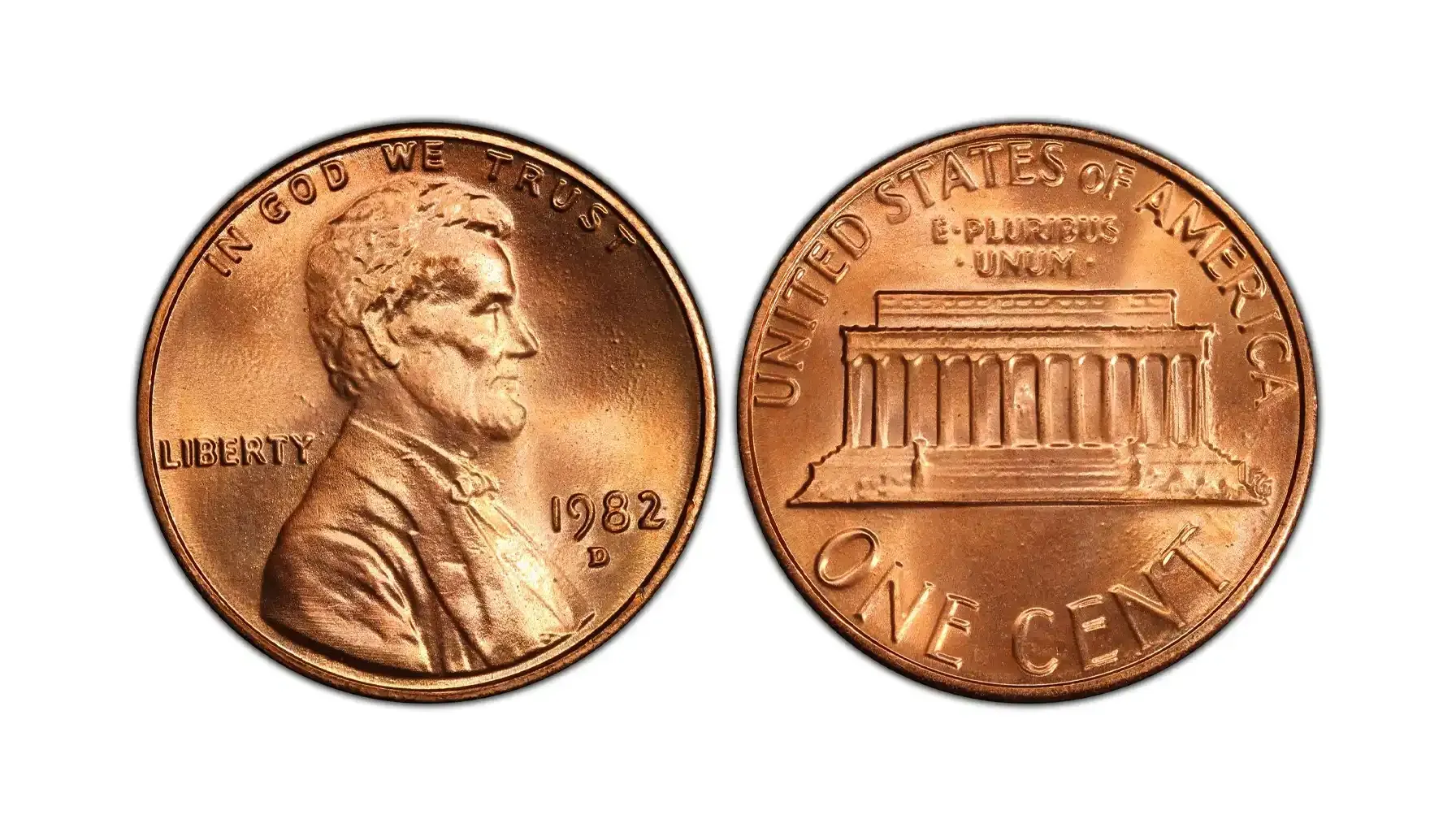
Composition: 97.5% zinc, 2.5% copper plating
Weight: ~2.5g
Date Type: Large Date
Mint Mark: None
Identifiers: Lightweight (~2.5g), Large Date, no mint mark.
Rarity: Very common. Most circulated 1982 pennies you encounter will be this variety or the zinc Large Date from Denver. Worth face value in circulated condition; modest premiums in MS-65+.
1982 Small Date (Zinc, Philadelphia — No Mint Mark)
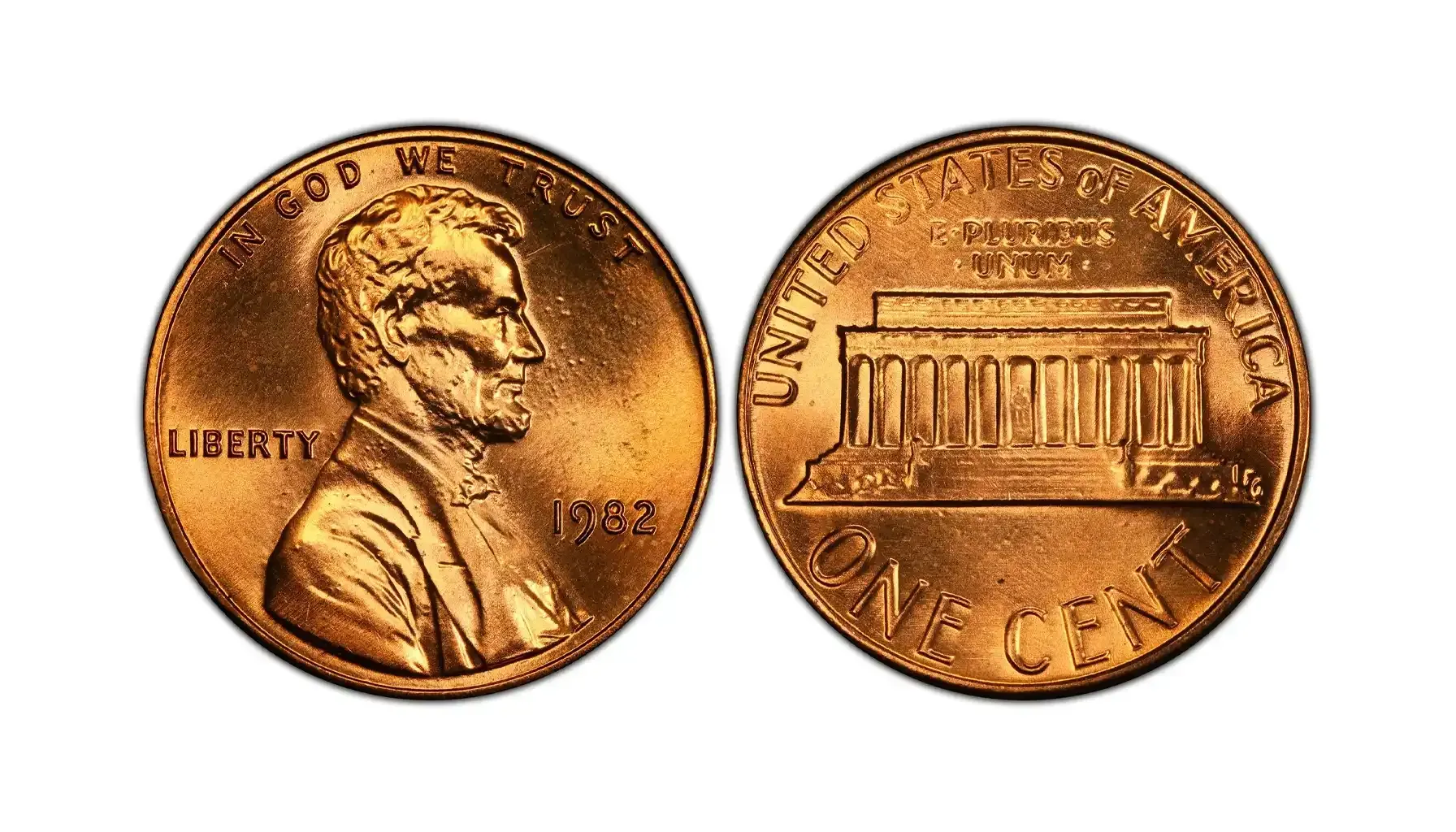
Composition: 97.5% zinc, 2.5% copper plating
Weight: ~2.5g
Date Type: Small Date
Mint Mark: None
Identifiers: Weight ~2.5g, curved "2," no mint mark.
Rarity: Common. Despite the Small Date designation, this is a regular zinc variety and not rare. Worth slightly more than Large Date zinc in MS-65+ because of variety interest, but still common overall.
1982-D Large Date (Zinc, Denver — D)
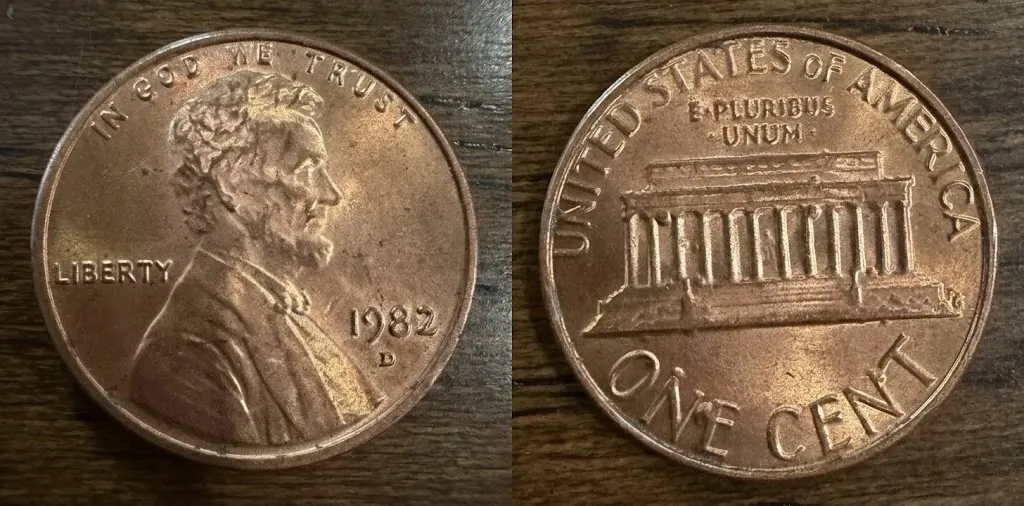
Composition: 97.5% zinc, 2.5% copper plating
Weight: ~2.5g
Date Type: Large Date
Mint Mark: D
Identifiers: "D" mint mark, ~2.5g weight, Large Date.
Rarity: Very common. Worth face value in circulated condition.
1982-D Small Date (Zinc, Denver — D)
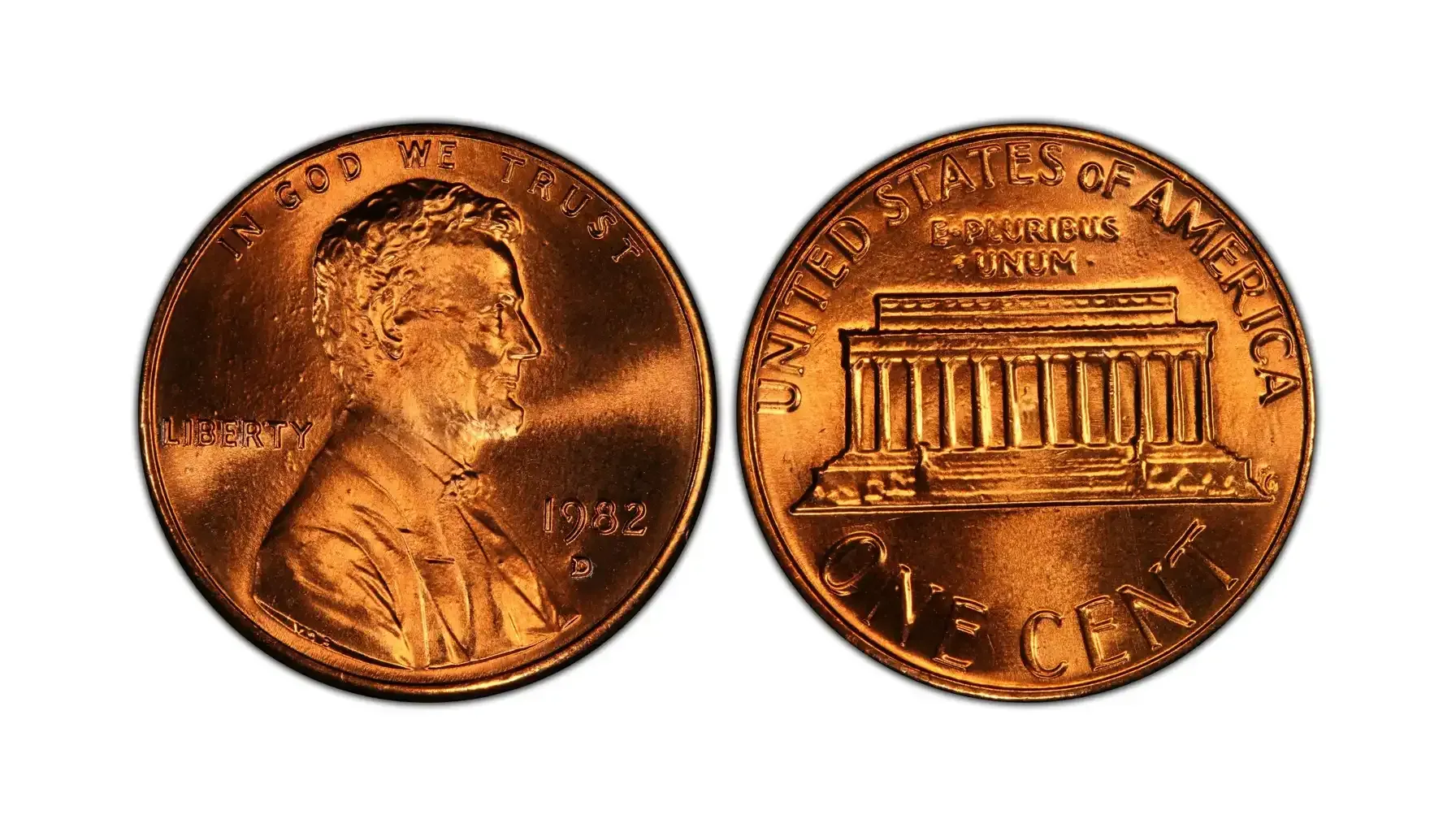
Composition: 97.5% zinc, 2.5% copper plating
Weight: ~2.5g
Date Type: Small Date
Mint Mark: D
Identifiers: "D" mint mark, ~2.5g weight, Small Date numerals.
Rarity: Common. This is the intended Small Date zinc variety from Denver. Not the rare copper version.
1982-D Small Date (Copper, Denver — D)
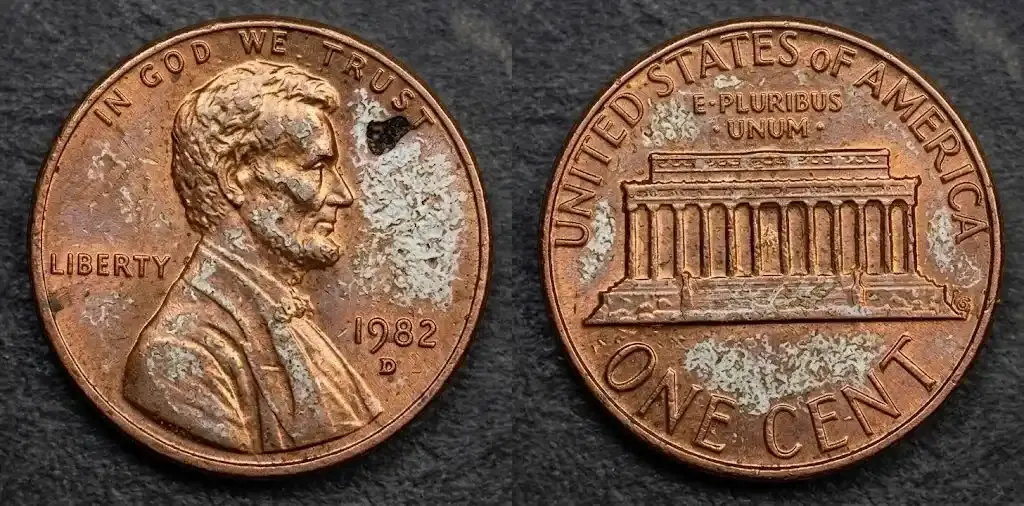
Composition: 95% copper, 5% zinc
Weight: ~3.11g
Date Type: Small Date
Mint Mark: D
Identifiers: Must satisfy all three criteria:
- "D" mint mark below date
- Small Date numeral style (curved "2," aligned tops)
- Weight ~3.1g (copper, not zinc)
Rarity: Extremely rare. Only two confirmed examples known to exist. Denver was supposed to have fully transitioned to zinc before introducing the Small Date hub, but a few leftover copper planchets were struck accidentally.
"The 1982-D Small Date copper penny is one of the rarest U.S. coins, with only two confirmed examples known to exist." — JM Bullion (July 16, 2026)
Value (2026 market):
- Circulated (AU-58): $8,400–$18,800 (Heritage Auctions verified sales)
- Projected MS-63 to MS-65: $20,000–$50,000
- MS-65+ with strong eye appeal: $50,000+
Authentication requirement: Professional grading and certification (PCGS or NGC) is mandatory for this variety. Self-attributions are not accepted by major auction houses or serious collectors.
1982 Penny Value Chart: Pricing All Seven Varieties
Value depends heavily on grade. Circulated coins show wear, reduced luster, and surface marks; uncirculated coins retain full striking detail and original luster. Professional grading assigns numeric grades MS-60 to MS-70, with MS-65 and above commanding significant premiums.
| Variety | Circulated Value | MS-63 Value | MS-65 Value |
|---|---|---|---|
| 1982 (P) Large Date Copper | $0.02–$0.10 | $1–$4 | $5–$20 |
| 1982 (P) Small Date Copper | $2–$5 | $150–$300 | $600–$1,500 |
| 1982-D Large Date Copper | $0.02–$0.10 | $1–$4 | $5–$25 |
| 1982 (P) Large Date Zinc | $0.01 | $0.50–$2 | $3–$10 |
| 1982 (P) Small Date Zinc | $0.01–$0.02 | $1–$3 | $5–$15 |
| 1982-D Large Date Zinc | $0.01 | $0.50–$2 | $3–$10 |
| 1982-D Small Date Zinc | $0.01–$0.03 | $2–$6 | $10–$40 |
| 1982-D Small Date Copper (Error) | $8,400–$18,800 | $20,000–$40,000 | $50,000+ |
Prices reflect 2026 market data from Heritage Auctions, Stack's Bowers, PCGS, NGC, and American Rarities. Actual realized prices vary with eye appeal, certification, and market demand.
How Condition Affects Value
Circulated grades Good, Fine, Very Fine, Extremely Fine, and About Uncirculated show visible wear on high points—Lincoln's cheek, Lincoln Memorial on the reverse. Luster is diminished or absent. For common 1982 varieties, circulated coins are worth face value to a few cents unless copper content drives modest bullion premiums.
Uncirculated (MS-60 to MS-70) coins retain full detail and original mint luster. Higher MS grades (MS-65+) show fewer contact marks, better strike, and stronger eye appeal. Even common 1982 varieties can be worth $5–$40 in MS-65 because of registry set demand and aesthetic preferences.
For the 1982-D Small Date Copper, condition affects value. A circulated example might realize $8,400–$18,800, but an MS-65 specimen with strong red color and sharp strike can exceed $50,000.
"PCGS and NGC population reports show very few high-grade examples of the 1982-P Small Date copper Lincoln cent. They are scarce even in MS64 and MS65 grades. It is one of the most difficult varieties to find in high grade out of all seven different varieties of this date. In MS66 grade and higher, they are extremely difficult to find." — Jaime Hernandez, PCGS
Laura Bennett notes: "Minor surface marks, spotting, or cleaning damage can drop a coin from MS-65 to MS-63, costing thousands in realized price. For rare transitional errors, proper handling and storage from the moment of discovery is critical."
1982-D Small Date Copper: Price Benchmarks and Liquidity
This variety is the crown jewel of 1982 cents. As of 2026, authenticated specimens trade as follows:
- Circulated (AU-58, certified authentic by PCGS/NGC): $8,400–$18,800 (verified Heritage Auctions sales)
- Projected MS-60 to MS-63: $20,000–$30,000
- Projected MS-65 (Full Red): $50,000–$70,000+
- MS-67+ (top pop or near-top): $100,000+ (speculative, based on extreme rarity and collector demand)
Auction history:
- August 2017: Heritage Auctions — AU-58 specimen realized $18,800
- Second AU-58 example: $10,800
Population: PCGS and NGC have each certified fewer than 10 examples across all grades as of early 2026. Only two specimens are confirmed and widely recognized by the numismatic community.
Liquidity: Major auction houses: Heritage, Stack's Bowers, GreatCollections, actively seek this variety. Turnaround from consignment to sale is typically 2–4 months. Private treaty sales through specialist dealers like American Rarities can be faster but may yield slightly lower net proceeds because of dealer margins.
Market outlook: The 1982-D Small Date Copper has achieved stable status as a modern rarity. Demand from Lincoln cent registry set builders and error collectors remains strong. Barring discovery of a large hoard, values are expected to hold or appreciate modestly through the mid-2020s.
Rare and Valuable Errors on 1982 Pennies (Beyond the Transitional Copper)
"If you notice any defect, even the smallest, do not send it. It is unlikely to receive a top grade." — Coin dealer advice on PCGS/NGC submission (2026)
Doubled die obverse (DDO) or reverse (DDR): Doubling in "LIBERTY," "IN GOD WE TRUST," or "ONE CENT" because of die misalignment. Examine under magnification. Strong, well-centered doubling can add value depending on grade and prominence.
Off-center strike: Coin not properly centered in the press, resulting in a partial design and visible blank planchet area. Value depends on percentage off-center and whether the date is visible.
Die cracks and die clashes: Raised lines (cracks) or "ghosting" of design elements from opposite die (clashes). Minor cracks add modest interest; major cracks or clashed dies can be worth more in MS.
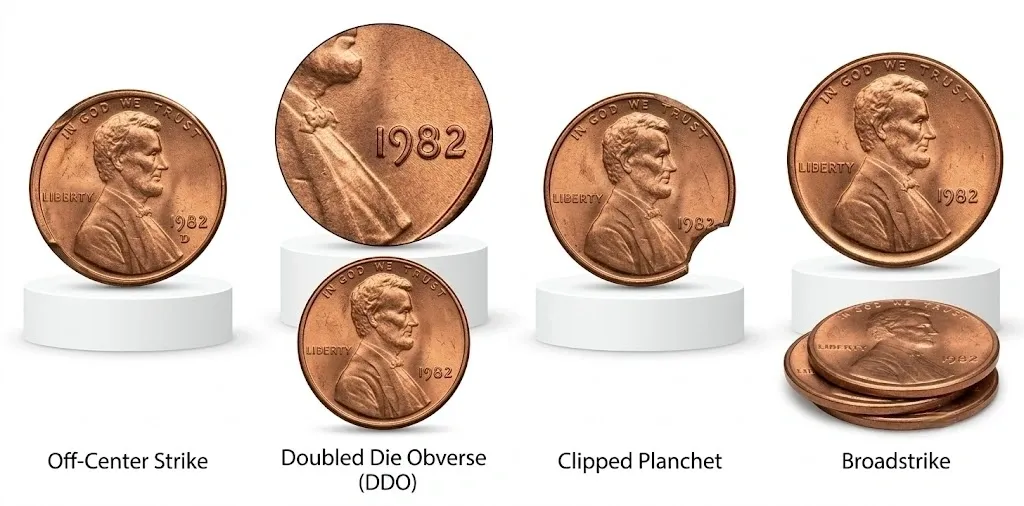
Blank planchet or clipped planchet: Unstruck or partially struck blank; clipped edge because of improper planchet cutting.
Broadstrike or multiple strike: Coin struck outside the collar (broadstrike) or struck multiple times with offset images.
Occluded gas bubbles: Minting a coin requires tremendous pressure, and that pressure can generate significant amounts of heat. Sometimes, the heat can create small pockets of air beneath the surface of the coin. — JM Bullion
Important: Many alleged "errors" are post-mint damage or environmental corrosion. Professional grading services can distinguish genuine mint errors from altered or damaged coins.
What to Do If You Find a Potentially Rare 1982 Penny
Safe Handling and Storage
- Handle by edges only. Avoid touching obverse or reverse surfaces; oils and acids from skin can damage the coin.
- Do not clean, polish, or test with abrasives. Cleaning lowers grade and value. Leave patina and toning intact.
- Store in inert holders. Use Mylar 2x2 flips, coin capsules, or archival-quality holders without PVC. Keep in a stable, low-humidity environment.
- Do not drop or impact the coin. Physical shocks can cause nicks, dings, and edge damage that reduce grade.
Professional Authentication and Grading
Preliminary assessment: American Rarities offers no-obligation appraisals. Text high-resolution photos (obverse, reverse, edge, date close-up) and weight measurement to their dedicated line. Specialists will provide feedback on variety and potential value.
Formal grading: Submit to PCGS or NGC for authentication and encapsulation.
Before submitting to PCGS/NGC:
- Verify the variety is recognized: Check the PCGS or NGC website to confirm your specific variety (e.g., 1982-D Small Date Copper) is listed in their registry. If not, the coin may be returned without a variety attribution on the label.
- Inspect for any defects: Do not submit coins with scratches, spots, or any visible damage. Even minor surface issues significantly reduce the likelihood of achieving a high grade.
- Understand submission tiers: PCGS and NGC offer different service levels based on declared value. For potentially high-value varieties like the 1982-D Small Date Copper, select the appropriate tier, "Express" or "Modern", for declared values over $10,000. Fees range from $20–$30 for basic submissions to $150+ for high-value coins.
PCGS submission process:
- Search for authorized dealers in your area via the PCGS website, or initiate direct submission via PCGS Online Submission Center.
- Select "Raw Coin Submission," enter coin details (1982-D cent), declare estimated value, and note unique attributes (e.g., "Small Date, weighs 3.1g, possible transitional error").
- Request variety attribution add-on if applicable.
- PCGS will recommend a service level based on declared value; choose turnaround time and return shipping options.
- Package coin securely (padded box, protective flip) and ship to PCGS.
- PCGS authenticates, grades, and encapsulates the coin in a tamper-evident holder with a label.
NGC process: Similar to PCGS; consult NGC's submission guidelines for details.
Cost considerations: Basic grading fees start around $20–$30 per coin; higher-value submissions, e.g., coins declared over $10,000, incur higher fees and may require insurance. Turnaround varies from economy (several weeks) to express (days).
Selling Options
Major auction houses: Heritage Auctions, Stack's Bowers, GreatCollections. Best for high-grade rarities (MS-65+) or significant errors. Auction consignment involves seller's commission (typically 10–15%) but maximizes exposure and competitive bidding.
Specialist dealers: American Rarities, coin shops affiliated with ANA. Can provide fast liquidity and fair offers based on the current market. Dealer margins reduce net proceeds slightly vs. auction, but transaction is faster.
Online marketplaces: eBay, Proxibid. Suitable for common varieties and lower-value errors. Requires buyer trust; certified coins (PCGS/NGC holders) sell better than raw coins.
Peer-to-peer: Coin forums, collector groups. Can eliminate middleman fees but requires caution re: fraud.
FAQ:
What is the rarest 1982 penny?
The 1982-D Small Date Copper is the rarest regular-issue 1982 penny. It's a transitional error—Denver was supposed to be striking only zinc Small Date cents, but a few copper planchets were accidentally used. Only two authenticated examples exist. Circulated specimens have sold for $8,400–$18,800; high-grade examples can exceed $50,000.
How much does a 1982 copper penny weigh?
A copper (bronze) 1982 penny weighs approximately 3.11 grams. This is the pre-transition composition: 95% copper, 5% zinc. Zinc pennies from 1982 weigh approximately 2.5 grams.
Can I tell if my 1982 penny is copper without a scale?
Reliably? No. Visual color is identical for copper and zinc pennies; both have copper surfaces. Sound tests: drop the coin and listen for a "ring" vs "thud" to exist—copper produces a high, melodic "ding," while zinc produces a duller "thud" or "click"—but this method is subjective and risks damaging the coin. Use a digital scale accurate to 0.1 grams for definitive identification.
What's the difference between a 1982 Small Date and Large Date penny?
Small Date curved top on "2", arched diagonal stroke, all four numerals align evenly along imaginary top line, delicate spacing, larger distance from "2" tail to rim, "8" has a smaller upper loop. Large Date is flat, straight top on "2," rigid diagonal stroke, middle numerals ("9," "8," "2") sit higher than "1," thicker, crowded appearance, smaller gap between "2" and rim, "8" has oval loops of similar size.
Are all 1982 Small Date pennies valuable?
No. There are three regular Small Date varieties (Philadelphia copper, Philadelphia zinc, Denver zinc), all common in circulation. The only rare Small Date is the 1982-D Small Date Copper weighing ~3.1g. Most Small Date pennies you find will be zinc and worth face value in circulated condition. The 1982-P Small Date Copper (no mint mark) is scarce in high grades and can be valuable in MS-64+ condition, though it is not as rare as the Denver error.
Does a 1982-S penny exist and what's its value?
Yes, 1982-S pennies exist as proof coins struck at San Francisco for collector sets. They are not circulation issues. Composition is 95% copper (Deep Cameo). Total mintage: 2,647,894 pieces. Typical 1982-S proofs in circulated condition are worth around 25 cents; in certified Mint State (MS+), up to $3. They are not as rare or valuable as the 1982-D Small Date Copper transitional error.
Where can I get my 1982 penny professionally evaluated?
Preliminary appraisals are available at American Rarities and Coin shops affiliated with the American Numismatic Association (ANA). Formal grading and certification are offered by PCGS (Professional Coin Grading Service), NGC (Numismatic Guaranty Corporation), ANACS (Official service of the ANA), and ICG (Independent Coin Graders). Search for authorized dealers via PCGS or NGC websites, or submit directly online. Certification costs $20–$150+ depending on declared value and service level. eBay accepts only certifications from ANACS, ICG, NGC, and PCGS as valid third-party grading.

 Facebook
  X (Twitter)
  Pinterest
  LinkedIn