Contents:
What would you do if you had a 1 trillion dollar coin? If I were you, I would definitely put it in the safest place. I’ve lost too many quarters, and I don’t want this super-coin to slip away.
Unfortunately, a one trillion dollar coin would be made not for personal use. It would be made to solve economic problems running deep within the US economy. What is a trillion coin, and can it save the US? Learn from this article.
Do you think coins in your collection could be worth much? Our app can check coin value.
What is a Trillion Dollar Coin?
This piece is technically not real.
Treasury trillion dollar coin is a proposed coin that could solve the U.S. debt crisis. This piece would be platinum-based and have a face value of 1 trillion dollars! Even more than the legendary American Gold Eagle.
Because this piece never came to fruition (at least not at this moment in November 2025), it doesn’t have an official design. Though some artists made concept designs based on the presidential dollar series.
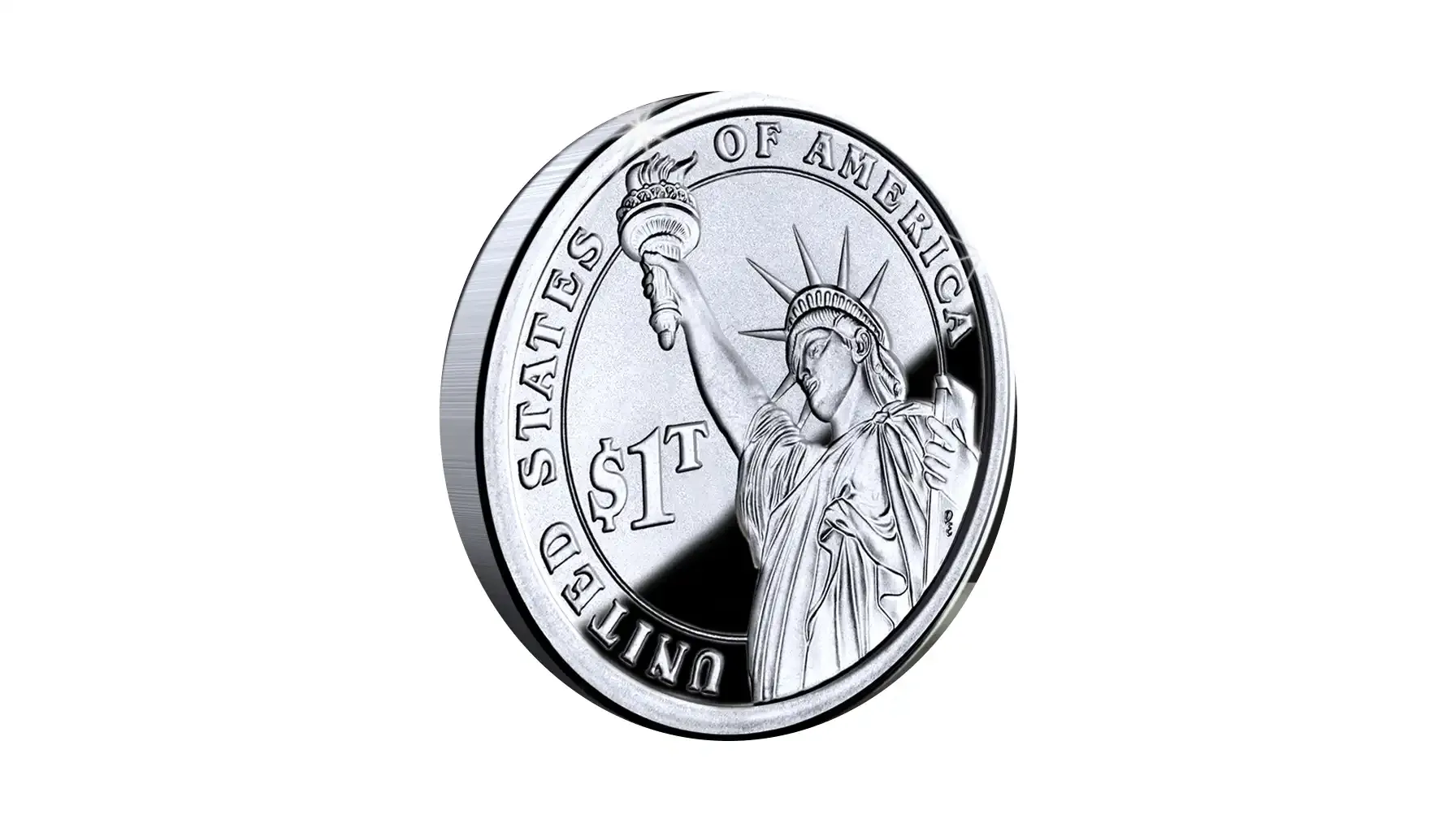
Speaking about presidents, some other artists proposed an Obama trillion dollar coin. The material and value would stay the same. The only difference would be Obama's portrait on the front. Funnily, Obama never officially appeared on the US pieces.
National Debt and Economic Problems
What made the US even think of introducing such a coin? A trillion dollar coin inflation! The inflation itself came from the many debts the US has. Let’s try to understand it.
1. The U.S. government routinely borrows money to pay its bills (Social Security, military, interest on debt, etc.).
2. It can borrow money from its “budget” infinitely. There’s a limit, a so-called “Debt Ceiling”.
3. Around 2020, it was close to hitting that ceiling. It could either:
Refuse to raise the ceiling. Then the Treasury could run out of cash, triggering a default. Then the government could no longer fund the military and the needs of society.
Continue borrowing and keep paying bills. Then the default is awarded, but the country is reaching higher inflation rates.

Back then, the government chose the latter option. They continued borrowing and raised the ceiling artificially. But they did not use the US trillion dollar coin and instead took different measures and policy.
While today the actual implementation of such a piece seems unlikely, people still discuss the idea.
The Trillion-Dollar Coin Issue in Government
The legal discussion centers on 31 U.S.C. § 5112(k), a provision enacted in 1996 that allows the U.S. Treasury to mint platinum coins in any denomination, size, or design.
The statute was drafted to support commemorative and bullion programs, but its broad language does not place a ceiling on the coin’s face value. This wording created the basis for the claim that Treasury could, if necessary, mint a coin with an extremely high denomination.
The debt ceiling applies to borrowing, not to the production of legal-tender coinage. Because coins are treated as money rather than debt obligations, minting a high-value coin would not violate the statutory limit. This distinction is the core legal argument put forward by supporters.
Critics counter that using § 5112(k) to bypass the ceiling conflicts with the structure of federal fiscal authority. Congress controls taxation and borrowing, and opponents argue that employing such a piece would undermine that role. They also note that the Federal Reserve is not obligated to accept such a piece, which introduces another layer of legal uncertainty.
The question has never been tested. The statute permits wide discretion, but its application in this context raises unresolved issues about separation of powers, statutory purpose, and the operational independence of the Federal Reserve.
“So minting the coin would be undignified, but so what? At the same time, it would be economically harmless – and would both avoid catastrophic economic developments and help head off government by blackmail.”
— Paul Krugman, economist and columnist
Wikipedia
How a Trillion Dollar Emerged
In 1992, Populist Party presidential candidate Bo Gritz proposed to send a special coin to the Federal Reserve to pay off the debt.
The concept was forgotten until 2012, when debt almost reached the ceiling limit. Famous economists began proposing the idea in 1992.
On January 12, 2013, the Treasury and Federal Reserve declared they would not mint it.
In 2020, the talk about implementing it resurged during the COVID-19 pandemic.
In January 2023, Treasury stated that minting a trillion piece is not planned, and they would solve the United States' ceiling crisis another way.
In April 2023, Bloomberg News reported a poll of 1,212 people. They were asked about their opinion on a trillion piece. 14% supported the minting, 37% opposed it, and 49% were indecisive.
Fun fact: There were and are other trillion currencies. For example, 1 Trillion Mark in Germany, created during a big post-war crisis. Unlike another wartime piece, 1941 Jefferson Nickel, it’s not valuable.
What Problems Could a Platinum Dollar Solve
By minting such a coin, the US economy would change. Big economists like Paul Krugman believed it would be for the better. So what problems could it solve?
Problem | Risks if unsolved | How the Coin Helps |
The debt ceiling reached | The Government can no longer pay its bills. The default comes | Provides a non-borrowing way to raise funds |
Risk of default | The Government can no longer support its people | Prevents missed payments |
Market instability | Negative economic growth. Constat borrowing | Maintains investor confidence |
Political deadlock | One party can ask for privileges, otherwise it would allow other parties to raise the ceiling | Offers an emergency legal workaround |
Shutdowns | Market chaos and political instability | Keeps essential payments flowing |
A Controversy
Of course, such a big change could not only solve problems, but also cause them. The majority is still against implementing a trillion dollar platinum coin. It could:
Weaken the checks and balances system of the U.S. government. The executive branch would be able to control the other two branches.
Bring long-term inflation. If you put a trillion into the fund, the dollar in general would lose some of its value. This could bring a crisis.
Start a Fiscal crisis. The coin sets a dangerous precedent: “If money can just be created to fund spending, why bother with borrowing limits or budgeting?” Then the whole system could spiral out of control.
Maybe it’s better to postpone the arrival of this piece. One trillion-dollar coin value is perhaps too high to handle.

But there’s one app that can tell the value of most US specimens.
FAQ
Is the $1 trillion dollar note real or fake?
There is no official note of such denomination issued by the U.S. government. Any such note circulating online or in print is novelty material or private artwork with no legal-tender status.
What is the trillion-dollar coin?
It refers to the idea of minting a high-denomination coin under the authority of 31 U.S.C. § 5112(k) and depositing it at the Federal Reserve to create spending capacity without increasing borrowing. The concept has never been used but remains a subject of legal and fiscal debate.
What is a trillion dollar worth?
It equals $1,000,000,000,000 and is a figure larger than the annual GDP of many countries and exceeds the total budgets of most U.S. agencies.
How does the debt ceiling work?
It is the legal limit on how much the government can borrow to meet obligations already authorized by Congress. When that limit is reached, the Treasury cannot issue new debt and must rely on temporary “extraordinary measures” to keep payments current. These measures only extend the timeline; eventually the ceiling must be raised or suspended for the government to continue operating normally.
What are the consequences if the U.S. fails to meet its debt obligations?
If Congress does not act in time and the Treasury exhausts its temporary measures, the government cannot pay interest or principal on schedule. That would put the country in default. A default would disrupt Treasury markets, increase borrowing costs, delay payments, and put pressure on financial institutions that rely on Treasurys as collateral. It would also raise concerns about the country’s creditworthiness.
How much debt does the United States currently have?
The $37–$38 trillion figure is the total federal debt, which includes:
Debt held by the public: Money borrowed from investors, banks, pension funds, foreign governments, and the Federal Reserve.
Intragovernmental holdings: Money owed to federal trust funds such as Social Security and Medicare.
The number is the result of years of budget deficits—the government consistently spends more than it collects. Major drivers include rising healthcare and retirement costs, downturns, war spending, tax changes, and growing interest payments.
Coin ID Scanner
Coin ID Scanner is an AI-based scanning app. You just take a photo of your collectible, and the app recognizes it in a sec.
The catalog is diverse and huge. The UK alone has 15000+ pieces, and if we combine all the countries, we’ll get more than 150,000 entries.
What’s More?
You might also appreciate many blogs that come with the app. They offer tips on how to find modern bits worth money and many blogs, from collecting to grading.
If you have any questions, the app comes with an AI Assistant.
The app is free to download. Compatible with iOS and Android.

 Facebook
  X (Twitter)
  Pinterest
  LinkedIn